
Lynx spider
Oxyopes
Description
How to identify
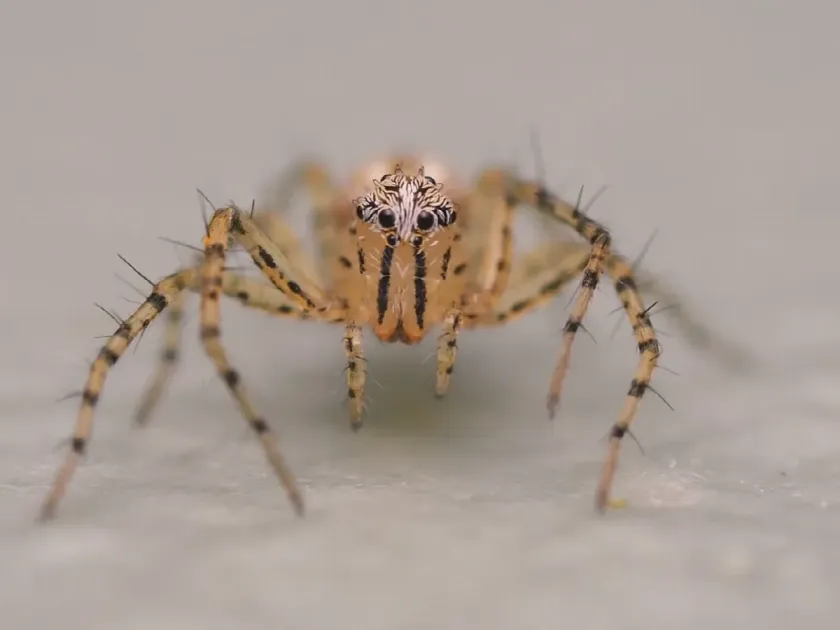
The lynx spider (family Oxyopidae) is a predatory spider that does not build webs to trap prey. It earned its name due to its agility and the habit of pouncing on insects, much like a lynx hunting.
Adult spiders have a slender body with long, spiny legs, which assist them in grasping and holding their prey firmly during the hunt.
They possess keen eyesight, utilizing eight eyes arranged in a hexagonal pattern, which allows them to track insects with extreme precision among foliage and flowers.
Their coloration is often cryptic, blending perfectly with the green leaves or floral structures where they sit in wait for potential prey.
In modern agriculture, these spiders are widely recognized as beneficial natural enemies that help regulate populations of various crop pests.
What it damages
Lynx spiders are not considered pests; they do not feed on plant tissue, sap, or roots. Consequently, they cause absolutely no direct damage to crops.
They are strictly carnivorous, feeding on a wide variety of small insects, which makes them an essential component of the natural pest management system.
The presence of lynx spiders on a farm is a sign of a healthy ecosystem and low toxic pressure, as they are sensitive to many harsh synthetic pesticides.
While they might occasionally startle a worker during harvest, their impact on agricultural operations is overwhelmingly positive due to their predatory activity.
There is no economic threshold for controlling this species, as their management is synonymous with environmental sustainability.
When it appears
The activity of lynx spiders begins in the spring, once temperatures become consistently warm, allowing them to emerge from their overwintering sites.
Throughout the summer, they reach their peak population levels, coinciding with the highest insect activity in agricultural fields and vegetable gardens.
During this period, females are frequently seen guarding their egg sacs, which are usually attached to stems or hidden within the foliage of host plants.
As autumn approaches and temperatures drop, their activity diminishes, and they search for protective niches in debris or soil to survive the winter.
Their life cycle is well-integrated with the seasonal growth of many agricultural crops, maximizing their effectiveness as biological control agents.
Signs of infestation
The most reliable sign of their presence is direct observation of the spider, typically perched motionlessly on a flower or leaf, waiting for prey.
During careful inspection, one can find their protective egg sacs attached to plant stalks, often with the female spider nearby guarding them.
The absence of typical herbivorous damage, such as leaf skeletonizing or wilting, in areas with high spider counts confirms their role as predators.
They are easily spotted by their sudden, leaping movements when disturbed or when they sense an approaching insect.
Their presence is a clear indicator that the field is being managed with an emphasis on biological diversity and sustainable practices.
Control measures
There are no measures required to control lynx spiders, as they serve as vital allies in natural pest control within the agroecosystem.
To preserve these beneficial predators, it is recommended to avoid prophylactic use of broad-spectrum insecticides that kill both pests and natural enemies.
Maintaining floral borders and hedgerows around fields provides essential habitat for lynx spiders to thrive and multiply.
If habitat reduction is required for technical reasons, regular maintenance of ground cover and weeding should be done with moderate care.
Embracing the presence of these spiders allows farmers to significantly reduce their dependency on chemical applications while maintaining crop health.
Taxonomy
- Latin name
- Oxyopes
- Family
- Oxyopidae
- EPPO code
- OXYSSP
Discussion
No discussions yet — be the first.