
Lynx spider
Peucetia
Description
How to identify
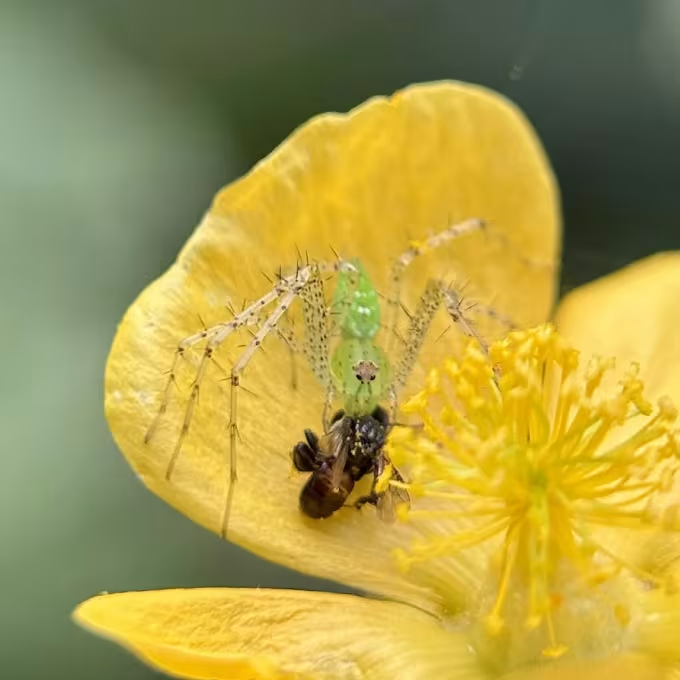
Lynx spiders, belonging to the family Oxyopidae, are easily recognized by their long, prominent spines on their legs and their slender body shape.
These spiders are active hunters and do not construct webs to trap prey; instead, they move quickly across foliage to ambush their victims.
They possess an excellent set of eyes arranged in three rows, providing them with superior depth perception and vision for jumping onto insects.
Their coloration often mimics the environment, such as green leaves or floral structures, providing perfect camouflage for hunting and protection.
Adult females are generally larger than males and are known for their defensive behavior, often guarding their egg sacs aggressively.
What it damages
In agronomy, the Lynx spider is not considered a pest; rather, it is a highly beneficial predator that helps regulate populations of harmful insects.
They feed on a wide variety of prey, including aphids, leafhoppers, beetles, and other small arthropods that damage crops like cotton or fruit.
There is no evidence of Lynx spiders feeding on plant tissues, as they are strictly carnivorous and focus their energy on catching moving insects.
The presence of these spiders is a sign of a healthy ecosystem, as they are sensitive to broad-spectrum pesticides used in conventional farming.
While their presence might be noticeable on harvested produce, they cause no physiological damage to the crop plant itself.
When it appears
The activity of Lynx spiders typically begins in late spring, coinciding with the rise in temperature and the beginning of the plant growing season.
Population peaks usually occur during mid-summer when the availability of prey insects is at its highest, ensuring abundant food for development.
Females attach their egg sacs to stems or foliage, and the emergence of spiderlings is synchronized with the availability of small insect prey.
As temperatures drop in autumn, their activity decreases, and they enter winter diapause, either as juveniles or within protected egg cases.
They are primarily diurnal predators, often found basking in the sun on leaves while scanning their surroundings for potential prey.
Signs of infestation
The primary sign of their presence is the observation of the spiders themselves, as they often remain motionless on plants while awaiting prey.
Egg sacs attached to plant structures are another indicator of a resident population of Lynx spiders within an agricultural plot.
A reduction in the number of small foliage-dwelling pests without the use of heavy insecticides is often the result of Lynx spider predation.
The absence of tangled silk webs, combined with the presence of jumping spiders on the foliage, confirms the role of Lynx spiders in the habitat.
Healthy, vibrant crops often host these spiders, as they avoid areas contaminated with high levels of harsh chemical pesticides.
Control measures
No control measures are needed or recommended for Lynx spiders, as they provide free and effective biological pest control in the field.
To support these predators, farmers should implement Integrated Pest Management (IPM) practices that reduce the impact on beneficial arthropods.
Avoid using non-selective insecticides that kill natural enemies, as this disrupts the natural balance and leads to secondary pest outbreaks.
Maintaining floral borders and hedgerows around fields provides essential refuge and alternative prey for Lynx spiders during the off-season.
Educating farm management to distinguish between pests and beneficial predators is a key component of modern, sustainable agricultural success.
Taxonomy
- Latin name
- Peucetia
- Family
- Oxyopidae
- EPPO code
- PEUCSP
Discussion
No discussions yet — be the first.