
Two-spotted stink bug
Perillus bioculatus
Description
How to identify
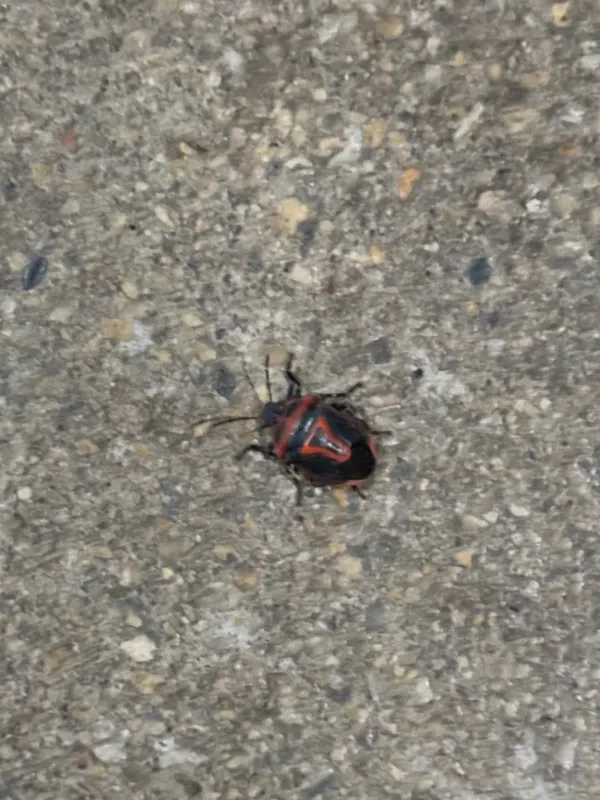
The two-spotted stink bug (Perillus bioculatus) belongs to the Pentatomidae family. It is a predatory insect recognized by its distinct coloration, typically cream, yellow, or red with a prominent black pattern on the pronotum and scutellum.
The adult bug measures about 10–12 mm in length. Its most identifying feature is the two black eye-like spots on the pronotum, which give the species its common name and help in field identification for scouting.
Nymphs undergo five instars. Early instars are primarily black, while later instars develop bright orange and red markings, resembling the adult stage in shape but smaller and wingless.
Adults overwinter in protected areas such as soil debris or leaf litter. As spring temperatures rise, they emerge to mate and lay eggs on the leaves of host plants, starting the new generation cycle.
The species is highly dependent on ambient temperature for development. In warm climates, it can produce multiple generations within a single growing season, allowing for sustained control of pest populations.
What it damages
The two-spotted stink bug is classified as a beneficial predator rather than a pest. It is highly specialized in hunting the Colorado potato beetle, feeding on its eggs, larvae, and adults.
As a predator, it uses its rostrum to pierce the exoskeleton of its prey. It injects digestive enzymes, liquefying the internal organs, and then consumes the fluids, leaving only the empty cuticle.
Beyond the Colorado potato beetle, the bug is known to prey on other leaf-feeding insects, including various caterpillars found in agricultural settings, contributing to overall field biodiversity.
A single predator is capable of consuming hundreds of pest eggs and dozens of larvae during its life cycle. This efficiency makes it a valuable asset in integrated pest management (IPM) programs.
While primarily predatory, if food sources become scarce, nymphs or adults may occasionally feed on plant sap. However, this behavior rarely results in economic losses that would warrant concern compared to the benefits of pest suppression.
Control measures
Effective management requires the avoidance of broad-spectrum insecticides that would kill these beneficial predators. Selective pest control measures are preferred to maintain the population of Perillus bioculatus.
In commercial agriculture, augmentation biological control is used, where lab-reared bugs are released onto potato fields exactly when Colorado potato beetle egg masses begin to appear.
Maintaining floral borders around fields provides nectar and shelter for the bugs, increasing their survival rates during periods when the target pest population density is low.
Since the species is sensitive to cold winters in northern latitudes, overwintering success is limited. Consequently, annual reintroduction or releases are often necessary to keep the predator population high.
Combining the release of two-spotted stink bugs with microbial pesticides like Bacillus thuringiensis allows farmers to significantly reduce their reliance on chemical sprays while maintaining high crop yields.
Taxonomy
- Latin name
- Perillus bioculatus
- Order
- Hemiptera (bugs, aphids, leafhoppers)
- Family
- Pentatomidae
- EPPO code
- PERLBI
Discussion
No discussions yet — be the first.