
Patanga succincta
Patanga succincta
Description
How to identify
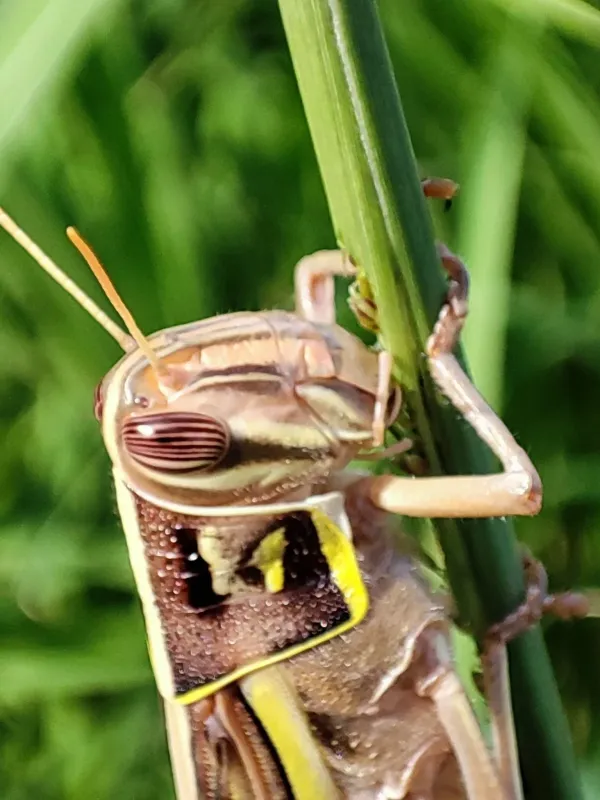
Patanga succincta, commonly known as the Bombay locust, belongs to the order Orthoptera and the family Acrididae. This species is a robust grasshopper recognized for its ability to form dense swarms in its native range.
Adult insects typically exhibit a brownish or yellowish-brown coloration, which provides effective camouflage against the dry vegetation and soil where they reside.
They are characterized by strong, muscular hind legs adapted for powerful jumping and well-developed wings that facilitate long-distance dispersal during migratory phases.
The life cycle follows a hemimetabolous development process consisting of egg, nymph, and adult stages. Nymphs undergo several molts, progressively increasing in size and wing development.
Sexual dimorphism is prominent, with females often being larger than males to accommodate the physiological requirements of producing and laying large egg pods in the soil.
What it damages
This species is a highly destructive polyphagous pest, known to cause severe economic losses in various agricultural sectors throughout Southeast and South Asia.
Rice is the primary host crop, with both seedlings and mature plants being highly susceptible to defoliation and stem damage caused by the locusts.
Beyond rice, Patanga succincta frequently attacks maize, sorghum, sugarcane, and a wide array of graminaceous weeds found in cultivated landscapes.
In outbreak years, large swarms can cause near-total destruction of crops, consuming not only foliage but also the ripening grain heads, which drastically reduces yields.
The feeding activity is often intense, and the sheer volume of insects in a swarm can lead to the rapid denudation of fields within a very short timeframe.
When it appears
The seasonal activity of Patanga succincta is heavily influenced by moisture availability and the transition between wet and dry seasons.
Outbreaks are frequently correlated with the onset of the monsoon, which triggers the hatching of eggs that have remained dormant in the soil during the dry season.
The insects' developmental cycle is finely tuned to the growing season of staple crops, ensuring that high-nutrition food sources are available for nymphs.
Adult populations are most active and destructive during the mid-to-late growth stages of host crops when the insects are preparing for reproduction.
Depending on the climatic zone, the pest may produce one or more generations per year, creating a prolonged window of vulnerability for agricultural producers.
Signs of infestation
The earliest signs of infestation are ragged or notched leaf margins on young plants, caused by the initial feeding of early-stage nymphs.
As the population grows, clear signs include the presence of large, irregular holes in leaves and the complete destruction of the green tissue between leaf veins.
Significant accumulation of fecal pellets (frass) on the ground around the base of plants is a definitive indicator of high feeding activity within a crop field.
Visual observation of large numbers of grasshoppers leaping away upon disturbance of the foliage is a primary method for detecting active infestations.
In severe cases, the damage extends to the reproductive structures of the plant, resulting in damaged rice panicles, lower grain quality, and significant crop loss.
Control measures
Effective management of Patanga succincta requires an Integrated Pest Management (IPM) approach that balances chemical interventions with ecological strategies.
- Deep plowing of fields after harvest to expose and desiccate egg pods buried in the soil.
- Application of targeted insecticides during early nymphal stages to prevent swarming behavior.
- Utilization of biological control agents, such as entomopathogenic fungi, to naturally suppress population growth.
- Implementation of weed management strategies in field borders to eliminate alternative food sources and breeding sites.
- Establishing monitoring networks to track population densities and forecast potential migration events.
Chemical control should be applied judiciously, ensuring adherence to safety protocols to minimize risks to non-target beneficial organisms and the environment.
Prompt action taken at the first detection of localized outbreaks can significantly prevent the development of larger, more destructive swarms later in the season.
Taxonomy
- Latin name
- Patanga succincta
- Order
- Orthoptera (locusts)
- Family
- Acrididae
- EPPO code
- PATASU
Discussion
No discussions yet — be the first.