
Camellia scale
Parlatoria camelliae
Description
How to identify
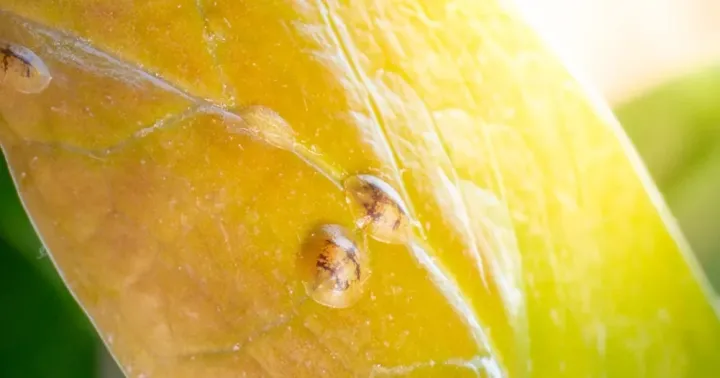
The Camellia scale (Parlatoria camelliae) belongs to the order Hemiptera, family Diaspididae. It is a tiny insect that, in its adult stage, is nearly immobile and protected by a dense, brownish waxy scale (test).
The female's body is hidden under a circular or slightly elongated scale that adheres tightly to the plant's surface. Males are significantly smaller than females and have wings, allowing them to move to find a mate.
First-instar larvae, known as "crawlers," are very mobile. They are yellowish, tiny in size, and capable of actively spreading across the plant or being carried by wind to neighboring specimens.
The development cycle includes several phases: egg, larva (crawler), nymph, and adult. Throughout the season, the pest can produce multiple generations depending on regional climate conditions and ambient temperatures.
It is difficult to detect the pest visually due to its camouflage, as it matches the color of the bark or leaf. They most often colonize the underside of leaves, petioles, and young shoots, forming visible clusters that resemble dry scales.
What it damages
The primary hosts are ornamental plants from the Theaceae family, primarily camellias, as well as various species of rhododendrons, citrus, and some orchids. In greenhouses, the list of host plants can be broader.
The insect sucks cell sap from the plant tissues, leading to a significant loss of nutrients. Strong infestations disrupt photosynthesis and general metabolism in the plant.
Chlorotic spots often form at the puncture sites, which may merge over time. Damaged leaves lose turgor, turn yellow prematurely, and drop, which reduces the plant's aesthetic value.
Weakened plants become highly susceptible to secondary infections, such as sooty mold, which develops on the sticky honeydew secreted by the pests. Young shoots also suffer severely, with growth slowing down significantly or stopping entirely.
In neglected cases, the scale can cause the drying of individual branches or the death of the entire plant if timely measures to limit the pest population are not taken.
When it appears
Pest activity begins with the arrival of consistently warm temperatures in spring, when crawlers start emerging en masse from under the female scales. This period is the most critical for the colony's spread across the garden.
In summer, with high temperatures and sufficient humidity, generation development occurs at maximum speed. In greenhouses and commercial nurseries, the pest can develop continuously throughout the year.
In autumn, as temperatures drop, the activity of adults decreases, and the pest enters its overwintering phase. Fertilized females usually overwinter under the protection of their scales, securely attached to the plant bark.
Population monitoring should be carried out constantly, paying special attention to periods of mass crawler emergence. Using pheromone traps or regular visual inspections helps to accurately determine the timing for chemical treatments.
In temperate climates, the most vulnerable stage for control remains the crawler stage, as it is not yet protected by the dense scale that acts as an effective barrier against most insecticides.
Signs of infestation
One of the first signs is the appearance of small yellowish spots on leaves that do not disappear after watering or fertilization. Subsequently, hard, circular brown scales appear on the underside of the leaves.
A sticky residue on the surface of leaves and shoots indicates the presence of sucking pests. Over time, sooty mold develops on this residue, giving the leaves a characteristic "dirty" appearance with a gray or black coating.
Deformation of young leaf blades and curling are often associated with heavy scale infestations. The plant looks depressed and loses its natural luster and healthy appearance.
The presence of a large number of dry, tiny "bumps" on branches that are easily removed mechanically is direct evidence of a Parlatoria camelliae colony.
- Yellowing and leaf drop.
- Stunted growth and reduced flowering.
- Presence of sticky honeydew.
- Growth of sooty mold.
- Visible scale covers on stems and leaves.
Control measures
Effective management combines cultural and chemical methods. First and foremost, infested plants should be isolated, and cleaning should be performed if the level of infestation allows for it mechanically.
Systemic insecticides are effective as they penetrate the plant's sap, making it toxic to the pests. Applications should be performed in cycles to destroy generations that hatch from eggs after the first treatment.
Contact insecticides work well during the active crawler movement phase. However, it is essential to ensure full coverage of all plant parts, including the underside of leaves, where scales hide most frequently.
Biological methods, such as the use of natural enemies or horticultural oils (e.g., mineral oil), allow for the reduction of pest numbers without significant harm to beneficial insects in greenhouses.
Prevention includes strict quarantine control when purchasing new plants. It is also necessary to maintain optimal humidity levels, as dry indoor air promotes the rapid reproduction of scale insects.
Taxonomy
- Latin name
- Parlatoria camelliae
- Order
- Hemiptera (bugs, aphids, leafhoppers)
- Family
- Diaspididae
- EPPO code
- PARLCA
Discussion
No discussions yet — be the first.