
Striped wolf spider
Pardosa pseudoannulata
Description
How to identify
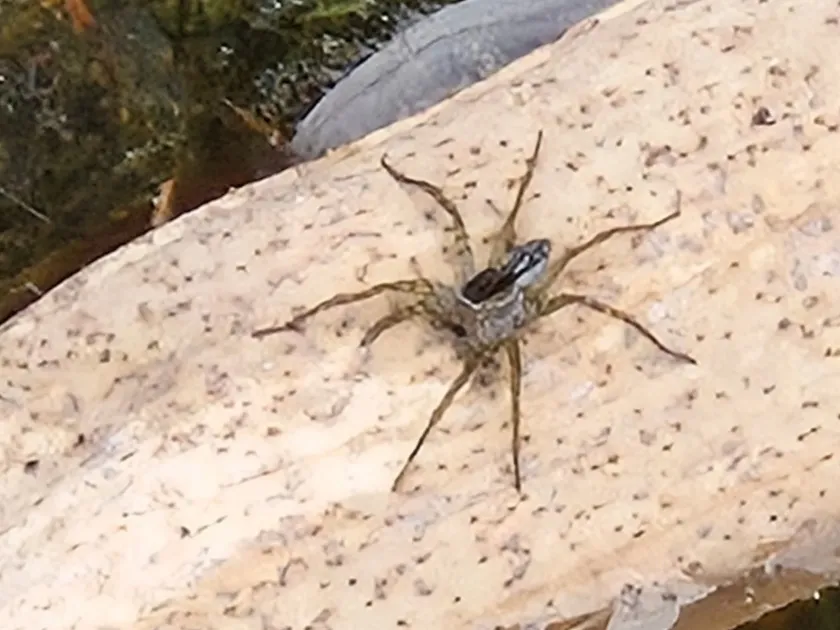
The striped wolf spider (Pardosa pseudoannulata) belongs to the Lycosidae family. These spiders are active hunters that do not build webs but chase their prey across the ground.
Adults exhibit distinct longitudinal stripes on their cephalothorax, which provide effective camouflage among crop residues and soil particles.
They are equipped with long, muscular legs that allow them to move rapidly, making them highly efficient predators in diverse agricultural environments.
Females display significant maternal care, carrying their egg sacs attached to their spinnerets and allowing their spiderlings to ride on their backs after hatching.
This species is widely distributed in Asian agricultural regions, particularly in rice paddies, where they play a vital role in local ecosystems.
What it damages
It is crucial to recognize that Pardosa pseudoannulata is considered a beneficial predator rather than a plant pest in agricultural settings.
These spiders feed on a variety of small pests, including leafhoppers, aphids, and lepidopteran larvae, effectively reducing their populations on crops.
There is no direct damage to plant tissues, such as leaves or stems, as their physiology is entirely adapted to a carnivorous diet.
Negative impacts are rare and generally occur only if chemical pesticide use disrupts the ecological balance, causing excessive population growth of certain species.
In agronomic terms, they are an asset, as their presence contributes to natural pest suppression and reduces the need for heavy chemical intervention.
When it appears
Activity levels for this spider are highly dependent on temperature and soil moisture, with peak abundance occurring during the mid-summer months.
In the spring, individuals emerge from their overwintering sites, such as soil crevices or dense mulch, to begin hunting and mating cycles.
During the summer, development progresses rapidly, often spanning several generations if environmental conditions remain favorable and moisture is abundant.
As temperatures decline in the autumn, activity slows down significantly, and the spiders seek shelter to survive the winter months.
In controlled environments, such as greenhouses or irrigated fields, their life cycle may be less seasonal, providing year-round pest control services.
Signs of infestation
Presence can be identified by visually inspecting the soil surface near the base of plants during the early morning hours when spiders are most active.
Rapid movement across the ground, especially when the soil is disturbed, is a hallmark behavior of these spiders, as they attempt to evade potential threats.
Finding female spiders with egg sacs or spiderlings on their backs is a strong indicator of a healthy and reproducing population within the field.
A notable absence of web-related damage to plants serves as an important sign that these spiders are present and acting as predators.
Observing lower-than-average numbers of leafhoppers or other soft-bodied insects often correlates with the active hunting patterns of this species.
Control measures
Active control of Pardosa pseudoannulata is generally not recommended, as they are key natural enemies of many significant crop pests.
The best management practice is to avoid broad-spectrum insecticides that negatively impact beneficial spider populations and decrease ecological stability.
Conservation of field margins and the use of sustainable tillage practices can help maintain suitable habitats for these beneficial predators.
Integrated Pest Management (IPM) strategies emphasize identifying pest thresholds before implementing any control, ensuring that predatory populations are preserved.
Promoting a healthy ecosystem encourages natural migration of these spiders into crop areas, which facilitates long-term biological control of pests.
Taxonomy
- Latin name
- Pardosa pseudoannulata
- Family
- Lycosidae
- EPPO code
- LYCSPS
Discussion
No discussions yet — be the first.