
Parasa vivida
Parasa vivida
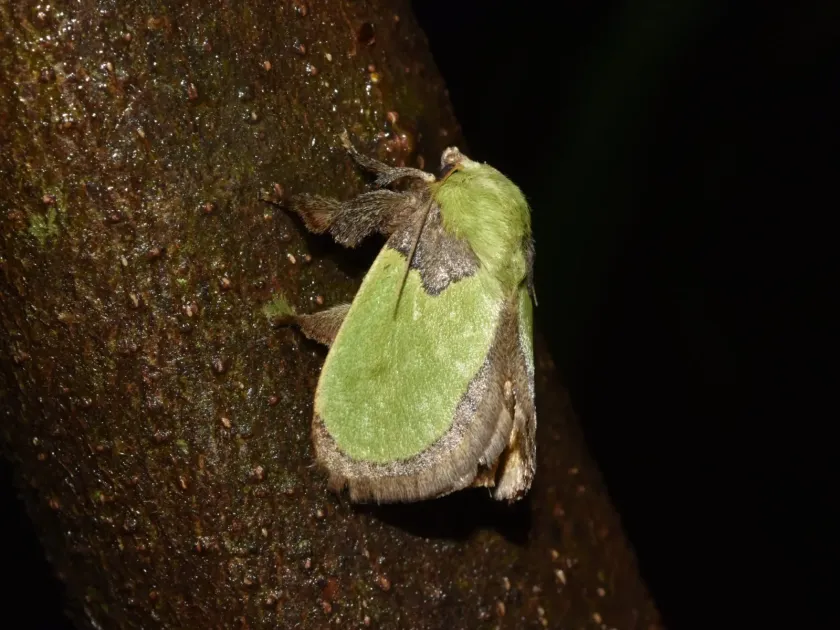
Description
How to identify
Parasa vivida belongs to the Limacodidae family, often referred to as slug moths due to the appearance of their larvae. This moth is primarily found in tropical environments where it acts as a significant herbivore.
The adult moths exhibit distinctive wing patterns, but the larval stage is the most recognizable for agronomists. These caterpillars have a smooth, flattened body and are often brightly colored.
A defining characteristic of these larvae is the presence of urticating hairs or spines. These structures are toxic and serve as a defense mechanism, causing significant irritation to human skin upon contact.
The life cycle encompasses eggs, larvae, pupae, and adults. The pupal stage is spent inside a hardened, spherical, or oval-shaped cocoon, typically attached to the stems or bark of the host plant.
As a member of the order Lepidoptera, its development is characterized by complete metamorphosis, allowing it to adapt to various environmental conditions in tropical orchards.
What it damages
Parasa vivida targets a variety of perennial crops, with particular preference for coffee, tea, cacao, and several species of fruit-bearing trees found in its habitat.
The larvae are active defoliators. They consume leaf tissue, often starting from the margins and moving inward, which significantly reduces the photosynthetic surface area of the plant.
In cases of heavy infestation, the cumulative damage can lead to total defoliation of the canopy, severely weakening the tree and drastically reducing annual yields.
Young plants or seedlings are particularly vulnerable and may suffer from stunted growth or mortality if they are unable to recover from the rapid loss of leaf mass.
Beyond leaf consumption, the damage creates open wounds on the vegetation, which often serve as entry points for various phytopathogenic fungi and bacteria.
Signs of infestation
The most prominent sign of infestation is the skeletonization of leaves, where only the primary and secondary veins remain, leaving a characteristic ragged appearance.
Observing the underside of the leaves or twigs often reveals the larvae, which remain relatively sedentary while feeding on the plant epidermis.
The presence of small, tough, and often camouflaged cocoons secured to the woody parts of the tree indicates the completion of the larval stage and the onset of pupation.
A painful or burning sensation experienced while pruning or inspecting foliage is a strong indicator of the presence of the toxic larvae of this species.
General yellowing or premature wilting of foliage, along with signs of plant stress in the canopy, often correlates with high larval density during the growing season.
Control measures
Manual removal of caterpillars is possible for minor infestations, provided that proper personal protective equipment, such as thick gloves, is used to avoid skin contact with spines.
Biological control agents, particularly microbial insecticides containing Bacillus thuringiensis, have proven effective in managing larval populations without disrupting the local ecosystem.
Chemical control involving selective insecticides may be required during peak outbreaks to protect sensitive crops and prevent economic losses in commercial plantations.
Cultural practices, such as maintaining healthy tree vigor and ensuring proper pruning, can reduce the number of favorable micro-habitats for the pest within the orchard.
- Periodic monitoring of canopy health during the growing season
- Winter pruning to remove overwintering cocoons
- Encouraging natural predators and parasitoid wasps
Taxonomy
- Latin name
- Parasa vivida
- Order
- Lepidoptera (butterflies)
- Family
- Limacodidae
- EPPO code
- PARSVI
Discussion
No discussions yet — be the first.