
Chinese slug moth
Parasa sinica
Description
How to identify
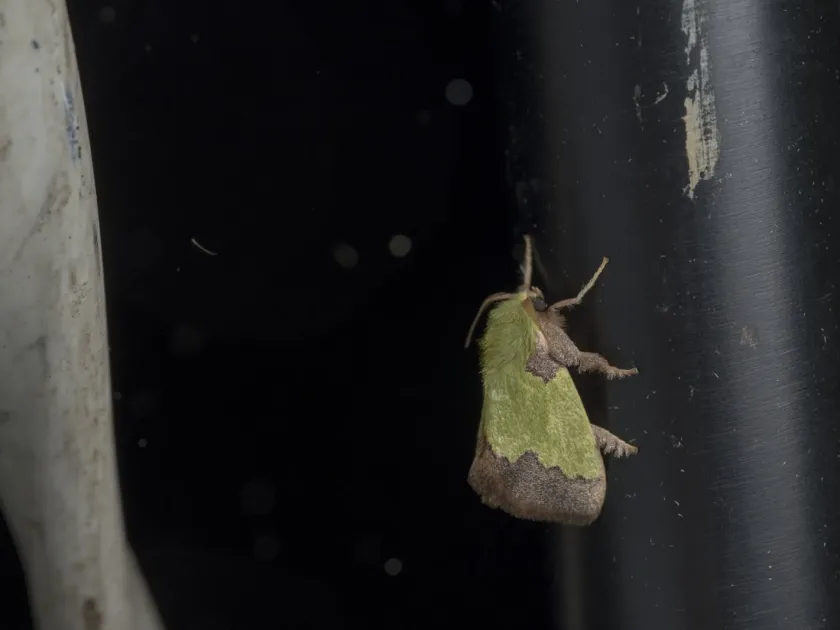
The Chinese slug moth (Parasa sinica) belongs to the Limacodidae family, commonly known as slug moths. The adults are small moths with a wingspan of 30–40 mm, featuring a subtle greenish and brownish pattern on their wings.
The larvae, or caterpillars, have a unique shape resembling a slug, which gives the family its name. Their bodies are often adorned with stinging spines or hairs that cause irritation if touched, serving as a defense mechanism.
The pupal stage occurs inside a very hard, compact, and resilient cocoon. These cocoons are typically attached to tree branches or nestled deep within crevices of the bark, providing excellent protection during the winter months.
The life cycle involves complete metamorphosis, consisting of the egg, larva (caterpillar), pupa, and adult stages. Each stage is adapted to ensure survival through seasonal changes in its environment.
Proper identification of the larvae is essential for pest management, as they can be easily overlooked due to their camouflaged appearance and their tendency to remain on the undersides of leaves.
What it damages
This pest targets a wide variety of deciduous trees and shrubs. Common hosts include fruit-bearing trees such as apples, pears, plums, and cherries, as well as ornamental trees like maples and birches.
The caterpillars are voracious feeders that consume leaf tissue. They skeletonize leaves by eating the soft tissue between the veins, which significantly reduces the tree's photosynthetic efficiency.
Severe infestations can lead to complete defoliation of the tree. This loss of foliage compromises the tree's ability to store energy for the winter and affects the production of flower buds for the following year.
The overall health of the tree declines, making it more susceptible to secondary environmental stressors, such as droughts, or opportunistic pathogens like fungi and bacteria.
In nursery environments, the economic impact is particularly high as the stunted growth of saplings caused by defoliation can render them unsuitable for sale or planting.
When it appears
Larval activity is most prominent during the summer months, typically peaking in July and August when the caterpillars are actively feeding and growing toward their final instar.
The species overwinters in the pupal stage. As temperatures rise in late spring, the adults emerge to mate and lay eggs, beginning the cycle for the new season.
The number of generations produced per year varies significantly based on the local climate; warmer regions may support multiple generations, whereas cooler areas typically have only one.
Regular scouting is recommended throughout the growing season, starting from late spring when adult activity is most likely to begin in the orchard.
Periods of dry and warm weather often promote the development of this pest, leading to potential population outbreaks if natural predators are insufficient to control them.
Signs of infestation
The first signs of infestation are small, irregular windows eaten into the leaves, where the larvae have consumed the leaf tissue but left the lower epidermis intact.
As the larvae mature, they consume entire sections of the leaf, leaving only the primary veins. This skeletonization of the canopy is a clear indicator of significant larval presence.
The discovery of firm, oval-shaped cocoons on the bark or branches is a definitive sign that the population is established and has successfully overwintered in the area.
Accumulation of frass (caterpillar excrement) on the ground underneath the canopy often points to high larval activity occurring in the upper portions of the tree.
Observers may also note the presence of caterpillars themselves, which are distinct for their vibrant colors and stinging spines, often found hidden on the underside of leaves.
Control measures
Mechanical control involves the removal and destruction of cocoons during the winter dormant season, which significantly reduces the population for the following year.
Biological control using Bacillus thuringiensis (Bt) is highly effective against early-instar larvae and is considered safe for the environment and non-target beneficial insects.
Chemical control can be implemented using appropriate insecticides if the population threshold exceeds manageable levels, ensuring applications comply with local regulations.
Encouraging natural predators, such as parasitic wasps and predatory beetles, is a sustainable way to maintain low pest populations and prevent major outbreaks.
- Monitor orchard trees for larval presence in late spring.
- Use pheromone traps to track adult moth emergence.
- Prune and destroy heavily infested branches during the dormant period.
Taxonomy
- Latin name
- Parasa sinica
- Order
- Lepidoptera (butterflies)
- Family
- Limacodidae
- EPPO code
- PARSSI
Discussion
No discussions yet — be the first.