
Stinging Rose Caterpillar
Parasa indetermina
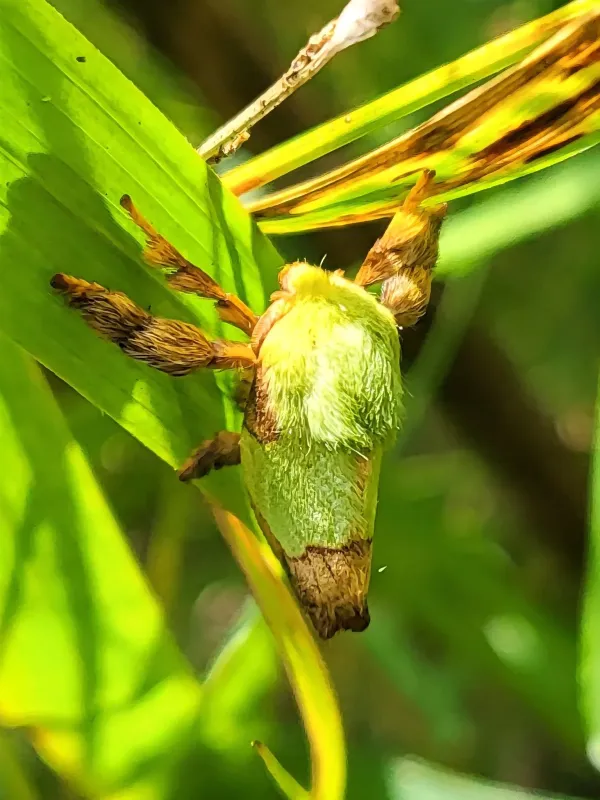
Description
How to identify
The Parasa indetermina, commonly known as the Stinging Rose Caterpillar, belongs to the Limacodidae family, or slug moths. The adult stage is a small moth with a wingspan of approximately 30 mm, displaying greenish and brown patterns.
The larval stage is the most recognizable form of this pest. These caterpillars have a distinctive slug-like body shape with no visible prolegs, gliding across leaves rather than walking.
Their bodies are adorned with colorful, branched spines that contain venomous hairs. These spines serve as an effective warning to predators, displaying bright yellow, red, or blue hues.
The life cycle involves complete metamorphosis, including egg, larva, cocoon, and adult moth. Overwintering occurs as a pupa, protected within a hard, spherical cocoon attached to twigs or branches.
Depending on the region, these moths can produce one or two generations per year. The adults are nocturnal and generally do not feed on plant foliage, focusing their energy on reproduction.
What it damages
This pest is a polyphagous insect that attacks a wide range of ornamental and fruit-bearing trees. It is particularly known for feeding on members of the Rosaceae family, hence its common name.
Common hosts include apple, pear, cherry, and plum trees, as well as landscape trees like oak and maple. Heavy infestations can lead to significant defoliation, stressing the host plant.
Caterpillars consume leaf tissue, often leaving only the veins behind. This damage reduces the tree's photosynthetic capacity, which directly impacts fruit yield and overall tree vigor.
Young trees and nursery stock are the most susceptible to severe damage. Continuous feeding can stunt growth and leave the plants vulnerable to secondary infections or winter damage.
Plants located near wooded edges or dense hedgerows are more prone to infestation. Regular inspections are vital to catch populations before they reach damaging levels in late summer.
Signs of infestation
The first signs of infestation are small, irregular holes or "windowpane" marks on leaves caused by young larvae. As they mature, they begin to consume large portions of the leaf blade.
Finding the larvae themselves is the most reliable sign. Their vibrant colors and unique body shape make them stand out against the green foliage if one looks closely at the undersides of leaves.
Frass (caterpillar droppings) found on leaves or branches directly beneath feeding sites is a clear indicator that a caterpillar is currently present and active on the host plant.
Hard, smooth, and rounded cocoons are often found attached to the bark or near leaf scars during the dormant season. These structures act as the winter residence for the developing moth.
A burning sensation or skin irritation after brushing against leaves is a common sign for gardeners. The stinging hairs can cause an immediate, painful reaction upon contact with human skin.
Control measures
For small infestations, manual removal is the most effective approach. Always wear protective gloves and long sleeves to avoid the painful venomous hairs when handling or destroying the caterpillars.
Biological insecticides containing Bacillus thuringiensis are highly effective against younger larval stages and have minimal impact on beneficial insects within the garden ecosystem.
Chemical control using systemic insecticides is an option if the pest population exceeds the economic threshold. Timing applications to coincide with peak egg hatching provides the best results.
Cultural practices, such as maintaining healthy tree vigor and clearing away debris from around the base of trees, can reduce the success rate of the overwintering generation.
Promoting a garden environment that supports natural predators, such as parasitic wasps and predatory beetles, can help keep the population of Stinging Rose Caterpillars in check naturally.
Taxonomy
- Latin name
- Parasa indetermina
- Order
- Lepidoptera (butterflies)
- Family
- Limacodidae
- EPPO code
- PARSIN
Discussion
No discussions yet — be the first.