
Parasa darma
Parasa darma
Description
How to identify
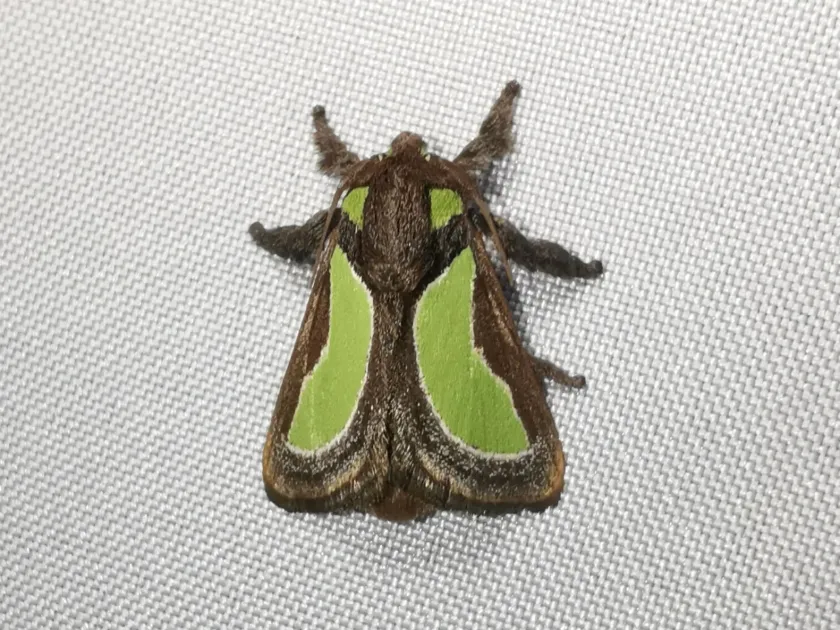
Parasa darma belongs to the Limacodidae family, commonly known as slug moths. This species is a significant agricultural pest, particularly in tropical regions of Asia where it impacts perennial crops.
The adult stage is a small moth, whereas the larval stage (caterpillar) is the one that causes direct damage to plants. The larvae have a distinctive, flattened appearance, resembling a slug, which gives the family its common name.
The caterpillars are often brightly colored, featuring complex patterns and spines. These spines are not only a warning signal but can also deliver toxins, causing painful skin irritation upon contact.
Pupation occurs within a tough, spherical, or oval cocoon. These cocoons are typically firmly attached to branches, twigs, or the underside of leaves, allowing the insect to survive periods of dormancy.
Adult moths are nocturnal and possess camouflaging colors, making them difficult to spot during daytime surveys, requiring nocturnal monitoring methods.
What it damages
The pest has a wide host range, with a preference for economically important crops like coffee, tea, and various fruit-bearing trees. It thrives in humid, tropical environments.
Young larvae initially graze on the surface of the leaf, skeletonizing it. As they mature, they consume the entire leaf lamina, leaving only the primary midribs intact.
Heavy infestations lead to significant defoliation, which severely stresses the host plant, restricts nutrient uptake, and hinders the plant's ability to produce flowers and fruit.
The loss of photosynthetic area due to the moth's feeding activity results in lower yield quality and, in severe cases, the eventual death of younger or weaker trees.
Additionally, the larvae's feeding sites provide entry points for opportunistic pathogens, further weakening the plant structure and increasing susceptibility to various diseases.
When it appears
The lifecycle of Parasa darma is heavily influenced by moisture and temperature cycles. In tropical climates, the moth can produce several generations per year.
The most active period for larvae usually correlates with the flush periods of the host plants, as they require succulent, young foliage for optimal growth and development.
Pupal diapause serves as a survival mechanism during extreme environmental conditions, such as prolonged droughts, allowing the population to persist in the area.
Monitoring the emergence of the first generation is crucial for timely intervention, as the density of the population can escalate rapidly if left unchecked.
Weather conditions, especially excessive rainfall or prolonged high humidity, can sometimes regulate the population through the promotion of natural entomopathogenic fungi.
Signs of infestation
The most common initial sign of an infestation is the presence of irregular, ragged, or scalloped edges on the leaves caused by the larvae's feeding patterns.
Frass (larval droppings), appearing as dark, granular deposits on the lower leaves or on the ground beneath the canopy, is a strong indicator of active infestation.
The presence of the larvae themselves, especially on the underside of leaves, confirms the infestation. Their unique shape and stinging spines make them easily recognizable.
Hard, button-like cocoons found along the stems or branches are indicative of previous successful cycles and warn of the upcoming emergence of adult moths.
Wilting, yellowing, or a general sickly appearance of the plant canopy in localized patches is a typical sign of advanced larval feeding pressure.
Control measures
Integrated Pest Management (IPM) is the best approach. Biological control using Bacillus thuringiensis is highly effective and safe for the environment.
Manual removal of larvae or infested leaves is practical for small-scale cultivation, but protective gear must be worn to avoid contact with the stinging hairs.
Selective use of insecticides may be required during peak outbreaks, but they should be applied cautiously to protect beneficial parasitic wasps that naturally predate the larvae.
Pruning and maintaining good canopy airflow can help reduce the suitability of the environment for the pest, as it limits places for cocoon attachment and egg-laying.
- Deploy light traps to capture and monitor adult moth populations.
- Encourage local populations of natural predators like mantids or predatory wasps.
- Strictly monitor for the presence of cocoons during the dormant season.
Taxonomy
- Latin name
- Parasa darma
- Order
- Lepidoptera (butterflies)
- Family
- Limacodidae
- EPPO code
- PARSDA
Discussion
No discussions yet — be the first.