
Parallelomma
Parallelomma
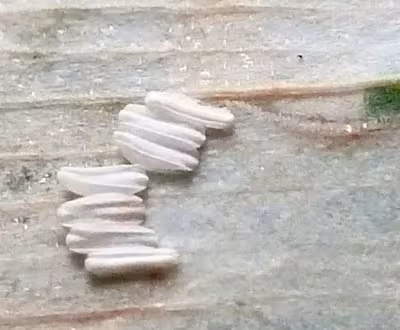
Description
How to identify
Parallelomma belongs to the family of dung flies (Scathophagidae), order Diptera. These are small flies typically found near moist habitats and agricultural fields.
Adults possess a slender body covered with fine hairs, with a color spectrum ranging from yellowish-brown to grayish. The head is well-defined, featuring mouthparts adapted for feeding on plant sap or floral secretions.
The larvae are typical dipteran larvae, legless and worm-like, usually white or yellowish. They possess developed jaw hooks specifically adapted for feeding on plant tissues.
Species identification often requires laboratory analysis, as adults can look similar to other members of the Scathophagidae family. The structure of male genitalia is the most reliable diagnostic characteristic.
The life cycle undergoes complete metamorphosis, consisting of egg, larva, pupa, and adult stages, each having specific ecological requirements and environmental preferences.
What it damages
The primary crops attacked by Parallelomma larvae are cereal plants, including wheat, rye, and barley. The pest is most frequently encountered in early-season cereal fields.
Larvae bore into the stems, where they feed on the soft internal tissues, which disrupts the normal transport of water and nutrients to the developing ear.
Beyond cultivated cereals, the species can develop on various wild grasses, allowing the population to persist in fields and surrounding areas even when main crops are absent.
The economic impact depends on the developmental stage of the crop and the population density; mass infestations can lead to significant yield losses.
Damaged stems often lose structural integrity, leading to lodging, which complicates harvesting processes and degrades the overall quality and market value of the grain.
When it appears
Adult activity typically begins in early spring as soon as temperatures rise, coinciding with the tillering phase of cereal crops.
Oviposition occurs directly on the vegetative parts of young plants, ensuring that larvae have immediate access to food upon hatching from the eggs.
Activity is highly dependent on weather conditions; wet and moderately warm spring weather promotes rapid larval development and increases population survival rates.
Depending on the climatic zone and temperature trends, the insect may complete one or two generations within a single growing season.
Overwintering usually occurs at the puparium stage within the soil or in crop stubble residues, providing protection against harsh winter conditions.
Signs of infestation
The first sign of infestation is the wilting and yellowing of the central leaf in the tillering node, which is often misidentified as drought stress or nutrient deficiency.
Careful field inspection reveals entry holes created by larvae during their penetration into the plant stem, often accompanied by localized tissue discoloration.
Dissecting the stem reveals internal tunnels created by the larvae, along with the presence of excrement, which destroys the plant's vascular system.
Due to the stem damage, plants develop poorly, producing small, shriveled ears or failing to head at all, remaining in a stunted, non-productive state.
- yellowing of the central leaf in the rosette;
- stunted growth of infected plants;
- presence of larvae inside split stems.
Control measures
The most important control measure is the implementation of crop rotation, which prevents the recurrence of cereal crops on the same field for at least two to three years.
Effective agricultural practices include thorough incorporation of crop residues and deep autumn plowing to destroy the puparium overwintering sites.
Optimized sowing dates help plants progress through their most vulnerable developmental phases rapidly, reducing their susceptibility to egg-laying by adult flies.
If population levels exceed the economic threshold, systemic insecticides are recommended to penetrate the plant tissues and target the larvae hidden within the stems.
Monitoring population dynamics using yellow sticky traps or systematic field scouting is essential for timely decision-making regarding chemical interventions.
Taxonomy
- Latin name
- Parallelomma
- Order
- Diptera (flies)
- Family
- Scathophagidae
- EPPO code
- PLLLSP
Discussion
No discussions yet — be the first.