
Black burrower bug
Pangaeus uhleri
Description
How to identify
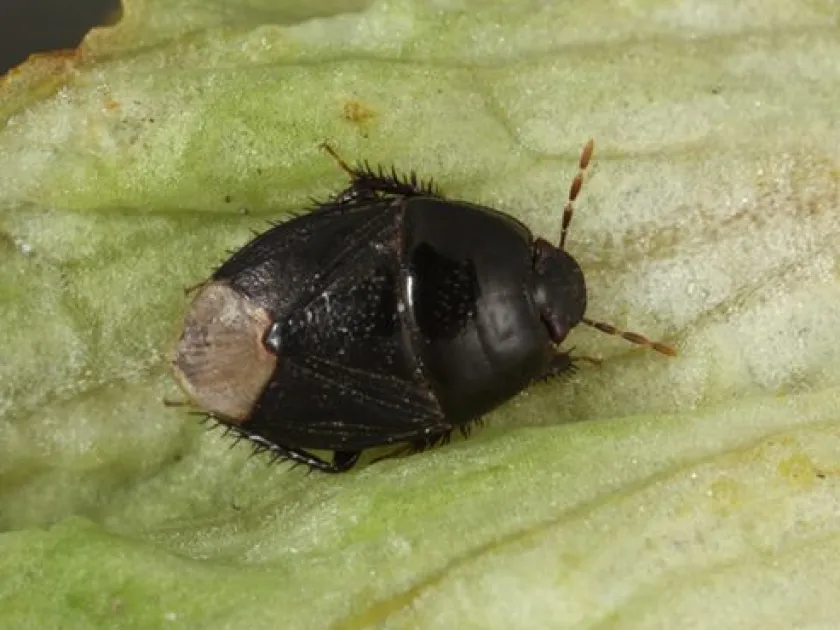
The black burrower bug (Pangaeus uhleri) is an insect belonging to the family Cydnidae, the burrowing bugs, within the order Hemiptera. Adults are characterized by a flattened, oval-shaped body, typically black or dark brown in color.
The body length of the adults usually ranges from 5 to 8 millimeters. A distinct feature of this species is its robust, spiny front legs, which are specifically adapted for digging through soil, reflecting their subterranean lifestyle.
The cuticle of the adult bug is smooth and chitinous, often exhibiting a slight metallic shine. The antennae are five-segmented, serving as a key diagnostic morphological trait for field identification.
The nymphs go through several developmental stages, gradually increasing in size while maintaining a general appearance similar to the adults. Like the adults, they primarily reside underground.
In natural habitats, this pest often hides under plant debris or within the top few centimeters of the soil, making it difficult to detect without focused inspection.
What it damages
This pest is known as a polyphage; however, it causes the most significant damage to cereal crops, certain vegetables, as well as various legumes and forage grasses.
The bugs damage plants during their early developmental stages by sucking sap from young seedlings, roots, and the base of the stems, leading to a significant loss of plant vigor.
Young sprouts are particularly sensitive to these attacks, as damage to the root system during the plant establishment phase often leads to stunted growth and eventual plant death.
The harm is manifested through weakened plant immunity, making crops highly susceptible to secondary fungal and bacterial infections entering through the feeding lesions.
Under high population densities, severe damage results in thin plant stands, which ultimately leads to substantial yield losses and decreased quality of the agricultural product.
When it appears
The activity of the black burrower bug is highly dependent on environmental conditions, specifically preferring warm and moist soil conditions for optimal development.
These insects typically overwinter in the adult stage within the soil at depths of 15-20 centimeters, where they are protected from extreme freezing temperatures.
As soil temperatures rise in the spring, typically reaching 12-15 degrees Celsius, the bugs emerge from their overwintering sites and begin active feeding.
The reproduction period usually occurs in late spring and early summer, when the bugs lay eggs in the soil or at the base of host plants.
Depending on the climatic conditions and the availability of food sources, one or even two generations of the bug can develop throughout the growing season.
Signs of infestation
A primary indicator of the bug's presence is the unexplained wilting of individual plants in the field, even when soil moisture levels are adequate.
Upon inspecting the root system of affected plants, one may observe puncture marks and dark necrotic spots where the bug has inserted its mouthparts to feed.
In some cases, adult bugs can be found on the soil surface near the stems, especially during the early morning or late evening hours when they are more active.
- Yellowing and gradual drying of the central leaves in young seedlings.
- Stunted growth compared to healthy neighboring plants.
- Visible small holes or depressions in the crown area of the stem.
In cases of heavy infestation, fields may exhibit patches where seedlings have either died completely or remain severely stunted due to extensive root damage.
Control measures
The cornerstone of managing the black burrower bug is the implementation of effective crop rotation, which disrupts the pest's life cycle and reduces overall population numbers.
Deep fall tillage is a crucial agrotechnical measure, as it disrupts the bugs' overwintering sites and exposes them to the surface, where they succumb to predators or freezing.
It is essential to maintain clean fields by eliminating weeds, which serve as alternative hosts and food sources for the bugs before the primary crop emerges.
The use of chemical protection, such as systemic insecticide seed treatments, significantly reduces the risk of crop damage during the critical early growth stages.
In scenarios of high pest density, the application of contact insecticides can be justified, provided that the decision is based on regular monitoring and scouting of the field.
Taxonomy
- Latin name
- Pangaeus uhleri
- Order
- Hemiptera (bugs, aphids, leafhoppers)
- Family
- Cydnidae
- EPPO code
- PNGEUH
Discussion
No discussions yet — be the first.