
Osprey
Pandion haliaetus
Description
How to identify
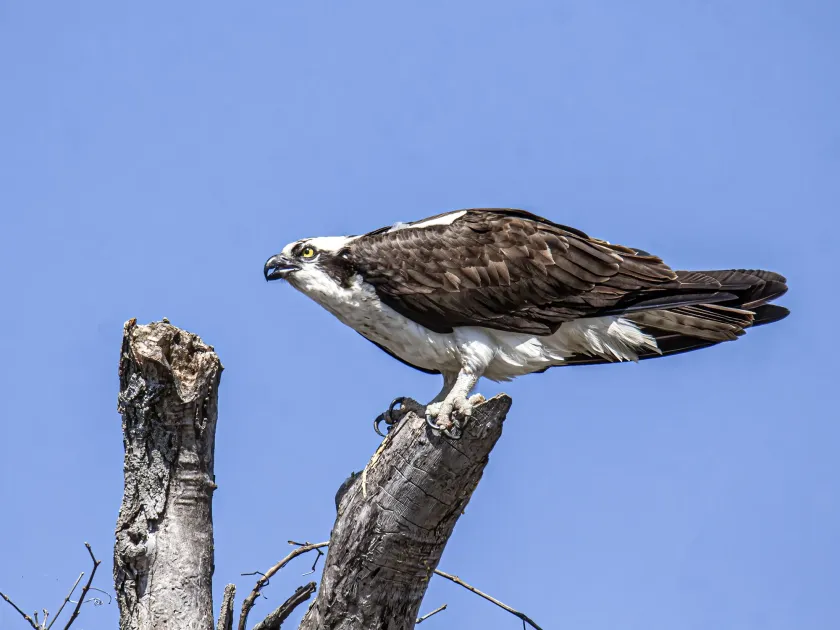
The osprey is a large bird of prey, the only member of the family Pandionidae. It has a contrasting plumage: a brown back and a white belly, with a dark stripe running through the eye on the head.
The bird possesses powerful talons and a specific structure of toes that allows it to securely hold slippery prey. In flight, the wings have a characteristic bend, making the bird's silhouette recognizable from afar.
Osprey nests are massive structures made of branches, which birds build at the tops of tall trees or on poles near large bodies of water. A pair of birds often uses the same nest for many years.
Adult individuals can weigh up to 2 kilograms, and their wingspan can exceed 170 centimeters. Females are generally larger than males, which is common in many raptor species.
An important identification feature is the hunting method: the osprey hovers over the water surface, and upon spotting a fish, it dives rapidly, often submerging completely underwater.
What it damages
From the perspective of agronomy and intensive aquaculture, the osprey can be considered a factor that reduces commercial production yields in specialized fish farms.
The osprey's primary food source is fish, so birds actively visit artificial ponds stocked with valuable fish species. In conditions of high fish density in cages, birds find easy prey.
Damage is expressed through the direct consumption of fish intended for commercial sale, causing direct economic losses to fish farming enterprises.
In addition to direct loss, the birds' hunting activities cause stress to the fish, which negatively affects their growth rates and the general health of the population in artificial conditions.
It should be noted that the osprey is a rare, protected species in many countries, so classic pest control methods are not applicable to it.
When it appears
The seasonal activity of the osprey is directly linked to the period of open water and migration cycles. In most regions, birds appear on water bodies in early spring as soon as the ice melts.
The peak activity of predators at fish farms occurs in the summer and early autumn, when young birds leave the nests and begin hunting on their own.
In autumn, with the drop in water temperature and the start of migration, osprey activity at ponds gradually fades.
The species spends the winter in southern latitudes, so during the winter period, there is virtually no direct impact on fish farming facilities.
Agronomists and fish farmers record surges in bird visits during periods of mass stocking of ponds, when the concentration of available food is at its highest.
Signs of infestation
The main sign of an osprey's presence near a body of water is the remains of fish left on coastal trees or special perches, which the predators discard after a meal.
A high concentration of birds above a specific pond is observed, accompanied by characteristic sounds — a loud whistle used for communication between individuals.
On the water surface in hunting areas, there may be traces of splashes, and sometimes wounded or dropped fish that the bird failed to retain during takeoff.
Damage to protective nets over ponds may also indicate the birds' attempts to access the fish if the netting is not tight enough or has weak points.
Reduced fish activity in the upper layers of water or the skittish behavior of shoals upon the approach of a "shadow" from above often signal the presence of a predator in the sky.
Control measures
Since the osprey is a protected species, all protection measures must be exclusively humane and deterrent in nature, causing no harm to the birds' health.
- Using visual deterrents that mimic birds of prey or dangerous animals.
- Installing protective nets over cages to prevent bird access to the water.
- Employing sound systems that play alarm signals or the calls of other predators.
- Maintaining optimal pond depths that make it difficult for birds to dive for fish.
Implementing such measures allows for the minimization of fish losses without violating conservation laws while maintaining ecological balance.
Taxonomy
- Latin name
- Pandion haliaetus
- Family
- Accipitridae
- EPPO code
- PNDNHA
Discussion
No discussions yet — be the first.