
Sharp-shinned hawk
Accipiter striatus
Description
How to identify
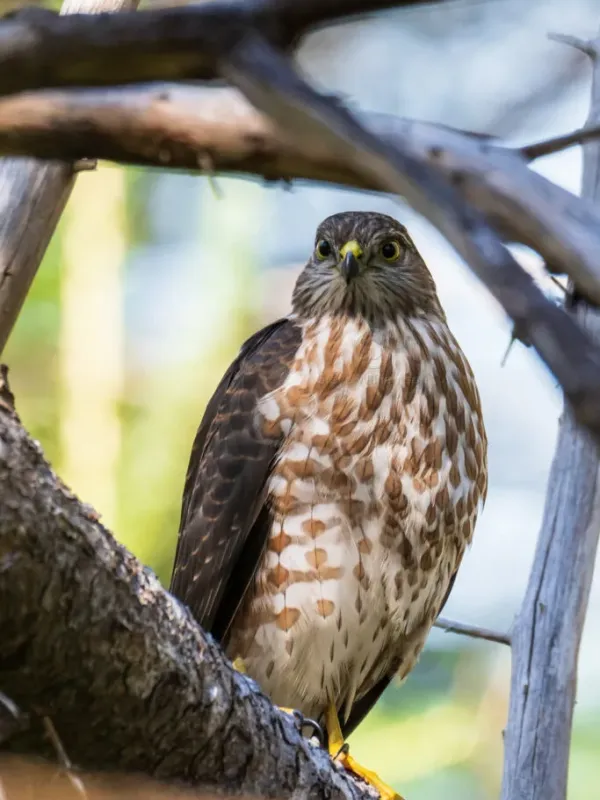
The Sharp-shinned hawk (Accipiter striatus) is a small bird of prey belonging to the family Accipitridae. It is characterized by its slender body, short rounded wings, and a long, square-tipped tail marked with dark bands.
Adults exhibit a bluish-gray plumage on their back and a reddish-brown, barred pattern on their chest and abdomen. The bird's eyes are typically a bright, piercing yellow, and its beak is sharply hooked, suited for carnivory.
As a member of the genus Accipiter, it is designed for agility in wooded areas. It is the smallest hawk species in North America, with females being notably larger than males, a trait known as reversed sexual dimorphism.
The flight pattern of the Sharp-shinned hawk includes short bursts of rapid flapping followed by a brief glide. This hunting style allows it to navigate through dense vegetation to ambush its prey with high speed.
This bird is an essential component of the avian fauna in forest edges and agricultural borders. Its presence is indicative of a healthy environment capable of supporting diverse predatory species.
What it damages
The Sharp-shinned hawk is not an agricultural pest. Because it is an obligate carnivore that feeds exclusively on small birds and occasionally small mammals, it does not cause damage to crops, seedlings, or harvest yields.
It does not consume any plant material or interact with plant physiology. Consequently, it cannot be classified as a pest species and requires no management to protect agricultural production from its feeding habits.
The economic impact of this hawk on agriculture is strictly non-existent. Any interaction with crops is coincidental, as the hawk uses trees and shrubs in fields merely as perches for hunting its prey.
Labeling this species as a pest is scientifically inaccurate. Its role in the ecosystem is that of a predator that maintains the balance of smaller animal populations within the agricultural landscape.
Rather than causing harm, these birds provide a valuable ecological service by managing populations of small vertebrates that might otherwise become pests in certain farming environments.
Control measures
No control measures are necessary for the Sharp-shinned hawk. In many jurisdictions, this species is protected by law, and any attempt to harm it would be illegal and ecologically detrimental.
Farmers are encouraged to preserve hedgerows and forest fragments, which provide essential habitat for these birds. This promotes the presence of natural predators that keep rodent populations in check.
If the hawk is viewed as a nuisance near poultry facilities, non-lethal deterrents such as netting or reflective devices are the only recommended and ethical solutions for protecting domestic birds.
Integrated Pest Management (IPM) practices acknowledge the benefits of having raptors in the field. They contribute to a decrease in the reliance on chemical pesticides by naturally controlling prey species.
Maintaining a balanced ecosystem is a core principle of modern agronomy. Supporting the presence of native predatory birds is a sustainable way to enhance the biological health of agricultural land.
Taxonomy
- Latin name
- Accipiter striatus
- Family
- Accipitridae
- EPPO code
- ACCIST
Discussion
No discussions yet — be the first.