
Hawk
Accipiter
Description
How to identify
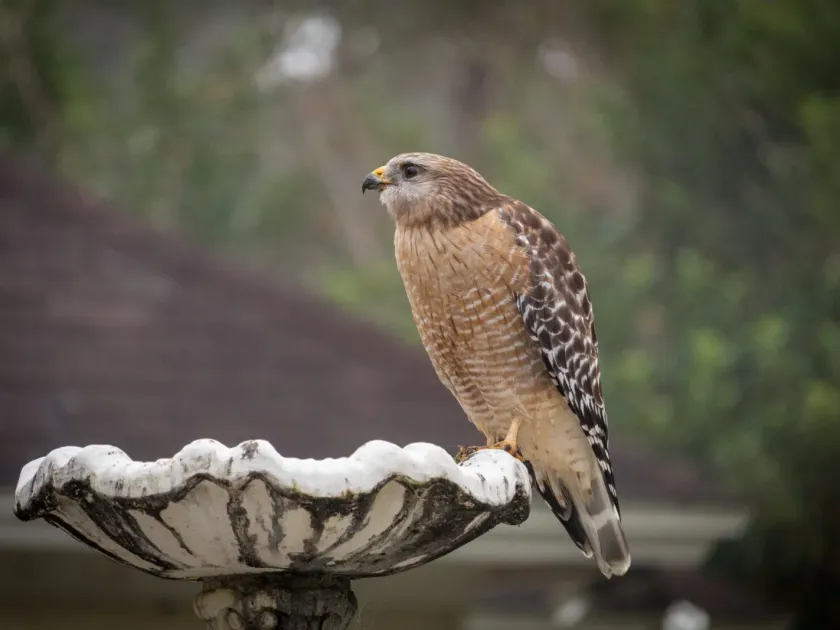
Hawks, belonging to the genus Accipiter, are diurnal birds of prey within the Accipitridae family. They are anatomically adapted for hunting in dense forests, characterized by relatively short, broad wings and a long, rudder-like tail that allows for rapid, agile maneuvers.
The plumage of adult hawks typically features horizontal barring on the underparts, while the dorsal side ranges from slate-grey to dark brown. Their eyesight is exceptionally acute, far exceeding human visual capabilities, which aids in detecting subtle movements in thick cover.
These raptors possess a sharp, hooked beak ideal for tearing prey, and powerful talons designed to grasp and penetrate the flesh of their targets during the brief moments of a hunt.
Sexual dimorphism is evident in the genus, with females being significantly larger and more robust than males. This size difference helps reduce competition for prey between mates during the nesting season.
Unlike soaring raptors, hawks utilize a "sit-and-wait" strategy, relying on the element of surprise and sudden acceleration to capture birds and small mammals before they have time to react.
What it damages
Hawks are not agricultural pests to crops, as they are strict carnivores. Their impact is exclusively felt in the livestock sector, specifically by small-scale farmers and poultry owners who provide free-range conditions for their stock.
The primary economic damage occurs when hawks target vulnerable poultry, such as young chickens, ducklings, or quail. A persistent individual can significantly deplete a backyard flock in a very short span of time.
Beyond direct loss, the presence of a raptor creates a state of constant stress among the flock, which can negatively affect growth rates, egg production, and the general welfare of the livestock.
In the broader ecological context, hawks may disrupt the balance of insectivorous birds in orchards or vineyards by scaring them away, which indirectly leads to a higher population of true insect pests on the farm.
Direct damage to agricultural infrastructure is rare but can occur when a raptor damages protective netting or housing materials while attempting to access prey trapped beneath them.
When it appears
The period of highest risk coincides with the nesting and fledgling season, typically spanning from late spring through mid-summer. During this time, parent birds must hunt intensively to provide food for their offspring.
In autumn, juvenile hawks that have recently left the nest become highly active as they refine their hunting skills. Due to their inexperience, they are often more bold and less cautious around human-inhabited areas.
Winter can also be a season of concern. As natural prey becomes scarce in forest environments, hawks often venture closer to barns and farmyards where high concentrations of songbirds and small rodents attract them.
The biological cycle of the Accipiter genus is tightly linked to seasonal climate changes, determining the nesting and migration patterns that dictate the pressure on local poultry farms.
In many temperate regions, the migratory habits of hawks mean their presence may fluctuate, with peaks observed during the transition periods of spring and autumn migration.
Signs of infestation
The most unmistakable sign of hawk activity is the sudden, unexplained disappearance of birds, often accompanied by "plucking posts"—areas covered in feathers where the predator has processed its meal.
Anxious behavior among the poultry flock is a primary indicator. Chickens often emit distinct alarm calls and scramble for cover under shrubs or roofs when a predator is spotted overhead.
The sighting of a hawk perched on high points such as utility poles, dead branches, or barn roofs, where it spends time scanning the area for potential prey, is a major warning sign.
The discovery of pellets—indigestible masses of fur, bones, and feathers coughed up by the hawk—found near the farm premises indicates that the area is being used as a hunting or resting territory.
Visible scratches or damage to protective wire cages or mesh fences are signs that a raptor has been attempting to penetrate the enclosures to reach the livestock inside.
Control measures
The most effective method for protection is the installation of fully enclosed pens using sturdy, small-gauge wire or UV-resistant netting to ensure no entry from above.
Visual deterrents can be employed, such as holographic tapes, reflective surfaces, or hawk decoys. However, these often require frequent relocation to prevent the raptor from becoming habituated.
Bioacoustic deterrents are available that broadcast the alarm calls of prey or the territorial calls of rival raptors, which can discourage hawks from establishing a hunting pattern on the farm.
Restricting free-range access during the dawn and dusk hours, when hawks are most prone to strike, is a simple yet highly effective management strategy.
- Covering outdoor enclosures with heavy-duty netting.
- Maintaining dense shrubbery for birds to hide in.
- Using automated motion-sensor lights near poultry housing.
- Regular grass mowing to reduce cover for the small rodents that attract hawks.
Taxonomy
- Latin name
- Accipiter
- Family
- Accipitridae
- EPPO code
- ACCISP
Discussion
No discussions yet — be the first.