
Green shield bug
Palomena viridissima
Description
How to identify
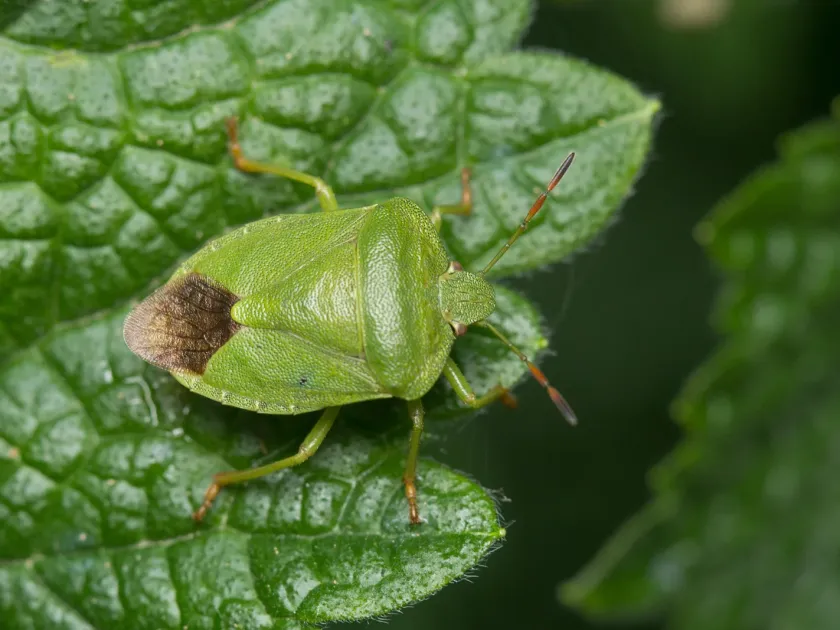
The green shield bug belongs to the Pentatomidae family within the order Hemiptera. Adult bugs have a vibrant green coloration, which often turns brownish or bronze as winter approaches.
The body is shield-shaped and flattened, measuring approximately 12 to 15 mm in length. A key identification feature is the five-segmented antennae, which is a diagnostic trait for this species.
Nymphs go through five developmental stages (instars), gradually increasing in size and transitioning from a light yellowish-green to darker colors with distinct markings on the abdomen.
Only the adults (imago) overwinter, typically seeking refuge under leaf litter, debris, or deep within the bark of trees to survive cold temperatures.
The insects emerge from hibernation in the spring when average daily temperatures reach 10-12 degrees Celsius, seeking out young vegetation for feeding and reproduction.
What it damages
This pest is highly polyphagous, meaning it feeds on a wide variety of cultivated and wild plants, making it a significant challenge for gardeners and farmers alike.
It causes substantial damage to berry bushes such as raspberries, currants, and gooseberries by piercing the fruit and draining the sap, which leads to shriveled and deformed berries.
Fruit trees like apples and pears are also vulnerable; feeding punctures can cause early fruit drop and visible malformations on the surface of the developing crop.
In vegetable gardens, the bugs attack legumes and tomatoes, puncturing the pods or fruit, which can facilitate secondary fungal infections and tissue decay.
A distinctive impact of this bug is the release of a noxious odor and a bitter secretion that makes the damaged produce unpalatable and unsuitable for consumption.
When it appears
The emergence of overwintered adults typically occurs in April or early May, marking the start of the primary feeding season for the local population.
Mating and egg-laying occur throughout the first half of the summer, with females carefully depositing clusters of eggs on the undersides of leaves.
The life cycle from egg to adult takes approximately six to eight weeks, leading to a peak in nymphal activity during the mid-summer months.
By late August and September, the new generation of adults reaches maturity and feeds intensively to build up energy reserves for the upcoming winter hibernation.
As autumn cooling begins in October, the bugs move away from the foliage to seek sheltered overwintering sites, where they remain dormant until spring.
Signs of infestation
The most immediate sign of a green shield bug infestation is the release of a pungent, unpleasant scent when the infested plants or berries are disturbed or harvested.
Leaves often show small, pale circular marks or chlorotic spots where the bugs have used their proboscis to pierce the plant tissues and extract nutrients.
Fruits that have been attacked show clear signs of deformation, such as bumps, pits, or dry, sunken areas that look as if the fruit has begun to rot from the outside in.
Vegetable pods, especially peas or beans, may show stunted growth and dry, empty seeds inside, resulting in a significant reduction in harvest quality.
During routine inspections in June or July, gardeners can find egg batches on the undersides of leaves, appearing as neat, hexagonal patterns of tiny eggs.
Control measures
Effective cultural control includes maintaining a clean garden by removing weeds and clearing away fallen leaves and plant debris where the bugs hibernate.
For smaller infestations, hand-picking the bugs early in the morning, when they are sluggish, is a highly effective method to reduce the population without chemicals.
Regular weeding around crop areas is essential, as many common weeds serve as alternate hosts that support bug populations before they migrate to your garden plants.
If chemical intervention is necessary, opt for products labeled for use on edible crops and strictly observe the safety intervals before harvesting.
- Inspect the undersides of leaves frequently for egg batches.
- Use physical barriers like fine netting on berry bushes.
- Encourage beneficial insects, such as parasitic wasps that target eggs.
- Implement trap crops to divert the bugs away from the primary vegetables.
Taxonomy
- Latin name
- Palomena viridissima
- Order
- Hemiptera (bugs, aphids, leafhoppers)
- Family
- Pentatomidae
- EPPO code
- PALOVI
Discussion
No discussions yet — be the first.