
Green shield bug
Palomena prasina
Description
How to identify
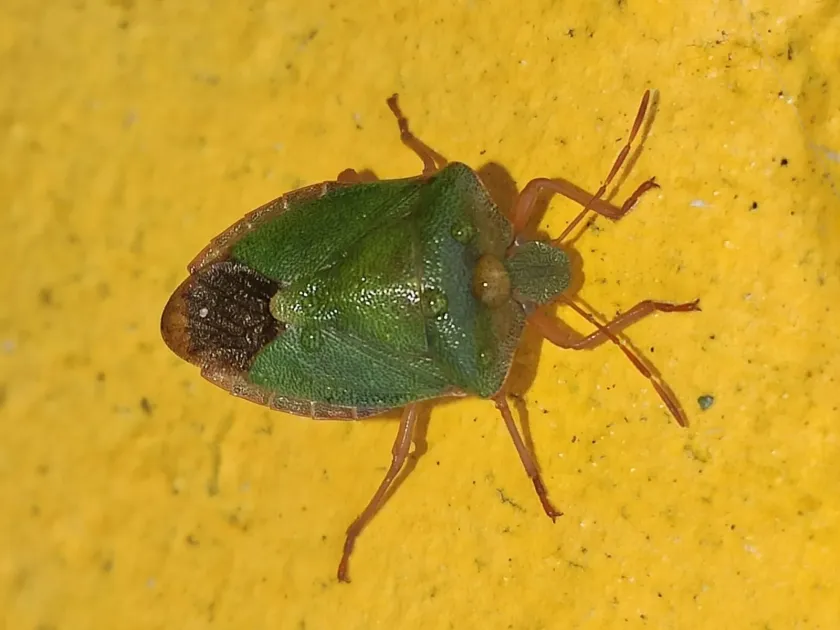
The green shield bug belongs to the order Hemiptera and the family Pentatomidae. The adult insect is characterized by its distinct shield-like body shape, measuring 11–15 mm in length.
The coloration of this pest changes throughout the season: in summer, the bug is bright green, providing excellent camouflage among foliage, while in autumn, it turns a brownish color before overwintering.
Nymphs resemble adults but are smaller and lack fully developed wings. They undergo five stages of development, gradually changing from yellowish to green with dark spots.
The insect is equipped with piercing-sucking mouthparts, which it uses to puncture plant tissues and extract vital cell sap for nutrition.
Only the adults overwinter, hiding in leaf litter, under tree bark, or in other sheltered areas, emerging from diapause in the spring as temperatures rise.
What it damages
This pest is a polyphage that affects a wide range of horticultural, vegetable, and forest crops. It causes significant damage to berry bushes, such as raspberries, currants, and gooseberries.
The bug also feeds on fruit trees, including apples, pears, and plums, sucking juices from developing fruits, which leads to fruit deformation and premature dropping.
In vegetable gardens, the bug attacks crops like beans, peas, tomatoes, and cucumbers. Feeding on legume seeds significantly reduces their viability and quality.
The green shield bug is often found on ornamental shrubs and flowers, weakening their immune systems and creating entry points for secondary fungal infections.
During periods of mass outbreaks, the bug population can move to cereal crops, causing substantial damage to the harvest quality during the grain-filling stage.
When it appears
The life cycle in temperate climates usually involves one generation per year, though under favorable warm conditions, a partial second generation may occur.
Spring emergence from hibernation sites begins when air temperatures reach 10–12 degrees Celsius, at which point they begin feeding on young shoots and budding leaves.
The breeding season takes place in early summer, where females deposit eggs in clusters on the undersides of leaves of host plants.
Peak damage is observed in mid-summer and August, when the population density of adults and nymphs reaches its maximum on ripening crops.
With the arrival of autumn cold, adult bugs begin migrating to their overwintering sites, where they enter diapause until the following spring.
Signs of infestation
One of the main signs of the bug's presence is a distinct, unpleasant odor emitted from its defensive glands when the plant is disturbed or touched.
On berry fruits, punctures result in light or brown spots that eventually harden, giving the fruit a bitter or foul "buggy" taste.
Leaves of infested plants often develop tiny yellowish necrotic spots that eventually merge, causing deformation and curling of the leaf blades.
- Deformation of fruit and ovary development.
- Premature yellowing and leaf drop.
- Presence of nymphs on the undersides of leaves.
- Reduced market value and taste quality of the produce.
Under heavy infestation, one can observe the mass wilting of young shoots, which lose turgor pressure due to intense feeding by a group of pests.
Control measures
Agrotechnical methods include the regular removal of weeds that serve as reservoirs for the pest throughout the season and proper disposal of leaf litter in autumn.
In smaller gardens, manual collection of insects in the early morning is effective, as the bugs are less active and slower due to lower temperatures.
The use of biological products based on entomopathogenic fungi or bacteria can help reduce the population size without the use of harsh chemicals.
In cases of high infestation density, broad-spectrum insecticides are used, though it is crucial to adhere to pre-harvest intervals to ensure safety.
Preventive spring spraying and encouraging natural predators, such as predatory insects and parasitoids, help maintain the population below economic damage thresholds.
Taxonomy
- Latin name
- Palomena prasina
- Order
- Hemiptera (bugs, aphids, leafhoppers)
- Family
- Pentatomidae
- EPPO code
- PALOPR
Discussion
No discussions yet — be the first.