
Green shield bug
Palomena
Description
How to identify
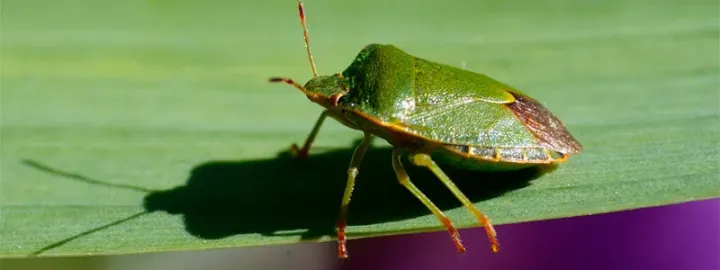
The Green Shield Bug (Palomena prasina) is a member of the Pentatomidae family, commonly known for its shield-like body shape and distinctive odor production.
Adult bugs typically measure between 11 and 15 mm in length. During the summer, they possess a vibrant green coloration which acts as effective camouflage among leaves.
As temperatures drop in autumn, their coloration shifts to a brownish or coppery hue, allowing them to blend into decaying plant material before hibernation.
The body is covered with fine dark punctures, and their wings, when folded, often show dark membrane tips, providing a key diagnostic feature for identification.
Nymphs undergo several growth stages, changing from a pale yellow to a mottled green-brown appearance as they develop toward their adult form.
What it damages
This insect is a polyphagous pest, meaning it feeds on a wide range of plants, including raspberries, blackberries, currants, and various vegetable crops.
By using their piercing-sucking mouthparts, these bugs extract sap from young shoots, flowers, and developing fruits, causing stunted growth and lower crop yields.
Affected fruits often become deformed or develop necrotic spots at the feeding sites, which can subsequently lead to secondary infections by fungi or bacteria.
The most significant impact is the contamination of food products with a foul-smelling secretion produced by their scent glands, rendering fruits unfit for consumption.
Because they target ripening fruits, the damage caused by Palomena prasina often goes unnoticed until the moment of harvest, leading to significant economic losses.
When it appears
Adults overwinter in protected areas such as leaf litter, bark crevices, or garden sheds, emerging in early spring when temperatures become consistently favorable.
The mating and egg-laying phase occurs throughout late spring and early summer, with eggs strategically placed on the undersides of leaves.
Nymphs hatch and begin feeding during the warm summer months, typically reaching their peak activity levels between July and August in most temperate climates.
A second generation may emerge in warmer regions, significantly expanding the population size and increasing the pressure on horticultural and garden crops.
As autumn approaches and temperatures fall below 12°C, the bugs stop feeding and seek out suitable overwintering sites to survive the cold months.
Signs of infestation
One of the earliest signs of infestation is the appearance of small, yellowish, or brownish spots on leaves, indicating where the bugs have been feeding on plant sap.
Misshapen berries and vegetables, particularly tomatoes and raspberries, are classic indicators that shield bugs have been active during the fruit-set period.
The presence of massed egg batches on the undersides of leaves is a definitive warning sign that allows for early intervention before damage escalates.
A strong, unpleasant odor released when touching or disturbing plants is often the first indicator that a population of shield bugs is present in the area.
Adults themselves are frequently spotted in gardens, especially on sunny days when they move between host plants to find the most nutrient-rich tissues.
Control measures
Good sanitation practices, such as removing weeds, fallen leaves, and plant debris, are essential to eliminate potential overwintering sites for adult bugs.
Hand-picking the insects and destroying egg batches during regular garden inspections is an effective method for small-scale gardening and organic farms.
Biological control using parasitic wasps, such as Trissolcus species that target shield bug eggs, can significantly help manage population densities naturally.
If chemical intervention is necessary, apply pyrethroid-based insecticides according to label instructions, ensuring safe intervals before harvesting edible crops.
Planting companion crops that attract predatory insects helps balance the ecosystem and reduces the risk of major pest outbreaks on sensitive vegetable patches.
Taxonomy
- Latin name
- Palomena
- Order
- Hemiptera (bugs, aphids, leafhoppers)
- Family
- Pentatomidae
- EPPO code
- PALOSP
Discussion
No discussions yet — be the first.