
Hackberry psyllid
Pachypsylla venusta
Description
How to identify
The hackberry psyllid (Pachypsylla venusta) is a member of the Psyllidae family within the Hemiptera order. It is a specialized pest that maintains a close biological relationship with hackberry trees (Celtis).
Adult psyllids are small, jumping insects equipped with functional wings, which they use to disperse between trees during the growing season.
The nymphs are the stage responsible for the characteristic damage, as they spend their developmental period protected inside plant tissues.
Their morphological adaptations allow them to thrive within the galls they induce, creating a micro-environment that provides both shelter and nutrition.
Understanding their life cycle is crucial for effective management, as the timing of control interventions is largely dependent on the psyllid's developmental stage.
What it damages
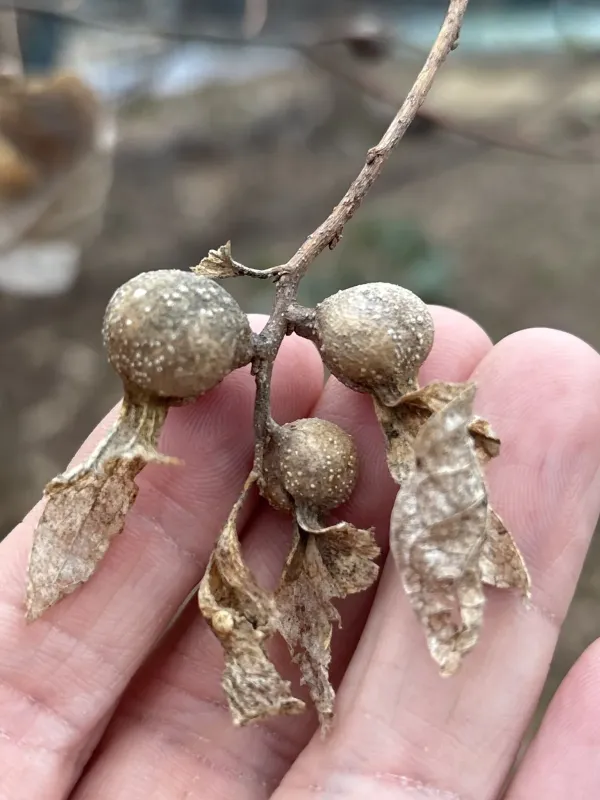
This pest is exclusively associated with hackberry trees. The primary damage is caused by the nymphs inducing the formation of leaf galls.
These galls are abnormal tissue growths triggered by the chemical substances injected by the nymphs while feeding on the leaf sap.
While the aesthetic damage is the most obvious, severe infestations can impact the tree's vigor by diverting resources toward gall production.
In landscaping and urban forestry, the presence of these galls can significantly reduce the ornamental value of the trees, making them less desirable for public spaces.
However, the long-term impact on the overall survival of healthy, established hackberry trees is generally considered moderate rather than fatal.
When it appears
The life cycle begins in spring when adult females lay eggs on the newly emerging foliage of the hackberry tree.
As the leaves grow, the nymphs hatch and initiate the formation of galls, providing them with a steady food source throughout the summer months.
By late summer or early autumn, the nymphs complete their maturation, and the adult insects emerge from the galls to seek overwintering sites.
Winter is typically passed in the adult stage, hiding in protected areas such as bark crevices, leaf litter, or other sheltered debris near the host trees.
The timing of these events can vary depending on local climate conditions and the specific species of the host plant in the region.
Signs of infestation
The most distinctive sign of infestation is the presence of leaf galls, which manifest as bumps, swellings, or nipple-like structures on the foliage.
These structures may change color, turning yellowish or reddish, and are easily observed against the green background of the leaves.
Upon closer inspection, particularly on the underside of the leaf, one can see the emergence holes left behind after the adults have vacated the galls.
Leaves heavily infested with galls may become deformed, chlorotic, or exhibit premature senescence, especially during hot and dry spells.
- Widespread swelling or bumps on the leaf surface.
- Leaf distortion and curling during periods of heavy infestation.
- Premature yellowing or browning of leaves.
- Small emergence holes visible on mature galls.
Control measures
Management usually focuses on maintaining tree health and aesthetic appearance rather than total eradication, which is rarely necessary for tree survival.
Systemic insecticides, applied as soil drenches or trunk injections during the early stages of gall formation, can be highly effective in reducing population numbers.
Manual removal of heavily infested leaves or shoots in early spring can help limit the spread if the infestation is localized on smaller ornamental trees.
Encouraging natural predators such as lady beetles, lacewings, and parasitic wasps can help keep psyllid populations at manageable levels naturally.
Proper irrigation and fertilization are essential to ensure the tree remains vigorous and can better tolerate the stress caused by the feeding activity.
Taxonomy
- Latin name
- Pachypsylla venusta
- Order
- Hemiptera (bugs, aphids, leafhoppers)
- Family
- Carsidaridae
- EPPO code
- PACPVE
Discussion
No discussions yet — be the first.