
Camphor psyllid
Mesohomotoma camphorae
Description
How to identify
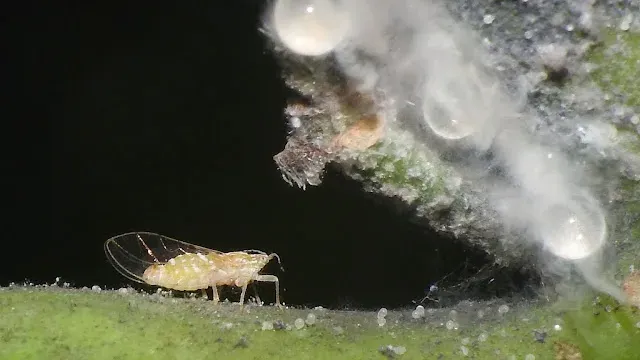
The camphor psyllid (Mesohomotoma camphorae) is a small insect belonging to the family Psyllidae (order Hemiptera). These insects are known for their jumping ability, provided by well-developed hind legs.
Adults typically measure between 2 and 3 mm in length. They possess transparent wings and a coloration that allows them to blend effectively into the foliage or bark of their host plants.
Nymphs are often flatter and may be covered in white, waxy secretions or filaments, which provide them with protection from predators and environmental stressors.
The life cycle involves egg, nymphal stages, and adult, with development speed highly dependent on ambient temperature and host plant vigor.
This species is recognized as a significant pest in various regions, particularly affecting decorative plants in both nurseries and urban landscapes.
What it damages
While the primary host is the camphor tree, the camphor psyllid also causes significant damage to other ornamental species, including various types of Hibiscus.
They feed by inserting their stylets into plant tissue to extract sap, which leads to stunted growth and distortion of new, tender shoots.
The insects secrete large amounts of honeydew as a byproduct of feeding. This substance coats the leaves and serves as a substrate for sooty mold fungus.
Sooty mold covers the leaf surface, blocking sunlight and severely impeding the plant's ability to perform photosynthesis, ultimately weakening the entire specimen.
Heavy infestations can lead to leaf yellowing, necrosis, and premature defoliation, drastically reducing the aesthetic and commercial value of the affected plant.
When it appears
The camphor psyllid is active throughout the year in warmer climates, while in cooler areas, its activity is focused on the growing season.
Population density typically peaks during spring and summer months when plants are flushing with new, succulent growth, providing ideal food sources.
In greenhouses or controlled environments, multiple overlapping generations can occur annually, leading to a constant threat of re-infestation.
Overwintering usually occurs in the adult stage, with insects finding shelter in bark crevices or protected plant debris until temperatures rise again.
Regular monitoring starting from early spring is crucial to detect early colonization and prevent large-scale outbreaks on susceptible crops.
Signs of infestation
Initial signs of infestation often include the curling and yellowing of young leaves at the growing tips of the plant.
The presence of sticky honeydew on the foliage is a primary diagnostic sign that sap-sucking insects are active on the host plant.
The accumulation of black, powdery sooty mold on the leaves or branches confirms the presence of an established psyllid colony.
Close inspection of leaf axils and undersides often reveals the presence of waxy, white nymphs huddled together in protective clusters.
Upon disturbing the plant, the sudden flight of numerous small, winged adults is a definitive confirmation of a camphor psyllid infestation.
Control measures
Managing the camphor psyllid effectively requires a combination of horticultural hygiene and targeted chemical control measures.
- Prune and destroy heavily infested branches to reduce the immediate population density.
- Apply systemic insecticides that are absorbed by the plant to kill psyllids during their feeding process.
- Use horticultural oils or insecticidal soaps as contact treatments to physically remove or suffocate nymphs and clear honeydew.
- Encourage biological control agents such as lady beetles, lacewings, and parasitic wasps in the garden.
- Maintain plant health through appropriate irrigation and balanced fertilization to help plants withstand and recover from pest attacks.
Taxonomy
- Latin name
- Mesohomotoma camphorae
- Order
- Hemiptera (bugs, aphids, leafhoppers)
- Family
- Carsidaridae
- EPPO code
- MESHCA
Discussion
No discussions yet — be the first.