
Mesohomotoma
Mesohomotoma
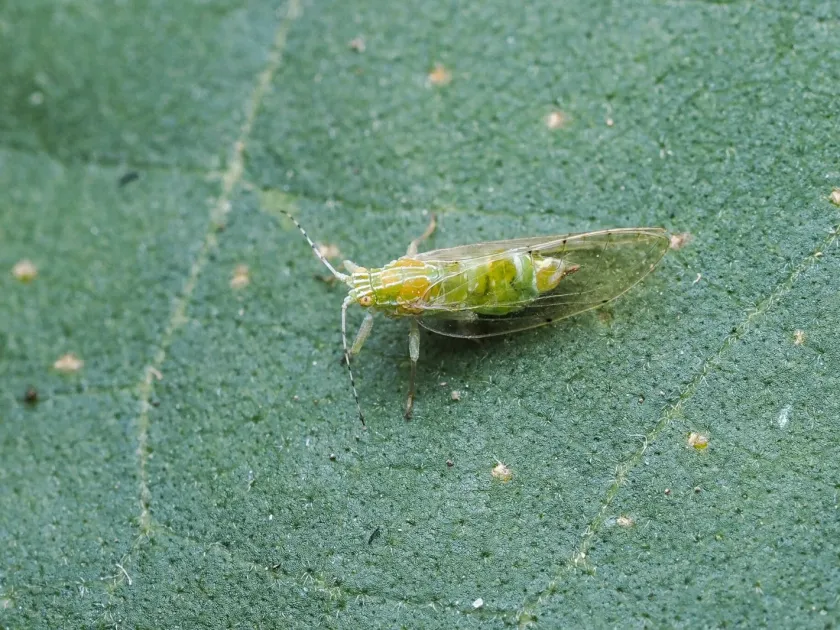
Description
How to identify
Mesohomotoma is a genus of jumping plant lice belonging to the family Psyllidae, in the order Hemiptera. These small insects are highly specialized, possessing morphological adaptations for leaping and feeding on plant phloem sap.
The adults typically have a wedge-shaped body with wings folded roof-like over the abdomen. Their hind legs are well-developed, allowing them to jump rapidly when disturbed, which is a key behavioral trait for identification.
Nymphal stages are generally sedentary and often dwell on the undersides of leaves, sometimes secreting waxy substances or honeydew that coats the surrounding foliage. Their appearance can vary significantly between instars.
Systematically, they are closely related to other sap-sucking pests like aphids and whiteflies. However, their specific mouthparts and biological cycle are distinct, often requiring microscopic examination of wing venation for precise species determination.
Understanding their taxonomy is essential for greenhouse management, as different species of Mesohomotoma have varying host preferences, primarily within the Malvaceae family.
What it damages
Mesohomotoma species primarily target plants in the Malvaceae family, with ornamental hibiscus being the most common victim. Both nymphs and adults feed by inserting their stylets into plant tissues to suck out essential nutrients.
This feeding behavior causes significant physiological stress, resulting in stunted growth, chlorosis (yellowing of leaves), and leaf curling. The extraction of phloem sap deprives the plant of the energy needed for development.
Excretions from the pest, known as honeydew, act as a substrate for sooty mold fungi. This black fungal growth blocks sunlight from reaching the leaves, further inhibiting photosynthesis and weakening the plant's health.
Heavy infestations can lead to premature leaf drop and the total degradation of the plant's aesthetic value, making it commercially unviable. In severe cases, the constant stress can lead to the death of young shoots.
Furthermore, these insects may act as potential vectors for plant pathogens. The micro-wounds caused by their feeding provide entry points for secondary bacterial or fungal infections.
When it appears
Mesohomotoma populations are highly dependent on temperature and humidity, thriving in warm, stable environments. In greenhouses, they can maintain continuous generations throughout the year.
In outdoor settings, peak population levels typically occur during late spring and summer. High temperatures accelerate the life cycle, shortening the time required for nymphs to develop into reproductive adults.
Overwintering usually occurs as eggs or adults in sheltered locations, such as plant debris, bark crevices, or protected parts of the host plant. This allows them to survive cooler seasons and re-infest crops when conditions improve.
The life cycle consists of the egg stage, several nymphal instars, and the adult stage. The rapid succession of these generations is the primary reason why infestations can become severe in such a short amount of time.
Monitoring is crucial during periods of rapid plant growth, as the insects are attracted to the tender, nutrient-rich tissues of new shoots and emerging foliage.
Signs of infestation
The initial signs of an infestation include the appearance of tiny yellow or whitish stippling on the leaves, caused by the insects' probing and feeding activities. These spots often coalesce as the damage progresses.
Visual inspection of the underside of leaves will reveal clusters of nymphs, often camouflaged or covered by a waxy secretion. Their presence is usually accompanied by a sticky, shiny layer of honeydew.
The accumulation of black, soot-like powder on the leaf surface is a hallmark sign that the pest population has reached a high density and that the plant's overall health is beginning to decline.
Distorted, curled, or "crinkled" leaves, especially on the tips of branches, indicate that the pest has targeted the most actively growing areas of the plant, hindering its vertical development.
The presence of small, jumping insects when the plant foliage is lightly tapped is the most definitive physical sign of a Mesohomotoma infestation.
Control measures
Effective control requires an integrated approach, starting with strict sanitation. Pruning and removing heavily infested parts of the plant can significantly lower the overall population pressure in the growing area.
Biological control involves the introduction or conservation of natural predators, such as ladybird beetles, lacewings, and predatory bugs, which actively feed on both eggs and nymphal stages of the psyllid.
Chemical control should be implemented using systemic insecticides that are absorbed into the plant's vascular system. These are particularly effective against sap-sucking insects, providing long-term protection.
Application of contact insecticides is also possible but requires thorough coverage, especially of the leaf undersides, to ensure the chemical comes into direct contact with the nymphs.
- Use yellow sticky cards for monitoring and mass trapping adults.
- Apply systemic insecticides containing imidacloprid or similar compounds.
- Regularly wash plants with a strong water stream to dislodge nymphs and wash off honeydew.
- Implement quarantine protocols for any new plant material introduced to the facility.
Taxonomy
- Latin name
- Mesohomotoma
- Order
- Hemiptera (bugs, aphids, leafhoppers)
- Family
- Carsidaridae
- EPPO code
- MESHSP
Discussion
No discussions yet — be the first.