
Hackberry nipple gall maker
Pachypsylla celtidisgemma
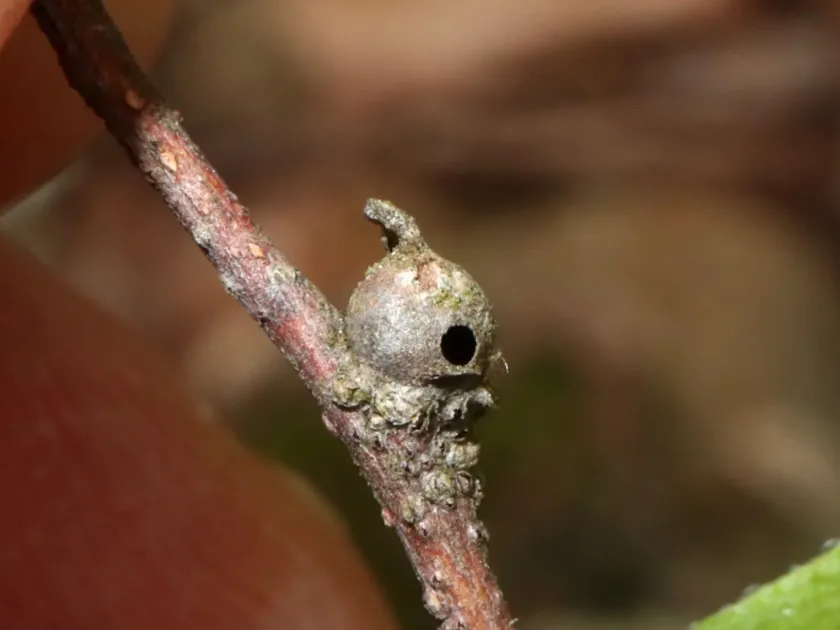
Description
How to identify
The hackberry nipple gall maker is a small insect belonging to the order Hemiptera and the family Psyllidae. These psyllids are known for their jumping legs and wings held in a tent-like fashion over the body.
This species is highly host-specific, primarily infesting hackberry trees (Celtis). The most recognizable aspect of its lifecycle is the creation of distinct galls, which serve as protective structures for the developing larvae.
Adults are small and often go unnoticed due to their protective coloration that blends in with tree bark. However, during early spring, they can be seen congregating on twigs as they emerge from overwintering sites.
The nymphs reside within the galls throughout their development. They are flattened and light-colored, remaining fully enclosed and protected by the plant tissue that forms the gall around them.
The biological cycle is tightly synchronized with the host plant's phenology. This specialized relationship makes the insect a predictable pest for arborists and landscape managers who monitor hackberry health.
What it damages
The primary damage is caused to hackberry trees, where the feeding activity of the nymphs triggers the host plant to produce pathological growths known as galls.
These galls are typically found on leaves and occasionally on young buds. They develop as raised, nipple-like protrusions, creating a micro-environment that sustains the larva's nutrition and protects it from predators.
While an infestation rarely kills a healthy tree, severe outbreaks can cause premature leaf drop and negatively impact the tree's overall vigor and visual appeal in landscape settings.
The gall formation disrupts the leaf's normal function, potentially interfering with photosynthesis. This energy loss weakens the tree, making it more susceptible to secondary pests or environmental stress.
In ornamental urban forestry, the presence of numerous galls significantly diminishes the aesthetic quality of the foliage, often prompting control measures to maintain the health and beauty of the hackberry canopy.
When it appears
Adults emerge from their overwintering sites on bark crevices in early spring as temperatures rise. This migration coincides with the development of new hackberry foliage.
The gall formation begins during the early growth phase of the leaves. Females lay eggs, and the resulting feeding causes the plant tissues to bulge, effectively enclosing the nymphs within the newly formed structure.
The nymphs develop throughout the summer months while protected inside the galls. They feed on the plant sap, isolated from external threats like weather changes or many parasitic insects.
Adults emerge from the galls toward the end of summer or in early autumn. They transition into their final life stage and begin seeking suitable locations on the tree to survive the winter.
Overwintering occurs exclusively in the adult stage. The insects remain dormant in protected areas such as bark fissures until the following spring, when the cycle begins anew.
Signs of infestation
The most prominent sign of infestation is the presence of nipple-like bumps or galls on the leaf surfaces. Initially, these may be light green, eventually turning yellowish or brownish as they mature.
Inspecting the undersides of the leaves or dissecting a gall will often reveal the presence of the nymph inside, which serves as a definitive confirmation of the pest.
A heavy infestation leads to widespread leaf discoloration and deformation. In severe cases, the foliage may look ragged or show signs of premature senescence due to the high density of galls.
Early leaf drop during mid-summer is another indicator that the tree has been under significant pressure from these psyllids, impacting its ability to store nutrients for the upcoming season.
- Characteristic nipple-like leaf galls
- Deformed or distorted leaf tissue
- Premature yellowing and leaf shedding
- Presence of small psyllid adults on branches in spring
Control measures
Managing the hackberry nipple gall maker is challenging because the larvae are protected inside the galls. Systemic insecticides are generally the most effective way to treat an established infestation.
Preventive treatments should be applied in early spring, specifically during the bud-break phase, to target the adults before they lay eggs and initiate gall formation.
If the infestation is localized or on smaller, younger trees, manual removal and destruction of heavily affected leaves or twigs can help reduce the local population of the pest.
Maintaining tree vitality through appropriate fertilization and regular watering is essential. A healthy, stress-free tree is much better equipped to tolerate the presence of galls.
In landscape scenarios, applying systemic neonicotinoid treatments to the soil or as a bark spray can provide effective, long-lasting control during the growing season.
Taxonomy
- Latin name
- Pachypsylla celtidisgemma
- Order
- Hemiptera (bugs, aphids, leafhoppers)
- Family
- Carsidaridae
- EPPO code
- PACPCG
Discussion
No discussions yet — be the first.