
Rice grasshopper
Oxya vicina
Description
How to identify
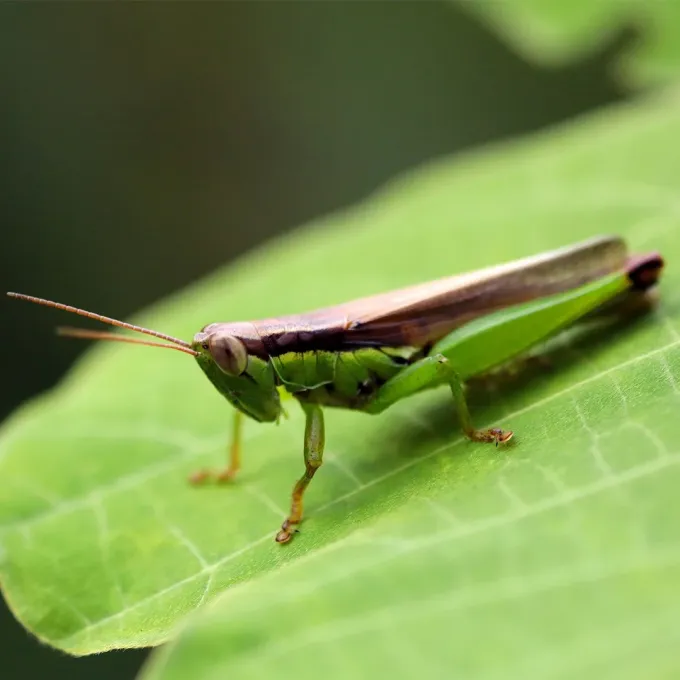
The rice grasshopper (Oxya vicina) belongs to the order Orthoptera and the family Acrididae (short-horned grasshoppers). It is a medium-sized insect, typically exhibiting green, brownish, or yellowish coloration that provides camouflage within dense vegetation.
The adult body is slender and elongated, adapted for living in the high-humidity environments of rice paddies. The hind legs are powerful and specialized for jumping, while the wings are well-developed for flight.
Females are significantly larger than males. Adult specimens possess specific morphological features on the pronotum and anal plate, which allow entomologists to accurately distinguish Oxya vicina from other grasshopper species.
Nymphs resemble smaller versions of adults but lack fully developed wings and reproductive organs. Through several molting stages, they progressively acquire the morphological characteristics of mature insects.
Eggs are typically laid in the soil or on the lower parts of plant stems, protected by a specialized foam-like substance that hardens rapidly to ensure the survival of the offspring.
What it damages
The primary host of this pest is rice (Oryza sativa), although the grasshopper can also feed on various other cereal crops found adjacent to rice fields.
These insects feed primarily on leaves, chewing irregular holes or stripping leaf tissues, which significantly reduces the photosynthetic surface area and the plant's overall vigor.
During periods of mass outbreaks, rice grasshoppers can destroy not only the foliage but also the reproductive structures, specifically the panicles, leading to substantial yield losses.
While damage caused by early-instar nymphs might appear negligible, the feeding intensity increases rapidly as the insects grow, potentially leading to severe defoliation if left unchecked.
High population densities can result in yield reductions of up to 15-25% if management interventions are not implemented during the critical growth stages of the rice crop.
When it appears
The life cycle of the rice grasshopper is closely tied to the water management regime of rice paddies. The insect overwinters in the egg stage, deposited within the soil or plant debris, where they remain protected until spring.
Hatching occurs in the spring when soil temperatures reach optimal levels, usually coinciding with the initial vegetative phases of the rice crop.
The development of nymphs involves several stages (typically 5-6 instars), with the duration determined by climatic factors: higher temperatures and humidity significantly accelerate the maturation process.
Adult emergence typically peaks in the second half of summer, which often coincides with the critical stage of panicle formation in rice, making this period the most vulnerable for the crop.
There is usually one generation per year, although favorable climatic conditions and prolonged warm seasons in southern regions may occasionally allow for a partial second generation.
Signs of infestation
The first visual sign of infestation is the appearance of characteristic "windows" or jagged edges on the leaves of young rice plants, which are easily identified during routine field inspections.
Because nymphs tend to aggregate in areas with dense cover, damage is often localized in patches rather than uniformly distributed across the entire field.
Adult grasshoppers are easily spotted by their sudden jumping or flight when humans or machinery enter the rice fields, acting as a clear indicator of a resident population.
As the insects mature, the damage becomes more pronounced; leaves may be reduced to midribs, and panicle damage often leads to empty or shriveled grains, significantly reducing harvest quality.
Increased activity is observed during the early morning and evening, when grasshoppers are most active in migrating between sections of the field and expanding the infestation zones.
Control measures
Agrotechnical methods form the foundation of management, including the rigorous removal of weeds along irrigation ditches and field borders where the grasshopper seeks refuge and egg-laying sites.
Regulating the water level is a highly effective control measure: short-term, deep flooding of the paddies can drown early-instar nymphs that are not capable of surviving prolonged immersion.
Biological control strategies emphasize the conservation and use of natural enemies, including predatory birds, insectivorous insects, and entomopathogenic fungi within the agroecosystem.
When infestation levels exceed the economic threshold, chemical control via insecticides is employed using aerial or ground-based spraying methods, following strictly regulated application guidelines.
- Systematic population monitoring using sweep nets or light traps.
- Crop rotation and deep plowing during the off-season to destroy egg clutches.
- Targeted application of authorized systemic insecticides.
- Maintenance of clean buffer zones around rice production areas.
- Careful monitoring during the panicle formation stage.
Taxonomy
- Latin name
- Oxya vicina
- Order
- Orthoptera (locusts)
- Family
- Acrididae
- EPPO code
- OXYXVI
Discussion
No discussions yet — be the first.