
Oats swedish fly
Oscinella vastator
Description
How to identify
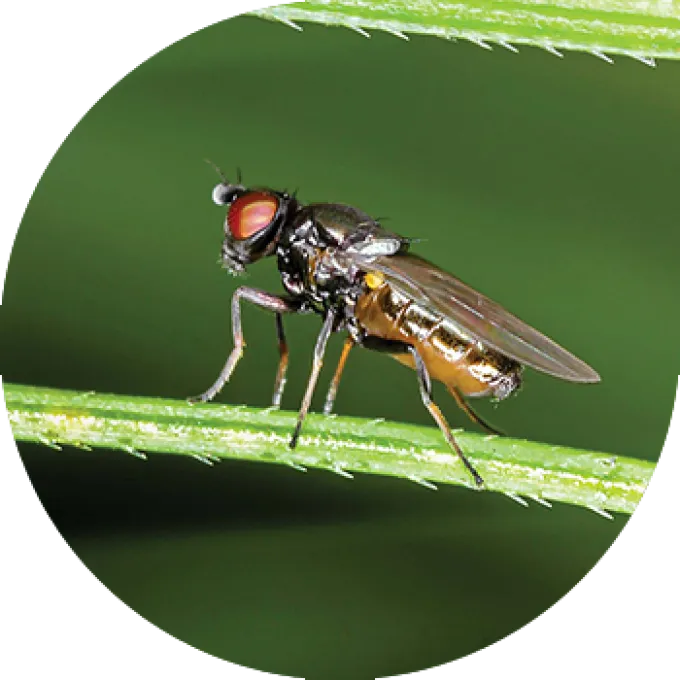
The Oats Swedish fly (Oscinella vastator) is a small dipteran insect belonging to the family Chloropidae. The adult fly is approximately 1.5 to 2 mm long, characterized by a shiny black body and yellowish legs.
The larvae are cylindrical, reaching 3–4 mm in length, and typically white to yellowish-white in color. They reside inside the stems of cereal crops, which makes them difficult to spot during early development stages.
The lifecycle includes four stages: egg, larva, pupa, and imago. The fly undergoes complete metamorphosis, with the number of generations per year depending heavily on local climate conditions and available hosts.
Pupation occurs within a puparium that often resembles a seed grain, found inside the plant stem. Overwintering occurs primarily as larvae within the stubble of cereal crops or on emerging winter crops.
Adult flies are highly active during the spring, with flight activity peaking when temperatures consistently rise above the threshold necessary for their metabolic processes and egg-laying behavior.
What it damages
This pest primarily attacks oats, barley, wheat, and rye. Damage is most significant during the early growth stages of the crop, particularly when plants are in the tillering phase.
Larvae feed by boring into the base of the shoot and consuming the central growing point. This feeding habit causes the central leaf to wither, turn yellow, and eventually die.
If the infestation occurs later in the plant's development, larvae may feed on the developing ear, causing sterile or malformed spikes, which drastically reduces the total yield and grain quality.
Infested plants may exhibit stunted growth or excessive secondary tillering, although these late-developing tillers rarely produce viable, high-quality grain by harvest time.
The extent of crop loss is directly proportional to the density of the fly population and the phenological stage of the cereal crop at the time of attack.
Signs of infestation
The primary symptom of infestation is the yellowing and drooping of the central leaf in a shoot. This is often referred to as "dead heart" by agronomists.
Plants affected by the pest often show increased tillering but remain stunted in height. The affected stems are easily distinguished by their poor overall development compared to surrounding healthy plants.
Evidence of larval activity, such as small dark excrement pellets, can be found within the stem if it is carefully opened. The larva itself can often be discovered near the base of the damaged shoot.
Field-level symptoms include uneven crop stands with distinct patches of yellowed or dead plants. This often leads to sparse areas in the field where the population density of the fly was highest.
Regular scouting during the 2- to 3-leaf stage is essential to detect the fly activity before larvae have caused irreparable damage to the growing point of the cereal crop.
Control measures
Effective management begins with strict crop rotation, ensuring that susceptible cereals are not planted in succession. This disrupts the lifecycle and reduces the overwintering population.
Early sowing dates are a critical strategy. By establishing the crop before the peak flight activity of the adult flies, plants can reach a growth stage that is less attractive for oviposition.
Seed treatment with systemic insecticides provides essential protection during the vulnerable seedling stage, significantly reducing the impact of early-season infestations.
Chemical control can be implemented by spraying fields with approved systemic insecticides during the peak migration and egg-laying periods of the adult fly.
- Proper soil cultivation to bury infested stubble.
- Control of grassy weeds which serve as alternate hosts.
- Balanced fertilization to promote rapid, vigorous seedling growth.
- Monitoring adult fly activity with yellow sticky traps.
Taxonomy
- Latin name
- Oscinella vastator
- Order
- Diptera (flies)
- Family
- Chloropidae
- EPPO code
- OSCIVA
Discussion
No discussions yet — be the first.