
Frit fly
Oscinella soror
Description
How to identify
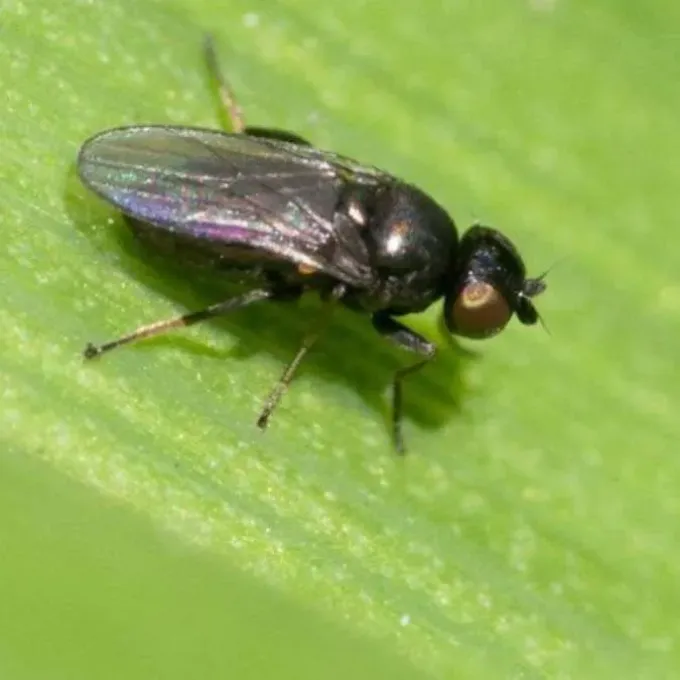
The Frit fly, known scientifically as Oscinella soror, is a small insect belonging to the Chloropidae family, commonly known as grass flies. The adult fly measures approximately 1.5–2 mm in length and features a shiny black body with clear wings.
The larva is a legless, cylindrical grub, white or yellowish in color, reaching up to 3–4 mm when fully grown. It possesses specialized mouth hooks designed to penetrate and feed on plant tissues.
Pupation occurs within a dark brown puparium, which is often located inside the damaged stem of the host plant. The life cycle involves complete metamorphosis: egg, larva, pupa, and adult.
Adult flies are highly mobile and are typically active during warm, sunny weather, feeding on the pollen of various grasses to support their survival and reproductive activities.
Depending on the climatic zone, this insect can complete two or more generations per year, making it a persistent threat in cereal-growing regions.
What it damages
This pest primarily attacks cereals, including oats, barley, and spring wheat. While its preference is for specific cereal crops, it may also infest maize and various wild grasses such as couch grass.
The larval stage is the most destructive, as larvae burrow into the main stem of young seedlings. By feeding on the growing point, they destroy the central shoot, leading to the death of the main tiller.
In cases of high infestation, the Frit fly can cause severe thinning of the stand. Early-season attacks often result in complete loss of the main stem, which is crucial for grain production.
If the plant manages to compensate through increased tillering, the resulting yield is often significantly lower in quantity and grain quality, affecting the economic viability of the crop.
The level of damage is highly dependent on the stage of plant development at the time of egg-laying; younger seedlings are significantly more vulnerable to terminal damage.
When it appears
The first generation of adults emerges in early spring, coinciding with the germination and early seedling stages of spring cereals. This provides immediate access to suitable host tissues.
Females lay individual eggs under the leaf sheaths or near the base of young plants. The duration of the egg stage is short, usually lasting about a week under optimal conditions.
Larvae develop rapidly, spending approximately 3–4 weeks within the host stem before reaching the pupal stage. This developmental speed allows the pest to exploit the most vulnerable period of plant growth.
Subsequent generations continue the life cycle throughout the season, utilizing available cereal crops, volunteer plants, or wild grasses to maintain population numbers.
Winter is typically survived in the larval stage, residing within the stems of winter cereals or perennial grasses, ready to emerge as adults when temperatures rise in the spring.
Signs of infestation
The most recognizable symptom of Frit fly infestation is the yellowing and subsequent death of the central leaf of the seedling, which is commonly referred to as the 'dead heart' symptom.
Heavily infested plants often fail to produce a head and exhibit a stunted, bushy appearance, as the plant directs resources into developing lateral tillers instead of the main stem.
If a damaged plant is dissected, the presence of the larva or the evidence of its tunneling into the growing point will be clearly visible, often accompanied by small amounts of frass.
In a field setting, damage often presents in patches, especially in areas sheltered from the wind or near sources of initial infestation like wild grass margins.
- Yellowing and death of the central leaf
- Stunted plant growth
- Increased, unproductive tillering
- Presence of larvae in the stem base
Control measures
Cultural control is the most effective strategy, particularly planting spring cereals early to ensure that plants reach a less vulnerable growth stage before the peak flight of adult flies.
Good agronomic practices, such as balanced fertilization and proper crop rotation, promote vigorous early growth, which helps seedlings survive moderate levels of larval feeding.
The use of cereal varieties with proven resistance or those that demonstrate rapid development is encouraged to minimize the window of opportunity for the pest.
Seed treatment with systemic insecticides provides excellent protection during the critical initial weeks of seedling development, significantly reducing early-season damage.
Foliar insecticide applications can be utilized if monitoring indicates that adult fly numbers exceed established economic thresholds during the susceptible growth stages.
Taxonomy
- Latin name
- Oscinella soror
- Order
- Diptera (flies)
- Family
- Chloropidae
- EPPO code
- OSCISO
Discussion
No discussions yet — be the first.