
Frit fly
Oscinella pusilla
Description
How to identify
The Frit fly (Oscinella pusilla) belongs to the order Diptera, family Chloropidae. It is a tiny insect, measuring about 1.5 to 2 mm in length, with a shiny black body.
Adults are characterized by clear wings with dark veins and yellowish legs. The head is rounded with large eyes, which assist the insect in navigating through dense cereal crop fields.
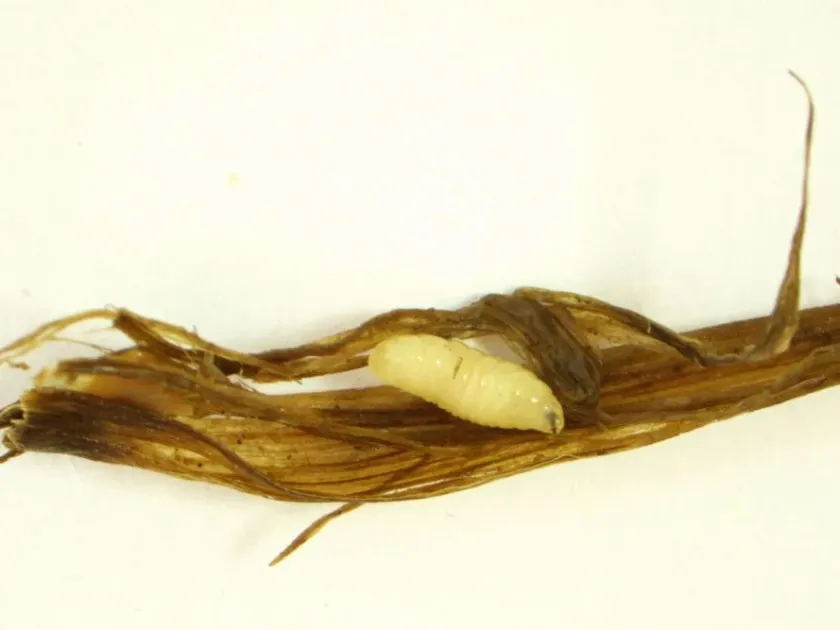
The eggs are minute, white, and elongated, usually laid on the surface of leaves. The larvae are 3–4 mm long, legless, translucent, and vary in color from white to yellowish.
Pupation occurs within a brown puparium, which is often found inside the stems of the damaged host plants. The life cycle is closely synchronized with the phenology of cereal crops.
Identifying the pest requires careful observation, as adult flies resemble other related species, but their presence in cereal fields during specific growth stages is a key indicator.
What it damages
The Frit fly larvae are major pests of cereal crops, including barley, oats, wheat, rye, and various wild grass species. They cause significant economic damage.
The larvae primarily attack seedlings during the early growth stages, specifically when the plant has 1 to 3 leaves. They tunnel into the main stem and feed on the developing ear and young tissues.
Symptoms include the yellowing and wilting of the central leaf, followed by the death of the main shoot. This forces the plant to form secondary tillers, which often do not reach full maturity.
Heavy infestations lead to sparse stands and reduced yields. The damage is particularly severe if the environmental conditions are favorable for the pest's rapid reproduction.
In addition to direct feeding damage, the tunnels made by larvae can become entry points for secondary infections by plant pathogens, further weakening the crop.
When it appears
The Frit fly typically produces two to four generations per year, depending on the climatic zone and temperature conditions during the growing season.
The overwintered flies emerge in early spring when air temperatures reach 10–12°C. This activity coincides perfectly with the emergence of spring cereal seedlings.
The flight period is often extended, meaning that crops remain at risk for several weeks. Females deposit eggs systematically on the most vulnerable young plants.
Subsequent generations complete their life cycle on late-sown cereals or wild grasses throughout the summer months, ensuring the population persists.
The final generation of the season poses a significant threat to winter cereal crops, as the larvae can cause substantial damage before the plants enter winter dormancy.
Signs of infestation
The most reliable sign of a Frit fly infestation is a yellowed or withered central leaf, which can be easily pulled from the sheath of the plant.
By splitting the stem of the affected plant, one can usually find the cream-colored larvae or the evidence of their feeding tunnels inside the tissue.
Fields may show patches of stunted or dead seedlings, often referred to as "thin spots." This creates an uneven appearance in the otherwise healthy crop stand.
The tillering of plants increases as a response to the loss of the central shoot, giving the plants a bushy appearance that is stunted compared to healthy neighboring plants.
Adult fly activity can be monitored using sweep nets early in the morning or during the evening, when they are most active at the tops of the plants.
Control measures
Cultural control, such as adjusting planting dates, is essential; early sowing for spring crops and late sowing for winter crops can avoid peak pest activity.
Eliminating grassy weeds from the field and surrounding areas is a critical strategy to remove alternative host sites for the fly throughout the season.
Seed treatment with systemic insecticides is the most effective preventative measure, providing long-lasting protection for the seedlings during the susceptible stage.
If the pest population exceeds the economic threshold, chemical intervention with foliar systemic insecticides is recommended to reduce the number of adults and larvae.
- Prioritize early sowing dates for spring cereals.
- Use professional seed treatments (insecticides).
- Control grassy weeds to limit pest breeding sites.
- Apply fertilizers to boost plant growth and vigor.
- Monitor populations and apply insecticides when necessary.
Taxonomy
- Latin name
- Oscinella pusilla
- Order
- Diptera (flies)
- Family
- Chloropidae
- EPPO code
- OSCIPU
Discussion
No discussions yet — be the first.