
Frit fly
Oscinella dorsata
Description
How to identify
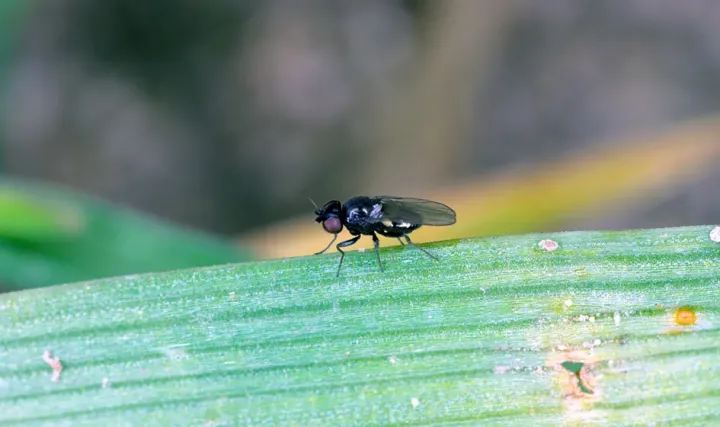
The Frit fly (Oscinella dorsata) is a significant pest of cereal crops, belonging to the family Chloropidae. The adult insect is very small, measuring approximately 1.5 to 2 mm in length, with a shiny black body and yellowish-brown legs.
The larvae are cream-white, legless, and reach about 3-4 mm when fully mature. They represent the primary damaging stage of the pest's life cycle, living and feeding inside the plant stems.
The fly typically completes several generations per year, depending on the climatic conditions. The rapid development allows the population to multiply quickly during the growing season.
Overwintering occurs primarily as larvae within the stems of winter cereals or wild grasses. When spring arrives, these larvae pupate and emerge as adults, starting the first generation of the new season.
Female flies lay eggs on the leaves of young cereal plants. The eggs are tiny and white, usually placed singly or in small clusters near the base of the plant or in the leaf sheaths.
What it damages
This pest attacks a wide range of cereals, including oats, barley, wheat, and rye. It also exploits various wild grasses as alternative hosts, which helps sustain the population between crop seasons.
Damage is caused by the larvae feeding inside the central shoot. They chew through the base of the plant, specifically targeting the growing point, which causes the central leaf to die.
Early-stage damage to young seedlings is the most devastating. If the main stem is killed, the plant either dies completely or produces excessive, unproductive tillers that fail to yield a proper grain crop.
In older plants, the infestation might target the developing ear within the stem. This results in the formation of empty or "blind" ears, often referred to as "whiteheads," which drastically reduce final yields.
The severity of the damage depends heavily on the crop growth stage at the time of attack. Crops that reach the 3-leaf stage quickly are generally more resistant to severe population outbreaks.
Signs of infestation
The classic symptom of an infestation is the wilting and yellowing of the central leaf, known as "dead heart." This leaf can be easily pulled out, and the base will show signs of chewing damage.
Field observation reveals patchy areas of stunted growth and thinning crop stands. Affected plants often exhibit abnormal tillering, appearing much bushier than healthy specimens because the main stem failed to elongate.
Inside the damaged stems, larvae or their feeding tunnels can be identified. These tunnels are often filled with brownish frass, which is a clear indicator of larval activity within the plant tissue.
On larger plants, look for the presence of whiteheads at harvest time. These ears are empty and stand out against the healthy, grain-filled heads, signaling an earlier infestation during the stem-extension phase.
Adult flies are often visible on the leaves and soil surface during the morning hours, especially when the weather is warm and humid, creating perfect conditions for their mating and egg-laying activities.
Control measures
Cultural control is the first line of defense. Adjusting sowing dates to avoid the peak flight periods of the fly can significantly reduce the risk of larval infestation in emerging crops.
Good soil preparation and the destruction of cereal volunteers and grassy weeds are crucial to removing breeding grounds. Maintaining adequate spacing and crop rotation helps break the cycle of the pest.
Seed treatment with systemic insecticides is highly effective for protecting seedlings during their most vulnerable stage. This provides a chemical barrier that kills larvae as soon as they attempt to feed.
During the vegetative period, if population monitoring using yellow sticky traps indicates high numbers, the application of approved insecticides may be necessary to protect the field from further damage.
- Utilizing early-maturing varieties to escape the peak infestation period.
- Applying nitrogen fertilizers to boost plant vigor and speed up growth beyond the vulnerable phase.
- Monitoring pest density through scouting and yellow water traps.
Taxonomy
- Latin name
- Oscinella dorsata
- Order
- Diptera (flies)
- Family
- Chloropidae
- EPPO code
- OSCIDO
Discussion
No discussions yet — be the first.