
Oat gout fly
Oscinella angularis
Description
How to identify
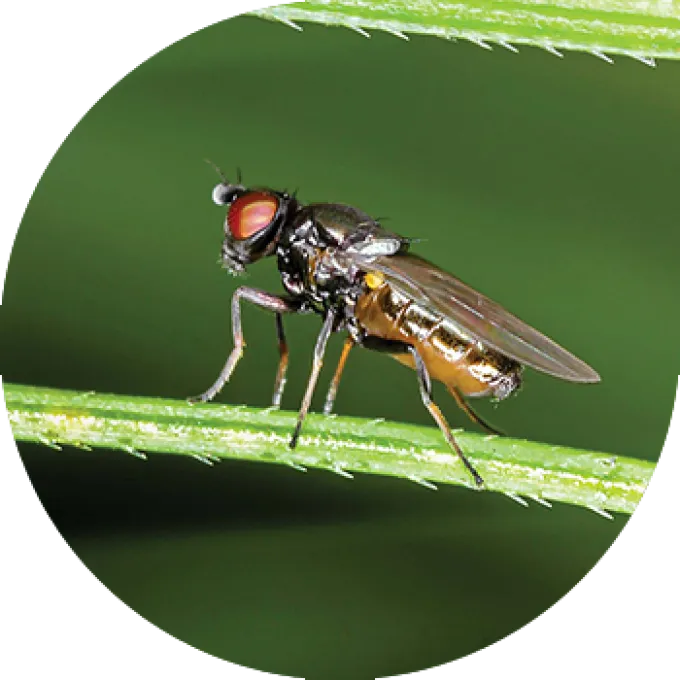
The oat gout fly (Oscinella angularis) belongs to the Chloropidae family, commonly known as frit flies or grass flies. It is a small insect, typically measuring 1.5–2 mm in length with a glossy black body.
The larvae are cylindrical and legless, reaching 3-4 mm in size, and range in color from white to translucent yellow. They develop hidden inside the plant tissues.
The life cycle encompasses four stages: egg, larva, pupa, and adult. Multiple generations can occur during a single growing season, allowing the population to increase rapidly.
Adult flies are highly mobile and attracted to young, lush vegetation where they lay eggs on the leaves or stems of cereal crops.
Pupation occurs within the stems of the host plant, often inside the hollowed-out parts created by the larva during its feeding process.
What it damages
The primary hosts of this pest include oats, barley, wheat, and rye. Larvae target the growing point of the plant, causing severe physiological disruption.
By feeding on the central stem, the larvae cause the central leaf to wither and turn yellow, a phenomenon commonly known as "heart rot."
Damage during the early tillering phase can result in the death of the main shoot, significantly reducing the density and uniformity of the crop stand.
If the damage occurs later in the plant's development, it leads to stunted growth, reduced ear size, or empty grains, which directly lowers the final yield.
In cases of high infestation, the pest can cause significant economic losses, impacting both the quantity and quality of the grain harvest.
When it appears
The emergence of the overwintered generation coincides with the early vegetative growth of spring cereals when temperatures exceed 10-12 degrees Celsius.
The peak flight period usually occurs during the tillering stage, which is the most critical time for crop susceptibility to larval damage.
Subsequent generations follow throughout the summer, often moving between different cereal crops and grassy weeds depending on their physiological maturity.
In autumn, the pest migrates to emerging winter crops, where larvae continue to feed until the onset of lower temperatures, preparing for winter diapause.
Favorable weather conditions, such as moderate temperatures and high humidity, significantly accelerate the development of the larvae and increase survival rates.
Signs of infestation
The most distinctive sign is the yellowing and wilting of the central leaf of the plant, which can be easily pulled out with slight pressure.
Affected plants often show stunted growth and an abnormal tillering response as the plant attempts to compensate for the loss of the main shoot.
- Yellowing of the central shoot leaf
- Significant decrease in plant stand density
- Stunted development of the ear
- Visible larval galleries inside the stem
- Presence of pupae within the leaf sheaths
Detailed examination of the stem base often reveals the presence of larvae or their excrement, which confirms an active infestation of the crop.
Monitoring the fields during the early spring phase is essential for identifying the presence of the fly before extensive damage occurs across the area.
Control measures
Cultural practices, such as choosing optimal sowing dates to avoid the peak flight of the fly, are the most effective preventive measures.
Deep plowing in the autumn helps to bury crop residues, effectively destroying the pupae and reducing the potential population of the following year.
Seed treatment with systemic insecticides provides robust protection to the young plants during the sensitive seedling establishment phase.
In-season chemical control with contact or systemic insecticides should be applied when field observations indicate the pest population exceeds the economic threshold.
Controlling grassy weeds in and around fields is crucial, as these plants serve as alternative hosts and reservoirs for the fly throughout the season.
Taxonomy
- Latin name
- Oscinella angularis
- Order
- Diptera (flies)
- Family
- Chloropidae
- EPPO code
- OSCIAN
Discussion
No discussions yet — be the first.