
Ornithacris turbida
Ornithacris turbida
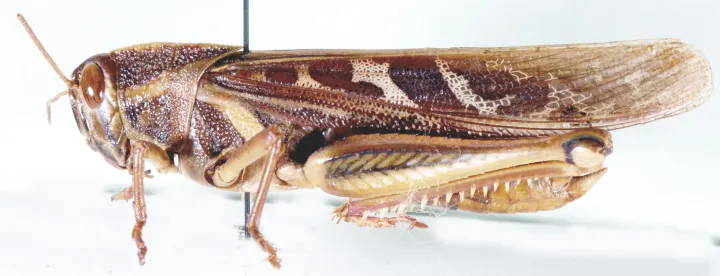
Description
How to identify
Ornithacris turbida belongs to the order Orthoptera and the family Acrididae. This species is a large insect, typical of locusts that are capable of forming dense swarms under favorable conditions.
Adults are characterized by strong hind legs, which enable them to jump efficiently. Their coloration usually ranges from olive to brown, providing excellent camouflage against dry soil and withered vegetation.
The insect possesses a robust biting mouthpart adapted for consuming tough plant matter. Well-developed wings allow for long-distance flights, making this species highly mobile and capable of colonizing new areas rapidly.
Nymphs resemble smaller, wingless versions of the adults. As they pass through several developmental stages (instars), they grow in size and gradually develop wing pads, becoming more destructive with each stage.
The biology of Ornithacris turbida is closely tied to arid and semi-arid environments, where they are adapted to thrive despite fluctuating moisture levels and harsh temperatures.
What it damages
This species is a generalist feeder (polyphagous), capable of causing significant damage to a wide array of agricultural crops. Major host plants include cereals such as maize, sorghum, millet, and wheat.
Besides grains, the pest frequently attacks industrial crops like cotton and various legumes. This makes it a significant threat to food security in regions where subsistence and commercial farming overlap.
Pastures and rangelands also suffer heavy damage as locusts graze on grasses, leading to a critical shortage of fodder for livestock. This can have devastating economic impacts on local agricultural communities.
The nature of the damage involves the complete defoliation of plants, including the consumption of stems and flowers. If the population density is high, the entire crop may be destroyed in a matter of days.
Direct economic losses are compounded by the costs of remediation and the inability to replant effectively during the remainder of the growing season due to soil moisture conditions.
When it appears
The life cycle is strictly regulated by rainfall patterns. Increased precipitation often triggers the hatching of eggs, which have been lying dormant in the soil during the dry season.
Eggs are deposited in protective pods (oothecae) buried within the soil. These pods keep the eggs viable for long durations, allowing the population to survive extreme heat and drought until conditions become suitable.
Mass hatching occurs shortly after the rainy season begins. The nymphs start feeding immediately, and their development rate is heavily dependent on ambient temperatures and the availability of fresh green food.
The adult phase typically coincides with the peak of the crop growing season. This is the most dangerous period, as adult locusts are highly mobile and can migrate across vast distances to find food.
Depending on the climatic zone, the species can complete one or more generations within a single year, significantly increasing the risk of explosive population growth.
Signs of infestation
The most prominent sign of an infestation is the presence of heavily skeletonized leaves. Because of their powerful mandibles, these insects often consume the entire leaf lamina, leaving only the primary veins.
Dense clusters of insects visible on field margins are a clear indicator of a burgeoning swarm. At high densities, the sound of thousands of insects feeding or flying becomes easily detectable.
Fecal pellets (frass) scattered on the soil surface beneath the crops indicate intense feeding activity. In the case of nymphs, one can often see them moving in groups or "bands" that sweep across the field.
Damaged stems often show signs of mechanical tearing or girdling. In severe cases, the structural integrity of the plant is compromised, causing it to lodge or die prematurely.
Regular monitoring of field borders and non-crop vegetation helps identify the early buildup of populations before the insects reach the stage of winged migration.
Control measures
Chemical control using broad-spectrum insecticides is currently the most common method to manage locust outbreaks. Treatments are most effective when applied during the nymphal stages before the insects develop wings.
Proactive monitoring using pheromone traps and field inspections is essential for detecting the emergence of hopper bands. Early detection allows for localized applications, which are more cost-effective and environmentally friendly.
Cultural practices, such as deep tillage of soil, help destroy the egg pods buried near the surface. This method is effective in disrupting the life cycle and reducing the density of the next generation.
Biological control, particularly the use of entomopathogenic fungi like Metarhizium anisopliae, is gaining traction as a sustainable and target-specific alternative to conventional chemical pesticides.
Regional cooperation between farmers and agricultural agencies is vital to coordinate large-scale control operations and prevent local infestations from escalating into uncontrollable regional swarms.
Taxonomy
- Latin name
- Ornithacris turbida
- Order
- Orthoptera (locusts)
- Family
- Acrididae
- EPPO code
- ORNATD
Discussion
No discussions yet — be the first.