
Domestic checkered beetle
Opilo domesticus
Description
How to identify
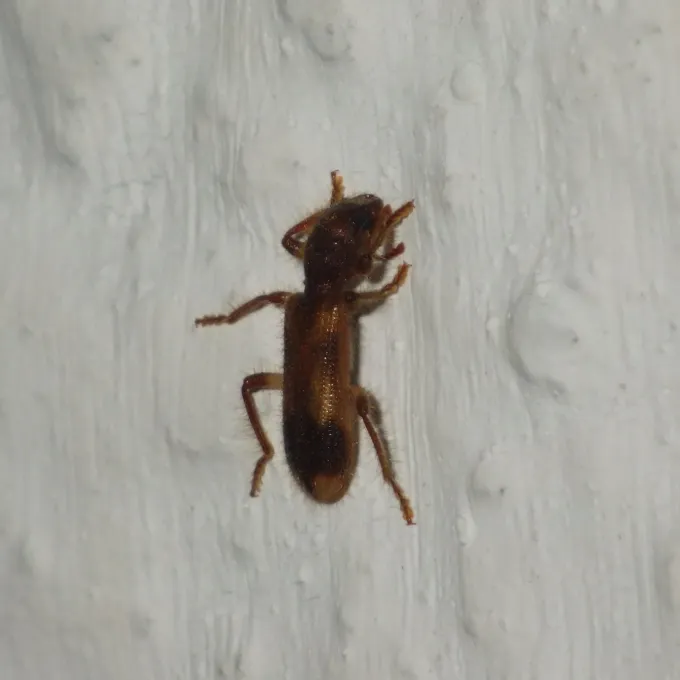
The domestic checkered beetle (Opilo domesticus) belongs to the Cleridae family within the order Coleoptera. Adult beetles typically range from 6 to 10 mm in length.
The body is covered in fine, light-colored hairs, giving it a somewhat matte or fuzzy appearance. The coloration is generally reddish-brown, often featuring pale, transverse bands on the elytra.
Larvae are white, well-developed, and possess robust mouthparts designed for chewing through dense organic materials like wood, where they spend most of their life cycle.
This beetle is known for its ability to thrive in indoor environments, occupying houses, warehouses, and wooden buildings where they remain hidden from plain sight.
The biological nature of this species is quite secretive, making it a challenging pest to manage effectively without professional diagnostic tools.
What it damages
While often acting as a predator of other wood-boring insects, Opilo domesticus is considered a pest because it contributes significantly to the degradation of structural timber.
It prefers coniferous and deciduous wood found in building frames, furniture, and various wooden interior elements, causing physical damage through its burrowing activity.
The damage manifests as a network of internal tunnels that compromise the mechanical integrity of structural beams and high-value antique wooden objects.
In warehouses, the presence of these beetles can lead to damage in wooden crates and packaged goods containing organic material, leading to significant economic losses.
The cumulative effect of their boring activity over several years can weaken critical structural supports, posing long-term risks to building safety.
When it appears
Development is highly dependent on environmental conditions, and in climate-controlled indoor spaces, the beetle can remain active and reproduce throughout the year.
In unheated environments, adult beetles typically emerge during the warmer spring and summer months, which is the most active phase of their annual cycle.
The life cycle is quite prolonged, often taking between one and three years depending on the availability of nutrients and the stability of ambient temperatures.
Larvae are the primary stage involved in overwintering, residing deep within the wood where the material provides protection against cold and external fluctuations.
Visual identification of adults is most common during their emergence period, as they move across surfaces to locate mates and initiate the next reproductive cycle.
Signs of infestation
The primary indicators of an infestation are small, circular exit holes, approximately 2 mm in diameter, found on the surface of wood or wooden items.
Frass (a mixture of fine wood dust and excrement) accumulating beneath or near wooden structures is a hallmark sign of ongoing larval activity.
In quiet indoor environments, one might occasionally hear subtle ticking or clicking sounds produced by the beetles during their mating or tunnel-clearing processes.
Internal damage is often extensive before any surface signs appear, revealing complex tunnel systems filled with wood debris once the timber is opened.
A soft or spongy texture in wood upon physical inspection often suggests severe internal tunnelling and a long-standing infestation that requires immediate attention.
Control measures
Effective management begins with moisture control, as maintaining low relative humidity is critical in preventing the proliferation of these wood-boring insects.
Chemical control involving the application of deep-penetrating insecticides and preservatives is necessary to eliminate larvae residing deep within the wood structure.
In cases of severe structural degradation, damaged sections of timber must be removed and replaced with properly treated or resistant wood materials.
- Regular inspection of structural timbers and old furniture.
- Maintenance of indoor humidity levels below 60%.
- Professional fumigation for extensive or deep-seated infestations.
- Use of borate-based wood preservatives during construction.
- Sealing surface cracks to limit sites for egg-laying.
Prevention relies heavily on sourcing well-seasoned, high-quality timber and ensuring that all wooden materials are properly protected with finishings and sealants.
Taxonomy
- Latin name
- Opilo domesticus
- Order
- Coleoptera (beetles)
- Family
- Cleridae
- EPPO code
- OPIODO
Discussion
No discussions yet — be the first.