
Clerid beetle
Opilo
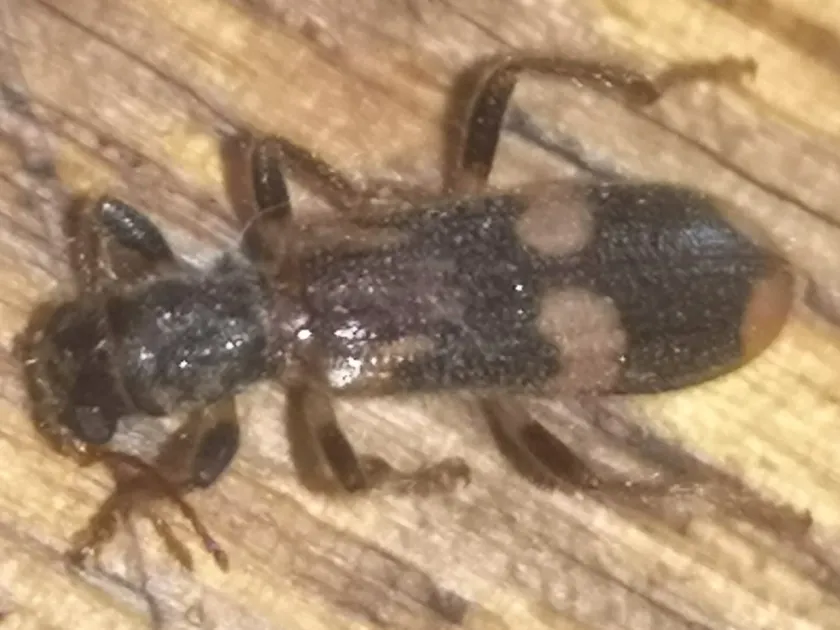
Description
How to identify
The genus Opilo belongs to the Cleridae family, commonly known as checkered beetles. These are small insects, typically measuring between 6 and 12 mm in length, often displaying striking black, red, or yellow patterns on their bodies.
They possess robust mandibles adapted for gnawing through wood and bark. Their bodies are frequently covered in dense, conspicuous hairs, which is a hallmark feature of the family Cleridae.
These insects belong to the order Coleoptera. While many members of this family are recognized as beneficial predators of wood-boring insects, species within the Opilo genus can act as secondary pests that further degrade stressed or dying timber.
The larvae are mobile and elongated, well-adapted for navigating the tunnels beneath the bark of host trees. Their movement is essential for finding suitable nutrition within the host material.
Identification often requires careful inspection of the bark and sub-cortical layers where these beetles establish their galleries during the developmental stages.
What it damages
Opilo species are known to infest weakened or stressed trees, primarily targeting the bark and cambium layers. This activity disrupts nutrient transport and leaves the tree vulnerable to secondary pathogens.
They can affect a wide range of host plants, including conifers like pine and spruce, as well as deciduous species such as oak and beech, especially when these trees have reduced vitality.
By creating networks of tunnels under the bark, they provide entry points for fungi, bacteria, and other wood-rotting organisms that ultimately accelerate the decline of the host tree.
Although they often act as secondary attackers, high densities of these beetles can significantly shorten the lifespan of an already stressed tree in the forest or garden.
Visible damage is often concentrated in the phloem and cambium regions, which are the most critical parts for the tree’s overall health and physiological function.
When it appears
Adult activity typically peaks during the late spring and summer months, coinciding with warmer temperatures that favor insect flight and reproduction.
The insects are most active when ambient temperatures remain consistently high, which accelerates their mating and colonization processes on suitable host trees.
The life cycle can vary based on regional climate, but it often spans one year or more, depending on the availability of food and environmental conditions.
Larvae usually overwinter under the bark, where they are protected from extreme cold, allowing them to resume development as temperatures rise in the spring.
Successful management strategies are usually focused on the period just before and during the initial phase of the adult beetle's emergence season.
Signs of infestation
The most common sign of infestation is the presence of fine sawdust or "frass" at the base of the trunk or caught in bark crevices, created by the beetles' feeding activity.
Careful observation of the bark surface reveals small, round exit or entry holes, indicating that the tree has been colonized by wood-boring insects.
The bark may appear loose, discolored, or show signs of sap flow in coniferous species, which is a defensive reaction to the tunneling damage beneath.
- Small, circular entrance holes in the trunk.
- Accumulation of wood dust at the base of the tree.
- Bark detachment or cracking in localized areas.
- Foliage yellowing or thinning in the upper crown.
- Increased bird activity pecking at the trunk bark.
These indicators should prompt an immediate evaluation of the tree's overall structural integrity and health status to prevent further spread of the pest.
Control measures
The primary control measure is strict sanitation, which involves the removal and destruction of dead, dying, or wind-thrown trees that act as breeding grounds.
Maintaining high tree vigor through proper irrigation, fertilization, and site management is the most effective preventative strategy against Opilo colonization.
When infestation is detected, systemic or contact-based insecticides can be applied to the bark during the adult beetle emergence period to reduce the population.
Using pheromone-based monitoring tools helps detect the presence of beetles early, allowing for timely intervention before the infestation becomes widespread.
Biological control methods, such as protecting native woodpeckers and other natural predators, play a significant role in keeping beetle populations at sub-economic levels.
Taxonomy
- Latin name
- Opilo
- Order
- Coleoptera (beetles)
- Family
- Cleridae
- EPPO code
- OPIOSP
Discussion
No discussions yet — be the first.