
Red-bellied grasshopper
Omocestus haemorrhoidalis
Description
How to identify
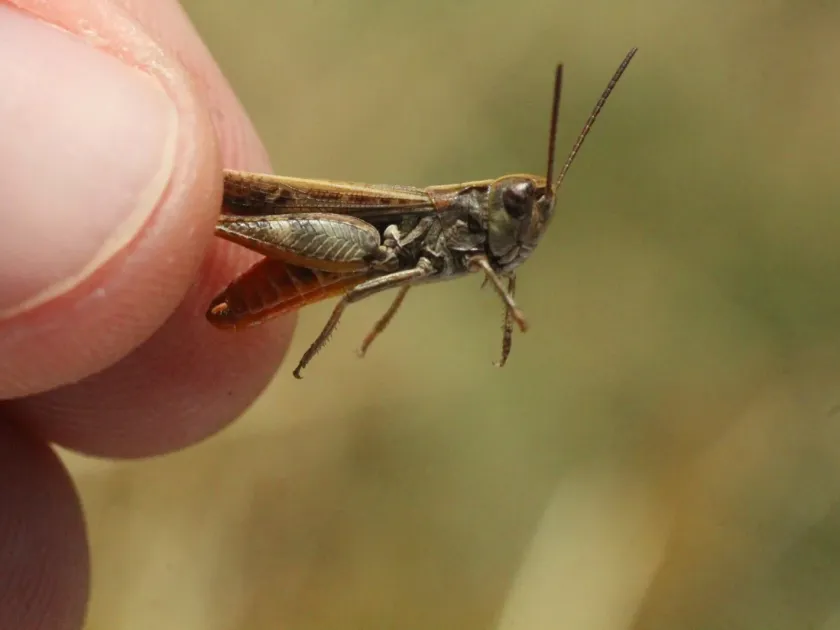
The Red-bellied grasshopper (Latin: Omocestus haemorrhoidalis) is a member of the Acrididae family within the Orthoptera order. Adult insects typically reach a length of 13–20 mm, exhibiting coloration that ranges from greenish to brownish-grey, which provides excellent camouflage within the grass.
A distinctive feature of this species is the reddish or orange hue often found on the underside of the abdomen, which serves as a key identifying characteristic. The pronotum features prominent lateral keels that diverge posteriorly, creating a clear, recognizable pattern.
The wings of the adults are well-developed and extend beyond the abdomen, allowing for high mobility and efficient relocation when seeking new feeding grounds. Females are generally larger than males and possess a robust ovipositor for depositing egg pods into the soil.
In their natural habitat, they prefer open, arid areas such as pristine steppes, dry meadows, forest edges, and abandoned agricultural land. They are diurnal insects, showing peak activity during sunny and warm weather conditions.
Their life cycle involves incomplete metamorphosis, where nymphs go through five stages, gradually increasing in size and developing morphological features, though they lack functional wings in the early stages.
What it damages
This species is a significant pest that affects a wide range of cereal crops, including wheat, rye, barley, oats, and millet. Additionally, it causes severe damage to natural pastures and hayfields, where they feed voraciously on essential forage grasses.
The economic impact occurs during both the nymphal and adult stages. During periods of massive population outbreaks, the Red-bellied grasshopper can consume up to 30–50% of green biomass, leading to a substantial decrease in crop yield.
These insects prefer the tender, succulent tissues of young shoots, but when population densities are high, they also consume tougher plant structures. This causes general plant weakness, making crops more susceptible to secondary diseases and pathogens.
In pastures, overpopulation leads to the degradation of the grassland, as the grasshoppers selectively feed on high-quality forage, leaving behind weeds that are unpalatable or nutritionally inferior for livestock.
Particularly dangerous are the breeding clusters located near crop fields, as grasshoppers migrate to cultivated areas during hot summer days, creating focal points of total defoliation and ear damage.
When it appears
The Red-bellied grasshopper completes one generation per year. Winter is spent in the egg stage, with females depositing their eggs into protective soil capsules, known as egg pods, at a depth of 1–3 cm within the topsoil layer.
Nymphs emerge in the spring as soil temperatures rise to 15–20 degrees Celsius, often coinciding with the tillering stage of cereal crops. The development of nymphs typically lasts about 30–40 days.
Adults (imagos) appear in mid-summer, usually during June or July, depending on the climatic zone. The peak of their population density and subsequent crop damage usually occurs in the second half of the summer season.
Mating and egg-laying take place during late summer and early autumn. Optimal conditions for reproduction include hot and dry weather, which enhances nymph survival rates and accelerates the overall development cycle.
Adults perish in the autumn after completing their reproductive cycle, leaving the egg pods in the soil until the following spring, making strategic soil tillage a crucial part of the pest management strategy.
Signs of infestation
The primary sign of an infestation is the presence of characteristic "ragged" edges on the leaves of cereal crops. Damage typically begins at the edges of the leaf blade and progresses toward the central vein, giving the foliage a shredded appearance.
At high population densities, the presence of jumping insects becomes immediately obvious when walking through a field. Shaking the stems will cause a noticeable flight of grasshoppers, which serves as a clear warning sign to initiate control measures.
During early growth stages, nymphs can be spotted within the lower canopy of the field. While less conspicuous than adults, their presence is betrayed by the visible thinning and depletion of the seedlings.
Another indirect sign is the presence of dry patches in the field where the vegetation appears heavily grazed or thinned. Upon close inspection, insect excrement may be found near these damaged areas.
- Presence of ragged leaf edges on cereal plants.
- Mass flight of grasshoppers when entering the field.
- Discovery of egg pods during autumn plowing.
- Appearance of bare patches in otherwise dense stands.
Control measures
The main agricultural control method is deep autumn plowing with soil inversion. This destroys the egg pods and exposes them to the surface, where they succumb to freezing temperatures and predation by birds.
Regular monitoring of pest populations in reservoir areas—such as wasteland, road verges, and uncultivated fields—is essential. If outbreaks are detected, localized insecticide treatment is recommended.
Chemical protection is justified when the economic injury level is exceeded. Contact-stomach insecticides from the pyrethroid, organophosphate, or neonicotinoid groups are generally effective and used according to local crop regulations.
Biological controls involve fostering conditions that support natural enemies, such as predatory beetles, tachinid flies, and certain parasitoid wasps, which can naturally regulate grasshopper population growth.
Timely mowing of grasses on territory adjacent to crop fields before the egg-laying period also significantly reduces the local grasshopper population by destroying their breeding and foraging sites.
Taxonomy
- Latin name
- Omocestus haemorrhoidalis
- Order
- Orthoptera (locusts)
- Family
- Acrididae
- EPPO code
- OMOCHA
Discussion
No discussions yet — be the first.