
Webspinners
Oligotoma
Description
How to identify
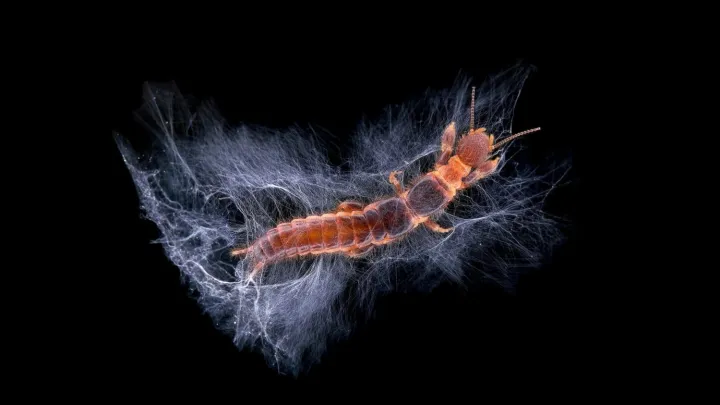
Webspinners (order Embioptera, family Oligotomidae) are a poorly studied group of insects characterized by an elongated body and distinct sexual dimorphism. Males are often winged and capable of flight, while females are always wingless and resemble larvae.
A unique feature of this family is the presence of specialized silk-spinning glands located on their front legs. These glands allow the insects to weave strong silken tunnels, which serve as protection from predators and adverse environmental conditions.
Adults typically range from 5 to 20 millimeters in length. Their coloration varies from light brown to nearly black, providing effective camouflage among organic debris and woody plant structures.
Systematically, the genus Oligotoma belongs to the Embioptera order, possessing chewing mouthparts. From an agronomic perspective, they are notable as specific inhabitants of organic substrates.
Their reproduction is characterized by maternal care: the female guards her egg clutch and offspring within the silken nest for a certain period, which significantly increases larval survival rates in natural settings.
What it damages
Webspinners primarily feed on decaying plant matter, lichens, and fungal mycelium. However, in cases of high population density or lack of natural food sources, they may damage living plant tissues.
Ornamental crops, vineyards, and citrus trees are the most susceptible to webspinner activity. The pests may gnaw on the bark of young saplings, leading to the disruption of sap flow and overall weakening of the plant.
In greenhouse conditions or nurseries, webspinners can damage the root collars of seedlings, causing wilting and death. Their silken tunnels pose an additional risk by blocking air access to plant tissues.
The presence of these insects often triggers secondary infections, as their silken galleries accumulate pathogenic fungi and bacteria, which facilitate rot in the damaged plant tissues.
The economic impact on commercial crops involves not only direct tissue consumption but also the degradation of fruit and shoot quality, rendering them unmarketable due to the tunnels and excrement left behind.
When it appears
The development cycle of webspinners is closely tied to humidity and ambient temperature. Peak activity is typically observed during warm and humid periods of the year.
In regions with mild climates, webspinners can remain active for most of the year, with population spikes often occurring during the spring and summer, coinciding with active plant growth.
They usually overwinter as larvae or adults, hiding deep within their silken galleries under tree bark, wall crevices, or layers of leaf litter, where a stable microclimate is maintained.
The temperature optimum for the development of most Oligotoma species ranges from 20 to 28 degrees Celsius, provided there is high relative humidity.
The life cycle includes the egg stage, several larval (nymph) molts, and the adult stage. The duration of a single generation can take several months depending on external environmental factors.
Signs of infestation
The primary sign of a webspinner infestation is the presence of characteristic silken tubes covering tree trunks, branches, or the soil surface around the base of plants.
When inspecting the bark, one may notice accumulations of small light-colored scales and insect frass, which gather in branch junctions or bark fissures.
In the early stages of infestation, plants may show signs of stress, such as yellowing foliage and premature fruit drop without any apparent external cause.
Upon closer examination, one can find the insects themselves beneath the silk webbing; they are known for their ability to run rapidly backward when disturbed.
Damage to the bark appears as superficial ulcers or small gnawed patches that may eventually merge to form large wounds, creating entry points for secondary pathogens and diseases.
Control measures
Effective protection against webspinners is based on rigorous sanitary measures. It is essential to remove old bark, clear areas of plant debris, and dispose of leaf litter where these insects establish their colonies.
Regular pruning and ensuring proper ventilation in plantations help lower humidity, making the environment less favorable for webspinner habitation.
In the event of a mass outbreak, the use of contact insecticides aimed at adult populations is advisable, provided the application is targeted at their known nesting sites.
Biological control methods may include the use of preparations based on entomopathogenic fungi, which are capable of infecting insects within their protective silken galleries.
- Regular removal of dead bark from tree trunks.
- Maintaining optimal soil moisture levels.
- Clearing weeds and organic debris from around the base of trees.
- Application of insecticides when necessary.
Taxonomy
- Latin name
- Oligotoma
- Family
- Oligotomidae
- EPPO code
- OLGTSP
Discussion
No discussions yet — be the first.