
Embioptera
Haploembia
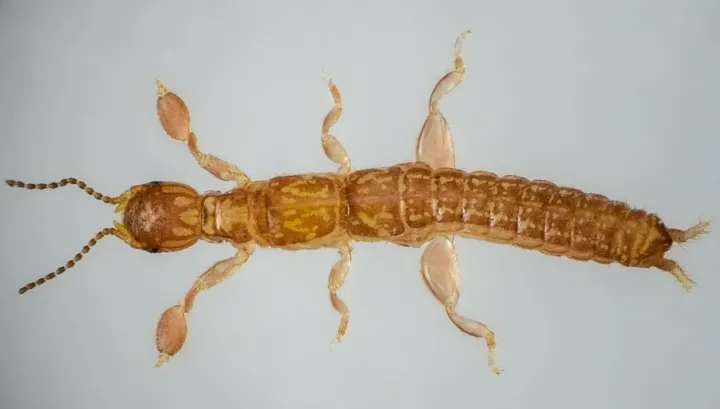
Description
How to identify
Embioptera, commonly known as webspinners, belong to the family Embiidae. These insects are distinguished by the presence of silk-producing glands located on their front legs, allowing them to weave complex silken tunnels.
Adult webspinners typically measure between 10 and 15 millimeters in length. While males often possess wings, females are wingless and look remarkably similar to larvae, making visual identification challenging for non-specialists.
The most distinctive behavior of these insects is their lifestyle; they reside almost exclusively inside dense silk galleries. These nests are constructed on tree bark, under stones, or within soil crevices to provide protection from predators.
The color of these insects ranges from light yellow to dark brown. They possess strong mandibles adapted for feeding on organic debris, lichens, and occasionally the soft tissues of living plants when conditions allow.
Their reproduction is unique, as many species in the Haploembia genus are capable of parthenogenesis, a form of asexual reproduction that allows colonies to expand rapidly when environmental humidity and temperature are optimal.
What it damages
While webspinners are primarily saprophagous, feeding on decaying matter, they can cause damage to live plants when population densities reach high levels in agricultural settings.
Affected crops include fruit trees, vineyards, and various vegetables grown in greenhouses. They may chew on young bark and tender buds, which stunts the growth of the plant and leaves it vulnerable.
The primary damage is often indirect; their silk galleries cover significant portions of trunks and stems. This physical barrier can obstruct normal gas exchange and harbor secondary fungal infections that damage the plant tissue.
In greenhouses, webspinners can be particularly harmful to seedlings, burrowing into the stem or crown, which often results in the wilting and eventual death of young plants if the soil is heavily infested.
Although their economic impact is often considered minor compared to primary pests, in arid regions, the cumulative effect of these silk-spinning insects can interfere with the health and yield of an orchard.
When it appears
The life cycle of webspinners is highly dependent on climate. Activity usually begins in the spring once the soil and ambient temperatures consistently remain above 15 degrees Celsius.
Peak activity is observed during the summer months, a period when these insects expand their silk networks across trunks and foliage. This is when they are most easily spotted by gardeners and farmers.
As autumn brings cooler temperatures, webspinners retreat deeper into bark crevices or soil pockets, where they remain in a state of diapause throughout the winter until conditions improve again.
In southern regions with mild winters, webspinners may remain partially active year-round if temperatures stay moderate, allowing for the persistence of stable colonies through the off-season.
The development cycle includes several larval instars, during which the insects molt and grow, continuously enlarging their silk tunnel networks to accommodate the needs of the growing colony.
Signs of infestation
The most prominent sign of a webspinner infestation is the presence of grayish-white silken threads forming dense, maze-like galleries on the trunks of trees or near the base of plants.
Close inspection of the bark reveals clusters of these silken tunnels. If disturbed, the insects can often be seen retreating rapidly into the deeper, safer parts of their elaborate structures.
Surface scars or scrape marks on young shoots are indicators of feeding activity. These damages are frequently mistaken for other pests if the silk galleries are overlooked during the initial inspection.
Unexpected wilting in greenhouse crops, without obvious leaf damage, may point to webspinner activity occurring within the root zone or the substrate, where they construct their hidden networks.
The presence of fine, granular frass (excrement) scattered within the silk tunnels is a strong indicator of a well-established colony and high population density on the infested plant or area.
Control measures
The most effective mechanical control involves cleaning tree trunks of old, loose bark and removing visible silk nests, effectively destroying the pest's habitat and forcing them to relocate.
For greenhouse environments, soil disinfection and substrate management are critical. Reducing excessive soil moisture helps prevent the high humidity that these insects favor for colony development.
Chemical control with contact insecticides is recommended only during mass outbreaks. Timing is essential; spraying should occur when insects are active outside of their protective silk galleries.
Good agricultural hygiene is the best preventive strategy. This includes the removal of organic debris, wood piles, and discarded materials near crops, as these serve as prime nesting sites for webspinners.
- Application of systemic insecticides when necessary.
- Manual removal of silken tunnels and nests.
- Improved greenhouse ventilation to reduce humidity.
- Whitewashing tree trunks to deter nesting.
Taxonomy
- Latin name
- Haploembia
- Family
- Oligotomidae
- EPPO code
- HPLESP
Discussion
No discussions yet — be the first.