
Blue-winged grasshopper
Oedipoda germanica
Description
How to identify
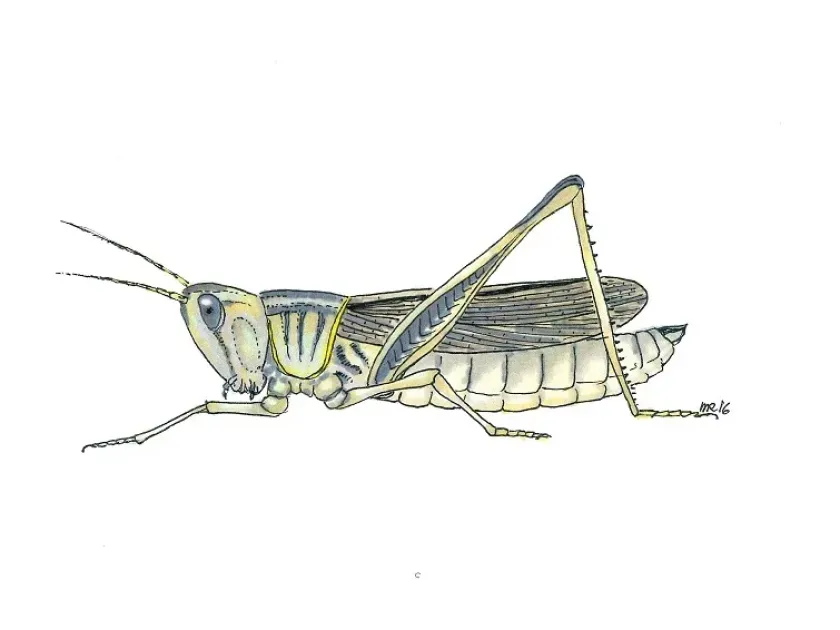
The blue-winged grasshopper (Oedipoda germanica) belongs to the order Orthoptera and the family Acrididae. It is a medium-sized insect known for its exceptional camouflage, matching the color of rocky or sandy soils.
Adults possess forewings colored in various shades of grey, brown, or reddish, making them nearly invisible when resting. In flight, they reveal bright red or orange hindwings with a distinctive black band.
The body is robust with a strong head and short, thread-like antennae. Their hind legs are highly developed for jumping, allowing them to escape danger quickly across arid environments.
Nymphs resemble smaller, wingless versions of the adults. Throughout their lifecycle, they undergo several molts, progressively increasing in size and developing wing pads.
This species prefers open, sunny habitats such as gravelly slopes, dry pastures, and uncultivated field borders where they can thrive in warm, exposed conditions.
What it damages
The blue-winged grasshopper is a generalist feeder (polyphage) capable of consuming a wide range of vegetation. In agricultural settings, it can damage cereal crops including wheat, barley, and oats.
Besides cereals, it frequently attacks legumes such as alfalfa and clover, potentially causing significant losses in forage production for livestock.
Both adults and nymphs cause damage by feeding on leaves, stems, and reproductive organs. This heavy grazing reduces the photosynthetic capacity of the plants, leading to weakened growth.
During outbreaks, this pest can devastate portions of a crop, leaving only bare stems behind and causing severe reductions in yield and forage quality.
The most significant damage usually occurs in dry seasons when natural vegetation withers, forcing the grasshoppers to migrate into irrigated or well-maintained crop fields.
When it appears
The lifecycle begins with eggs overwintering in the soil, protected within special capsules known as egg pods or oothecae.
In spring, as soil temperatures rise, nymphs emerge. This timing is closely linked to the warming of the ground and the early growth stages of surrounding plants.
The period of active growth for nymphs occurs throughout late spring and early summer. During this phase, they feed voraciously and move constantly to find fresh food sources.
Adults typically emerge by mid-summer, usually peaking in July and August. This is the period of maximum activity, mating, and subsequent egg-laying for the next generation.
Farmers should conduct regular monitoring throughout the growing season, particularly focusing on field edges and non-crop areas after mowing or dry spells.
Signs of infestation
A primary sign of infestation is the presence of ragged edges on leaves. Insects chew through the leaf tissue, often leaving only the midribs or completely stripping the plant.
When populations are high, crops may appear thinned out or stunted due to the repeated consumption of growing points and apical plant parts.
Spotting the insects themselves while walking the fields is a clear indicator, as they will jump or fly in short bursts when disturbed, revealing their distinct wing colors.
The presence of grasshopper frass (droppings) on leaves or the soil surface beneath plants confirms their recent presence, even if the insects have temporarily hidden.
Changes in field color are also indicative: damaged patches often turn brown or yellow as the injured plant tissues dry out prematurely, making these areas visible from a distance.
Control measures
Cultural control via deep plowing is the primary management tactic, as it destroys the egg pods in the soil and significantly reduces the following season's population.
Chemical control should be implemented by targeting field margins and local infestation hotspots with approved insecticides to prevent the spread of the pest across the entire crop.
Biological control involves maintaining a healthy ecosystem that supports natural predators such as birds and predatory insects, which help keep grasshopper populations in check.
Keeping fields free of weeds and maintaining good crop rotations helps reduce the overall attractiveness of the area to this pest.
- Monitor nymph populations early in the season.
- Use spot treatments of insecticides when thresholds are exceeded.
- Remove weed habitats in surrounding non-crop zones.
Taxonomy
- Latin name
- Oedipoda germanica
- Order
- Orthoptera (locusts)
- Family
- Acrididae
- EPPO code
- OEDIGE
Discussion
No discussions yet — be the first.