
Senegalese grasshopper
Oedaleus senegalensis
Description
How to identify
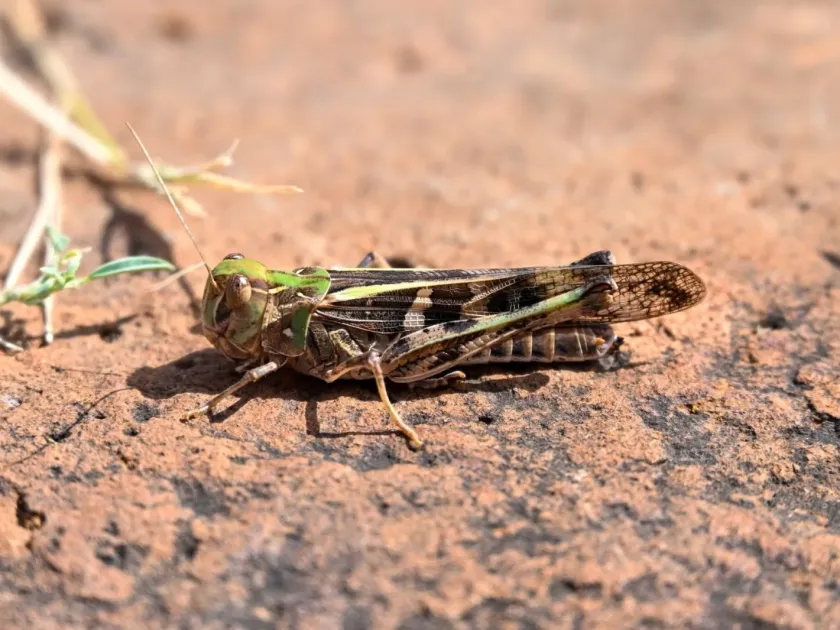
The Senegalese grasshopper (Oedaleus senegalensis) belongs to the order Orthoptera and the family Acrididae. These insects are typically 20–35 mm in length and exhibit colors ranging from gray to brown, providing excellent camouflage in dry grasslands.
A key identifying feature of the adult is a prominent cross-shaped marking on the pronotum. The hind wings are transparent with a distinct dark spot at the base, which differentiates it from many other grasshopper species.
Nymphs resemble smaller versions of adults but lack wings. Throughout their development, they undergo several molts, gradually increasing in size and changing their color patterns depending on environmental conditions.
This species is well-adapted to semi-arid regions and is known for its ability to form dense swarms when environmental conditions, such as rainfall patterns, favor rapid population growth.
The life cycle consists of the egg stage, five nymphal instars, and the winged adult stage. Adults are highly mobile and capable of long-distance flights to seek fresh vegetation.
What it damages
The Senegalese grasshopper is a significant polyphagous pest capable of devastating a wide variety of agricultural crops, including millet, sorghum, maize, rice, and wheat.
Both nymphs and adults possess strong mandibles that allow them to consume large amounts of plant biomass, causing rapid defoliation and severe stunting of crop development.
Beyond leaf consumption, these insects frequently attack the reproductive parts of plants, such as ears and panicles, which leads to substantial yield losses and potential total crop failure.
In high-density swarms, the feeding pressure is so intense that entire fields can be destroyed within days, posing a serious threat to food security in affected regions.
Furthermore, the physical damage inflicted by their feeding creates entry points for various bacterial and fungal pathogens, further weakening the stressed plants.
When it appears
The activity of the Senegalese grasshopper is closely tied to the onset of the rainy season, which triggers egg hatching and provides the necessary moisture for rapid plant growth.
Depending on local climate and rainfall availability, the species can produce multiple generations annually, with populations peaking when food resources are most abundant.
Adults are most active during the warmest parts of the day, exhibiting high levels of flight activity and feeding when temperatures are optimal for their physiological needs.
Large-scale migrations typically occur towards the end of the rainy season as pastures dry out, forcing swarms to move towards greener, more fertile agricultural lands.
Environmental fluctuations, particularly prolonged droughts, can lead to natural population declines, although the eggs can remain in diapause, surviving harsh conditions until the next rain.
Signs of infestation
The earliest signs of infestation are ragged leaf margins and holes in the foliage, which progress quickly to total defoliation as the grasshopper population density increases.
Observing the field reveals large numbers of insects moving through the canopy, often jumping or flying when disturbed by farm activity or human presence.
Large amounts of frass (excrement) covering the soil surface and plant bases are a clear indicator of a high concentration of feeding nymphs or adults.
Egg pods can sometimes be found in the top layers of soil in specific areas, which serve as a diagnostic tool for planning future intervention strategies before hatching begins.
- Ragged leaf margins and skeletal remains of leaves.
- Reduced plant stand density due to total destruction of young seedlings.
- Presence of grasshoppers on stalks during the day.
Control measures
Successful management of the Senegalese grasshopper relies on early detection through consistent scouting and the application of insecticides while the pests are still in their early nymphal stages.
Chemical control is most effective when targeted at localized breeding sites before the grasshoppers develop wings and initiate mass migration patterns across larger areas.
Agrotechnical methods, such as deep plowing of fields after harvest, help expose and destroy egg pods located in the soil, effectively reducing the population for the next season.
Biological control agents, including specific entomopathogenic fungi, offer an environmentally friendly alternative that can help suppress population levels without harsh chemicals.
Regional cooperation is essential for effective control, as the high mobility of the Senegalese grasshopper requires a synchronized effort across neighboring farms to prevent re-infestation.
Taxonomy
- Latin name
- Oedaleus senegalensis
- Order
- Orthoptera (locusts)
- Family
- Acrididae
- EPPO code
- ODALSG
Discussion
No discussions yet — be the first.