
Black-winged grasshopper
Oedaleus decorus
Description
How to identify
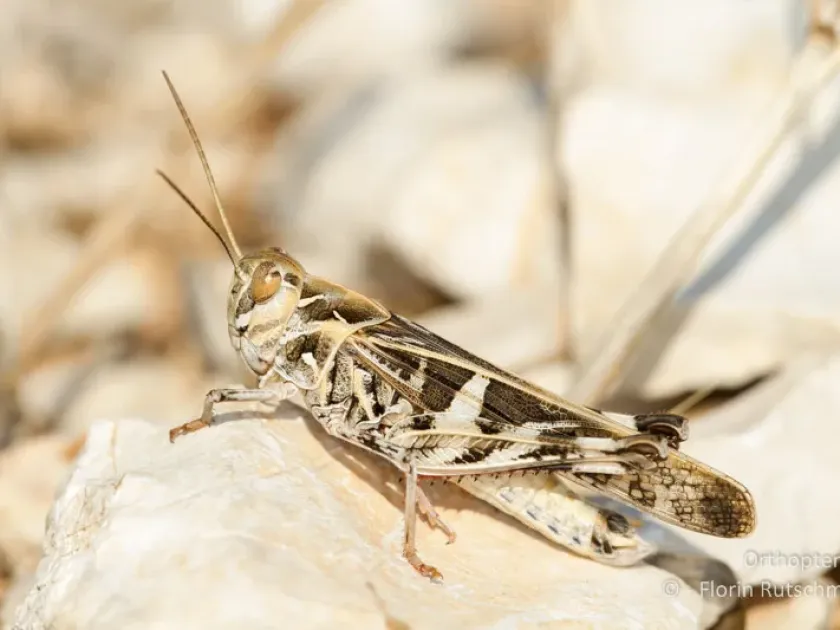
The black-winged grasshopper (Oedaleus decorus) is a member of the Acrididae family. The adult insect typically measures between 18 and 30 mm in length, with body colors ranging from pale green to brownish.
The most distinctive feature is a prominent black band located on the hind wings, which is clearly visible when the insect is in flight. Additionally, the thorax often displays a pale cross-shaped pattern.
Females are generally larger than males and possess a robust ovipositor designed for laying eggs deep into the soil. Nymphs resemble miniature versions of adults but lack functional wings.
These insects prefer dry, well-exposed, and sun-drenched habitats with sparse vegetation. They are highly active, exhibiting jumping behavior and short flights when disturbed by movement.
The life cycle encompasses three main stages: egg, nymph, and adult. In most geographical ranges, the species produces one generation per year, with the egg stage serving as the primary form for winter survival.
What it damages
As a generalist herbivore (polyphage), this species feeds on a wide array of plant species. The most significant agricultural damage is observed in cereal crops such as wheat, barley, oats, and millet.
Besides grain crops, the pest frequently attacks forage grasses, meadows, and pastures. In cases of massive population outbreaks, vegetables and industrial crops may also suffer severe foliage loss.
Both nymphs and adults feed on leaves and stems, significantly reducing the photosynthetic area of the plant. High densities of these grasshoppers can lead to complete defoliation of the crop.
Adults are capable of migrating long distances in search of better food sources, which makes localized pest outbreaks difficult to manage. Their mobility often results in rapid crop destruction across large areas.
The damage caused by feeding weakens the plants, making them more susceptible to subsequent plant diseases and environmental stress, ultimately leading to significant yield losses in both quantity and quality.
When it appears
Nymphs typically hatch from overwintered eggs in the spring, usually between April and May, depending on soil temperature. Early-stage nymphs are highly dependent on favorable thermal conditions for growth.
The nymphal development period lasts approximately 30 to 40 days. During this time, they undergo several molts, progressively increasing their consumption of plant matter as they approach maturity.
Adult grasshoppers typically emerge in mid-summer, spanning from June to July. This is the period of peak feeding and reproductive activity, marking the timeframe when the most severe damage occurs.
Females deposit their eggs into the soil in late summer and early autumn. These eggs are encased in specialized structures called pods, which protect them against the freezing temperatures of winter.
Activity gradually declines with the onset of autumn frosts. By this time, the population has ensured the next generation survives via the overwintering eggs buried in the soil.
Signs of infestation
The first signs of infestation are ragged leaf edges, where the grasshoppers have consumed tissue. On young plants, this can look like uneven notches along the leaf margins.
A reliable indicator of a high population is the sudden movement of numerous grasshoppers when walking through a field. Observing their flight, the distinct black wing band is easily identifiable.
Small, pellet-like frass (excrement) deposited on the soil or leaves is a clear sign of grasshopper presence. In areas of high concentration, plants may appear stunted or yellowed due to excessive foliage consumption.
Visual inspection in the early morning often reveals nymphs and adults resting on plant stems. During the heat of the day, they move closer to the ground or seek shade to avoid dehydration.
Rapid wilting of plant segments or patches of field indicates severe localized feeding. These patches often expand as the grasshopper population matures and shifts feeding locations.
Control measures
Cultural control is the most effective preventative strategy, with deep autumn plowing being essential. This practice exposes egg pods to the elements and predators, significantly reducing the hatching rate.
Effective weed management on field borders and non-cropped areas is critical, as these zones serve as primary reservoirs and breeding sites for the grasshopper population.
Chemical control involving insecticides is necessary if the pest population exceeds the economic injury level. Applications are most effective when targeted at early nymphal stages.
Biological control methods encourage the presence of natural predators, such as birds, beetles, and certain parasitic wasps. Minimizing non-selective pesticide use helps maintain these beneficial insect populations.
- Regular monitoring of population density using square-meter counts or sweep netting.
- Application of selective insecticides at the early nymphal stage.
- Maintaining field sanitation to minimize habitat suitability for oviposition.
Taxonomy
- Latin name
- Oedaleus decorus
- Order
- Orthoptera (locusts)
- Family
- Acrididae
- EPPO code
- ODALDE
Discussion
No discussions yet — be the first.