
Rice stink bug
Oebalus pugnax
Description
How to identify
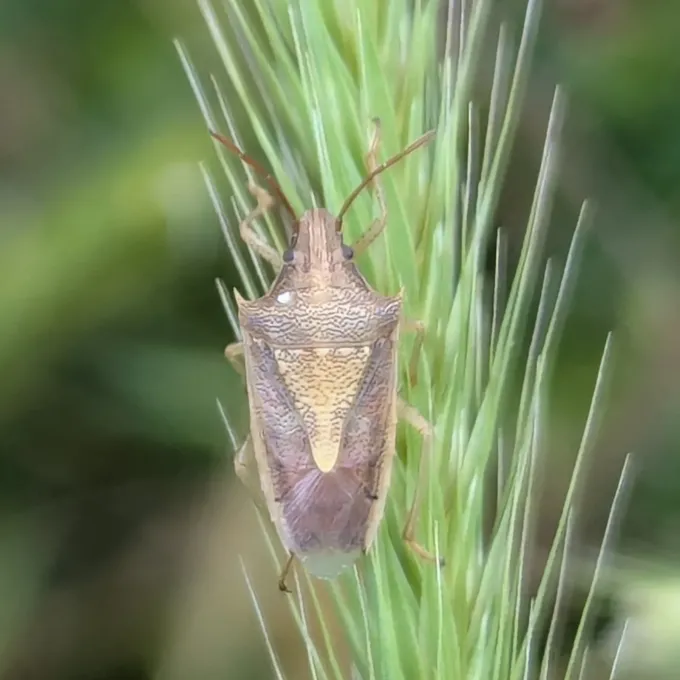
The rice stink bug (Oebalus pugnax) is a member of the Hemiptera order and the Pentatomidae family. These insects are characterized by a straw-colored, elongated, shield-shaped body that typically reaches 10 to 12 millimeters in length.
Adults are easily identifiable by the sharp, outward-pointing spines on their shoulders, known as the pronotum. They possess a needle-like proboscis, which they use to pierce plant tissues and extract nutrients from developing seeds.
The eggs are cylindrical and are typically laid in double rows on leaves or stems. They are initially a bright green color but turn darker as the embryo inside develops.
Nymphs go through five distinct growth stages (instars). As they mature, their color shifts from reddish-orange to darker tones with intricate patterns, eventually resembling the adult form but without wings.
Because they are highly mobile and tend to hide within the dense canopy of rice crops, observing them directly can be difficult without dedicated field scouting practices.
What it damages
The primary damage caused by the rice stink bug occurs during the milk and dough stages of rice grain development. The insects pierce the hull and feed on the liquid content of the grain.
This feeding activity causes the grains to become shriveled, chalky, or completely empty. The physical wounds provide entry points for pathogens, leading to "pecky rice" or stained grain kernels.
In addition to cultivated rice, the pest survives on various grasses and weeds found near irrigation ditches, which serve as alternative food sources throughout the growing season.
The economic impact is significant, as the damaged kernels are prone to breakage during the milling process, which drastically reduces the market value and processing yield of the crop.
High infestation levels can result in substantial yield losses, requiring growers to monitor fields carefully during the flowering and grain-filling periods.
When it appears
Adults overwinter in protected areas such as thick leaf litter, tall grasses, or debris found along the edges of fields and along the banks of irrigation systems.
As temperatures rise in the spring, the overwintered adults emerge and migrate toward early-maturing host grasses before eventually moving into rice fields.
The pest completes multiple generations per year. The most critical timeframe for damage is during the reproductive stages of the rice plant, usually spanning from mid-summer to early autumn.
Warm and humid weather conditions are ideal for the rapid development of nymphs, often leading to population surges if environmental conditions remain favorable.
Once the rice harvest is completed, the remaining population moves back into wild host plants, where they feed until temperatures drop, signaling the start of the winter dormancy period.
Signs of infestation
The most reliable sign of a rice stink bug infestation is the presence of discolored, dark spots on the grain kernels, commonly referred to as "pecky rice."
Crop symptoms include empty or partially filled panicles that stand out against the healthy, greener portions of the field, often appearing bleached or dried out.
Scouting by using a sweep net is the standard method for detection; swinging the net through the canopy reveals the presence and density of the bug population.
Early in the morning, when the insects are less active, farmers can sometimes spot them clustering on the stems or at the base of the panicles.
In cases of extremely high infestations, a foul, pungent odor may be noticeable in the field, which is a defensive chemical released by the bugs when disturbed.
Control measures
Effective management begins with strict sanitation, specifically removing weeds and tall grasses along field margins and irrigation canals to eliminate overwintering sites.
Adjusting the planting schedule to ensure that the susceptible grain-filling stage of rice does not coincide with peak bug activity can help minimize overall crop losses.
Chemical control with insecticides is recommended when the density of insects exceeds the economic threshold, focusing on systemic or contact-based products.
Conservation of natural predators, such as egg parasitoids, is a sustainable approach to suppressing the pest population without over-relying on synthetic chemicals.
The use of pheromone traps for monitoring is increasingly popular, as it provides accurate data on pest arrival times, allowing for targeted and more efficient pesticide applications.
Taxonomy
- Latin name
- Oebalus pugnax
- Order
- Hemiptera (bugs, aphids, leafhoppers)
- Family
- Pentatomidae
- EPPO code
- OEBAPU
Discussion
No discussions yet — be the first.