
Odontotermes horai
Odontotermes horai
Description
How to identify
Odontotermes horai is a species of termite belonging to the family Termitidae, known for its complex social structure and nest-building habits.
The colony consists of distinct castes, including workers, soldiers, and reproductives, each playing a vital role in the survival of the colony.
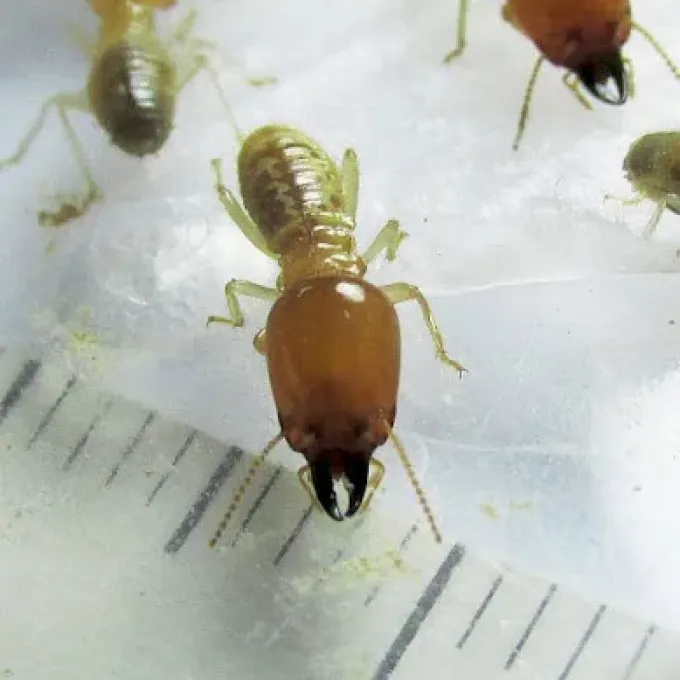
Soldiers are identified by their heavily sclerotized heads and powerful mandibles, which are used to defend the colony from predators like ants.
Workers are responsible for foraging, nest construction, and maintenance, often operating deep within the soil or inside plant tissues.
The species constructs large, earthen mounds that act as a climate-controlled environment, essential for the survival of the queen and the brood.
What it damages
This termite is a significant agricultural pest that feeds on a variety of crops, including cereals, legumes, and sugarcane.
It primarily attacks the root system and the base of the stem, often causing complete plant wilting and death within a short period.
By consuming the cellulose-rich tissues, the termites destroy the plant's ability to take up nutrients and water from the soil.
Young seedlings are particularly vulnerable, and infestations can lead to significant yield losses or the total destruction of nursery stocks.
Beyond live plants, they can also damage wooden infrastructure such as fencing, irrigation pipes, and agricultural storage facilities.
When it appears
Odontotermes horai remains active throughout the year, but feeding intensity often correlates with soil moisture levels.
The period following the rainy season is typically when foraging activity peaks, as the soil provides optimal conditions for tunnel expansion.
During extreme drought, the insects move deeper into the soil profile to access moisture, continuing their destructive behavior underground.
The swarming of winged reproductives to start new colonies usually coincides with the arrival of the first monsoon or seasonal rains.
Field monitoring should be consistent, especially during early crop establishment stages when young plants are most susceptible to attack.
Signs of infestation
The most visible indicator of infestation is the presence of mud tubes or galleries built on the surfaces of plant stems or tree trunks.
Piles of loose soil or earthen structures around the base of a plant often indicate high worker activity in the root zone.
Rapid, unexplained wilting or yellowing of plants despite adequate soil moisture is a classic sign of root damage caused by termites.
When an infested plant is removed, the roots often appear hollowed out or entirely consumed, replaced by earthen tunnels.
The discovery of subterranean nests or surface mounds near the edge of the cultivated area confirms the presence of an established colony.
Control measures
Effective management requires a combination of cultural practices, such as deep ploughing to disturb nest structures and foraging trails.
Applying compost and organic matter must be managed carefully, as decomposing plant material can attract termites to the field.
Chemical control involving soil drenching with systemic insecticides is often used to create a protective barrier around the root zone.
- Seed treatment with insecticides to protect vulnerable seedlings.
- Use of slow-acting bait stations to eliminate the queen in the colony.
- Encouraging natural predators that help regulate termite populations.
Integrated Pest Management (IPM) strategies, including biological control using specific fungi, are increasingly recommended to reduce chemical usage.
Taxonomy
- Latin name
- Odontotermes horai
- Family
- Termitidae
- EPPO code
- ODOEHO
Discussion
No discussions yet — be the first.