
Purple shield bug
Odontotarsus purpureolineatus
Description
How to identify
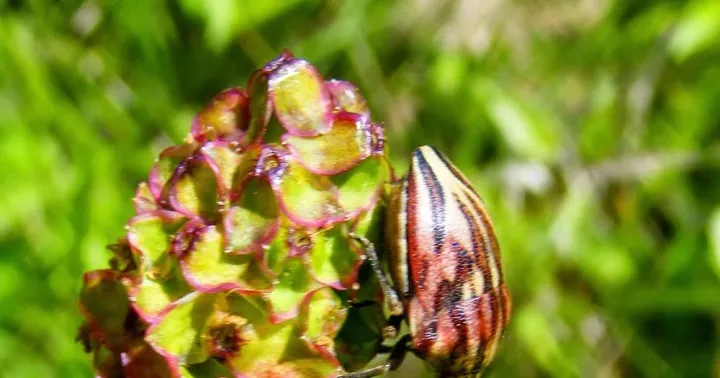
The Purple shield bug (Odontotarsus purpureolineatus) belongs to the Hemiptera order and the Scutelleridae family. It is characterized by a distinctive oval and highly convex body shape, usually measuring 8–10 mm in length.
The coloration of these bugs varies significantly, typically ranging from yellowish-grey to brown or reddish-purple, with noticeable longitudinal light stripes across the scutellum and pronotum.
The head is small and triangular, tightly pressed against the pronotum. The scutellum is exceptionally large, covering almost the entire abdomen and wing covers, which is a key identification feature for this species.
Nymphs resemble adults but are smaller in size, lack fully developed wings, and often display a lighter, yellowish-green or greyish coloration with dark spots.
Their life cycle consists of egg, five nymphal instars, and the adult stage, with nymphs gradually increasing in size and morphological resemblance to adults with each molting phase.
What it damages
The primary food sources for the Purple shield bug are wild and cultivated cereal grasses. They cause significant damage to wheat, barley, and rye crops across various geographic regions.
These bugs feed by piercing plant tissues with their proboscis to suck sap from stems, leaves, and developing ears, causing physiological stress and reducing overall crop vigor.
Damage during the early tillering phase often results in stunted growth, yellowing, and general weakness of the plants, which can eventually lead to decreased stand density and yield loss.
Infestation of ears during the grain-filling period is particularly critical, as it leads to shriveled grains, lower test weights, and poor quality of the harvested seed material.
Heavy infestations can cause localized patches of damaged crops throughout the field, necessitating active monitoring and swift pest management interventions to avoid significant yield reduction.
When it appears
Adults overwinter in sheltered locations such as dry vegetation, leaf litter, or the upper soil layers in field margins, forests, or roadside areas, showing high resilience to cold temperatures.
Emergence from hibernation occurs in the spring when air and soil temperatures stabilize, usually around April, as the bugs migrate to young cereal fields to feed and reproduce.
Mating and egg-laying typically happen in early summer. Females deposit small clusters of eggs directly onto the leaves or stems of host plants to ensure immediate access to food for hatching nymphs.
The nymphal development phase occurs throughout the summer months, aligning with the active growth stages of cereal crops, which provides the insects with abundant nutritional resources.
By autumn, the new generation of adults completes their development and migrates back to their overwintering sites to survive the dormant season, repeating the biological cycle.
Signs of infestation
The earliest signs of infestation include the presence of adult bugs on cereal plants during the spring, which can be confirmed by inspecting the undersides of leaves for egg clusters.
Typical damage symptoms appear as small, light-colored spots on stems and leaves, which are the sites of the bugs' feeding punctures; these spots may eventually turn dark as the tissue dies.
Deformation of the ear or whiteheads (empty, bleached ears) are clear indications of heavy feeding on the stem or rachis, which blocks the flow of nutrients to the developing grain.
General wilting or yellowing of the crop, despite adequate soil moisture, often points to an underlying pest issue requiring detailed field inspection to assess population levels.
Field scouting with an insect net is the most effective way to detect the presence of nymphs early, as they are otherwise difficult to spot due to their camouflage against the foliage.
Control measures
Agricultural management practices include early planting to get ahead of pest peaks, diligent weed control to remove alternative hosts, and deep autumn plowing to disrupt overwintering habitats.
Effective crop rotation is a primary defense, as it limits the availability of host plants and disrupts the reproductive cycle of the bug, making fields less attractive for colonization.
Chemical control becomes necessary when populations exceed the economic threshold. Applying authorized systemic or contact insecticides is the standard approach to suppress significant outbreaks.
It is essential to rotate between different insecticide classes to prevent the development of resistance in the bug population, ensuring that chemical interventions remain effective over multiple seasons.
Biological control, by preserving natural predators and parasitoids that target egg clusters and nymphs, can help keep pest populations below damaging levels without excessive chemical reliance.
Taxonomy
- Latin name
- Odontotarsus purpureolineatus
- Order
- Hemiptera (bugs, aphids, leafhoppers)
- Family
- Pentatomidae
- EPPO code
- ODTRPU
Discussion
No discussions yet — be the first.