
Odontoscelis bug
Odontoscelis
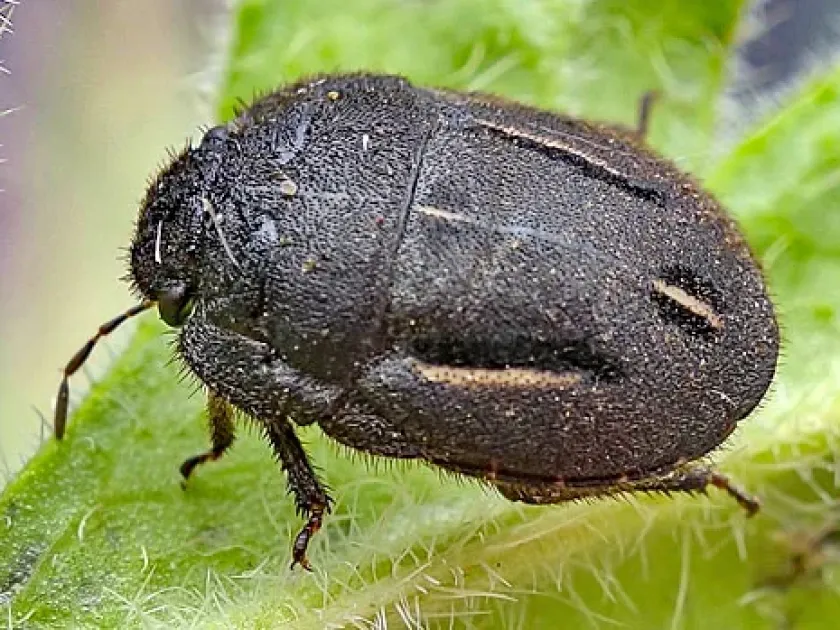
Description
How to identify
The genus Odontoscelis belongs to the family Scutelleridae (jewel bugs or shield-backed bugs). These are small insects characterized by a rounded, highly convex body shape that resembles a shield.
Adult insects typically measure between 7 and 10 mm in length. Their coloration is generally brownish, grey, or yellowish-brown, often featuring dark spots that provide excellent camouflage against soil and crop debris.
Nymphs resemble adults in shape but are significantly smaller and possess a lighter color profile. The bodies of these nymphs are often covered in fine, short hairs, which is a distinctive morphological feature of the genus.
These bugs maintain a secretive lifestyle, predominantly inhabiting the base of plants or the top layer of soil. They possess a specialized piercing-sucking mouthpart designed to feed on plant vascular systems.
While adults are capable of flight, they are more frequently observed walking along the ground. When threatened, they press themselves tightly against the soil, effectively mimicking pebbles or plant debris to avoid detection.
What it damages
The primary food sources for Odontoscelis are wild and cultivated grasses. They are known to cause economic damage to crops such as wheat, barley, and millet, particularly during the early developmental stages.
The pest targets the vegetative parts of the plant. By piercing the stems and the bases of young shoots, they extract essential plant sap, leading to stunted growth and reduced plant vigor.
In cases of high population density, the pest can cause significant seedling mortality. Such damage is particularly severe during dry spells when plants are already suffering from water stress and struggle to recover.
In addition to sap extraction, the puncture sites serve as entry points for secondary fungal and bacterial pathogens. This drastically lowers the plant's natural resistance and overall physiological health.
Severe infestations are commonly recorded in fields adjacent to uncultivated land, grassy borders, or areas with dense vegetation, which serve as primary breeding grounds for the bug population.
When it appears
Adults overwinter beneath crop residues, leaf litter, or in the topsoil of fields and hedgerows. As temperatures rise in early spring, they emerge from their hibernation sites to begin their active season.
Activity typically commences when daily mean temperatures reach 10–12°C. Initially, they feed on wild grasses before migrating to young cereal crops as they germinate and emerge.
Mating and egg-laying occur between late spring and early summer. Females lay eggs in small clusters, usually on the underside of leaves or near the base of the plant stems.
The development of nymphs progresses through several instars and lasts approximately six weeks, depending on the ambient climate. Warm and dry conditions are generally optimal for their development.
By late summer or early autumn, the new generation of adults finishes feeding and begins seeking overwintering sites, gradually entering diapause until the following spring.
Signs of infestation
The primary indicator of an Odontoscelis infestation is the presence of wilting or yellowing seedlings along the field margins. Close inspection of the stem base often reveals small puncture marks.
During the day, these bugs are difficult to spot due to their protective coloration. Detection is best achieved using a sweep net or by carefully examining the soil surface around weakened plants during early morning hours.
Infestations typically show a clustered pattern, where damaged plants appear in patches or strips along the field borders where the population density is highest.
Under heavy infestation, plants exhibit reduced height and stem deformation. Tillering is often compromised, which significantly reduces the potential yield long before the heading stage.
During dry weather, affected plants dry out rapidly. Conversely, in high humidity, the puncture sites may develop mold, making the infested areas visually distinct against the healthy crop.
Control measures
Effective management relies on a combination of agronomic and chemical practices. The most critical component is the elimination of weed reservoirs, which provide essential habitats for the pest.
Deep autumn plowing helps destroy overwintering sites, significantly reducing the pest population for the upcoming season. Crop rotation is also an effective strategy to break the lifecycle of the bug.
When economic thresholds are exceeded, targeted applications of systemic or contact insecticides are recommended. Treatments are most effective during the early nymphal stages of the pest.
Border treatments for fields adjacent to known reservoirs can effectively contain the pest population, often eliminating the need for full-field pesticide applications.
- Adhering to optimal planting dates to ensure vigorous early growth.
- Using high-quality, pre-treated seeds to protect against early pests.
- Regular monitoring of field edges during the spring season.
- Rigorous weed control in fields and surrounding headlands.
Taxonomy
- Latin name
- Odontoscelis
- Order
- Hemiptera (bugs, aphids, leafhoppers)
- Family
- Scutelleridae
- EPPO code
- ODSCSP
Discussion
No discussions yet — be the first.