
Plum lappet moth
Odonestis pruni
Description
How to identify
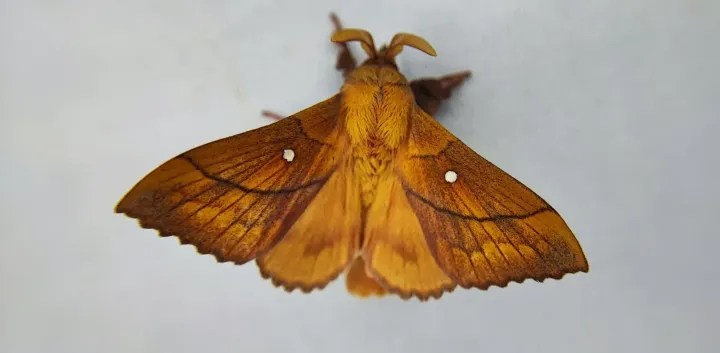
The plum lappet moth (Odonestis pruni) belongs to the Lasiocampidae family within the order Lepidoptera. The adult moth has a wingspan ranging from 45 to 70 mm, with colors typically appearing in shades of ocher-yellow to reddish-brown.
The forewings feature a distinctive small white spot in the center and dark transverse bands. When at rest, the moth adopts a "tent" position with its wings pressed against the body, mimicking a dry leaf for camouflage.
The caterpillars can reach lengths of 70-80 mm. Their bodies are covered in dense tufts of hair and feature dark, velvet-like transverse bands between segments, which are only visible when the larva is moving or disturbed.
Pupae are enclosed in dense, parchment-like, spindle-shaped cocoons. These are often attached to the branches or bark of host trees, providing excellent physical protection against predators and environmental stress.
The eggs are spherical, greyish in color, and laid by females in clusters on the undersides of leaves or twigs, tightly packed together to ensure collective survival during the early stages of development.
##damage##The plum lappet moth primarily targets stone fruit species, including plums, cherries, apricots, and peaches. While less common, they have also been observed feeding on apples, pears, and certain wild species like willow or birch.
Caterpillars feed nocturnally, causing damage to the foliage. Early-stage larvae skeletonize the leaf tissue, leaving only the veins behind, which severely impairs the plant's ability to photosynthesize and gain energy for the season.
Large infestations can lead to complete defoliation of the tree. This damage is particularly devastating during the fruit-ripening stage, often causing fruit drop, poor fruit quality, and inhibited sugar accumulation.
Repeated defoliation weakens the overall structure and vigor of the tree. Weakened trees become highly susceptible to secondary pests and various fungal infections, which can eventually lead to the tree’s death if left untreated.
Significant economic losses occur when the population is allowed to grow unchecked. In commercial orchards, if preventative measures are not taken, the reduction in crop yield can be substantial, impacting the farm's profitability.
##season##Adult moths typically emerge during the summer months, usually between June and August. In warmer southern climates, the species may produce two generations annually, whereas northern regions generally see only one.
The species overwinters as young larvae. They seek refuge in crevices within the tree bark, forks of branches, or beneath fallen leaves, remaining dormant until the return of warmer spring weather triggers their activity.
Spring activity begins as soon as the buds start to open. The caterpillars emerge from their overwintering sites to feed on the fresh, succulent spring foliage, entering a period of rapid growth.
Pupation typically occurs in early summer. Once the adult moths emerge, the breeding cycle begins, leading to the deposition of new egg clusters that will either develop into a second generation or prepare for the upcoming winter.
Population density is highly sensitive to weather patterns. Mild, humid springs favor survival rates for overwintering caterpillars, while extreme temperature fluctuations in winter can significantly reduce the population size naturally.
##signs##The most prominent sign of infestation is the presence of skeletonized leaves on the branches. Because caterpillars often feed in groups, the damage is typically localized initially, spreading as the population grows.
Observers may notice droppings (frass) accumulating on the leaves or branches below the feeding site. This is a reliable indicator of active larval feeding occurring higher up in the tree canopy.
Finding the characteristic parchment-like cocoons on branches is a definitive sign of the pest's life cycle being completed within the orchard, suggesting that adult moths will be present soon.
Adult moths are often attracted to artificial light at night. Their presence near porch lights or orchard security lighting can serve as an early warning for potential future infestations.
- Skeletonized or missing leaf tissues.
- Accumulated larval frass on foliage.
- Spindle-shaped cocoons on branches.
- Localized defoliation within the canopy.
- Presence of adult moths near light sources.
Cultural control methods include removing loose bark from trees during the winter months, which destroys the overwintering sites of the larvae and reduces the number of pests ready to emerge in the spring.
Hand-picking caterpillars and removing visible cocoons is highly effective in small gardens. Collected materials should be destroyed immediately to ensure that no individuals survive to continue their development.
Biological insecticides, specifically those containing Bacillus thuringiensis, are an effective way to target larvae. These treatments are safe for beneficial insects and predators, helping to maintain natural ecological balance.
Chemical control should be reserved for periods of high infestation levels. Pesticides should be applied when the larvae are most active, always adhering to the recommended dosage and pre-harvest intervals to ensure safety.
Monitoring the orchard using pheromone traps can help detect the emergence of adult moths. This allows farmers to time their control strategies more accurately, ensuring maximum efficacy with minimal intervention.
Taxonomy
- Latin name
- Odonestis pruni
- Order
- Lepidoptera (butterflies)
- Family
- Lasiocampidae
- EPPO code
- ODNEPR
Discussion
No discussions yet — be the first.