
Ochrilidia tibialis
Ochrilidia tibialis
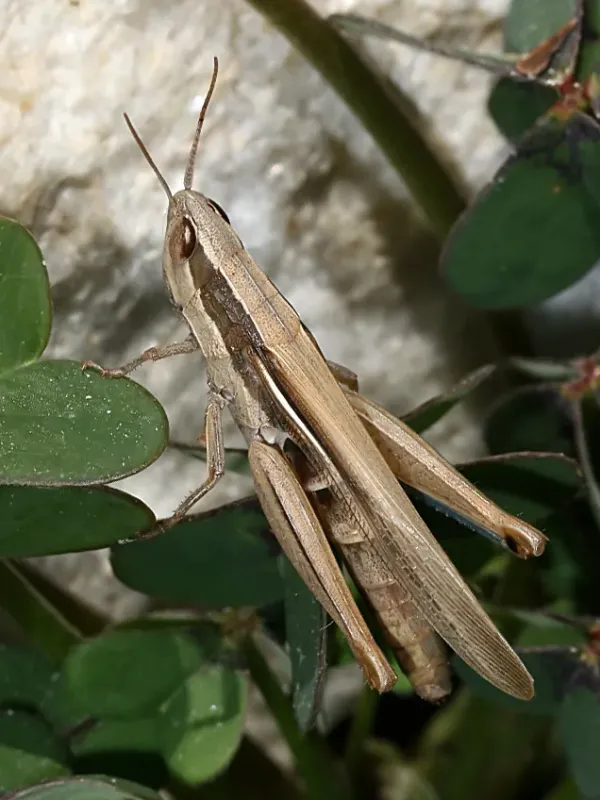
Description
How to identify
Ochrilidia tibialis is a member of the order Orthoptera and the family Acrididae. This grasshopper is characterized by an elongated body shape, evolved for rapid jumping and movement through tall vegetation.
The adult insects typically exhibit coloration ranging from light brown to yellowish-gray, providing them with excellent camouflage against the dry or senescing vegetation common in arid environments.
The head of this species is distinctly pointed, and the hind legs possess powerful femurs that allow the insect to perform long, sudden jumps, making monitoring and identification challenging.
Morphologically, the species is highly adapted to steppe, semi-desert, and agricultural landscapes where grasses form the primary food source.
Sexual dimorphism is evident in size, as females are generally larger than males, which is a common trait among many orthopteran species in this region.
What it damages
This pest primarily damages various wild and cultivated grasses. In agricultural settings, Ochrilidia tibialis can cause significant damage to wheat, barley, millet, and other cereal crops.
Both nymphs and adults feed using strong mandibles, consuming leaves and causing ragged edges or large irregular holes in the foliage.
During outbreaks, these grasshoppers can destroy substantial amounts of green plant tissue, leading to decreased photosynthetic capacity and weakened overall crop health.
Damage during the early growth stages of cereals can lead to stunted stem development, which negatively impacts ear formation and total grain yield at harvest.
If preferred food sources are scarce, these insects may move on to other plant species present within or near the field, including certain weeds.
When it appears
The life cycle of Ochrilidia tibialis is heavily influenced by regional temperature and moisture levels. The pest progresses through egg, nymph, and adult stages.
Eggs overwinter in the soil within protective clusters called egg pods, where they remain dormant until the onset of warmer spring weather.
Nymph hatching is typically synchronized with the start of the active growth period for cereal crops, ensuring immediate food availability for the emerging population.
Nymphs pass through several developmental stages, feeding intensely and growing throughout the vegetation period until they reach adulthood.
Mass emergence of adults usually occurs in the second half of summer, after which they mate and lay eggs in the soil to ensure the next generation.
Signs of infestation
The primary sign of infestation is the presence of shredded or ragged leaves on cereal plants, often with uneven edges or large missing leaf sections.
The presence of adults is easily detected by observing sudden, mass jumping of insects away from the path when a person or machine moves through the field.
In areas of high population density, one may observe patches of thinned vegetation due to the rapid consumption of foliage over a short duration.
Excrement droppings found on the leaf surfaces or the soil surface near infestation hot-spots can also serve as a diagnostic indicator of the pest's presence.
Careful inspection of the crop base and the underside of leaves during morning or evening hours allows for the detection of nymphs, which are less mobile during these cooler times.
Control measures
Effective management of Ochrilidia tibialis relies on crop rotation and the timely cultivation of fallow lands to destroy egg-laying sites.
Agrotechnical methods, such as deep autumn plowing, are crucial as they disturb the soil, exposing egg pods to freezing temperatures and desiccation.
When population levels exceed the economic threshold, the application of contact-stomach insecticides authorized for the specific crop is required.
Proactive monitoring and early detection of infestation hot-spots allow for targeted spot-spraying, reducing the need for field-wide chemical applications.
Maintaining healthy populations of natural predators, including predatory insects and insectivorous birds, is an important component of integrated pest management strategies.
Taxonomy
- Latin name
- Ochrilidia tibialis
- Order
- Orthoptera (locusts)
- Family
- Acrididae
- EPPO code
- OCRITI
Discussion
No discussions yet — be the first.