
Redfin shiner
Notropis umbratilis
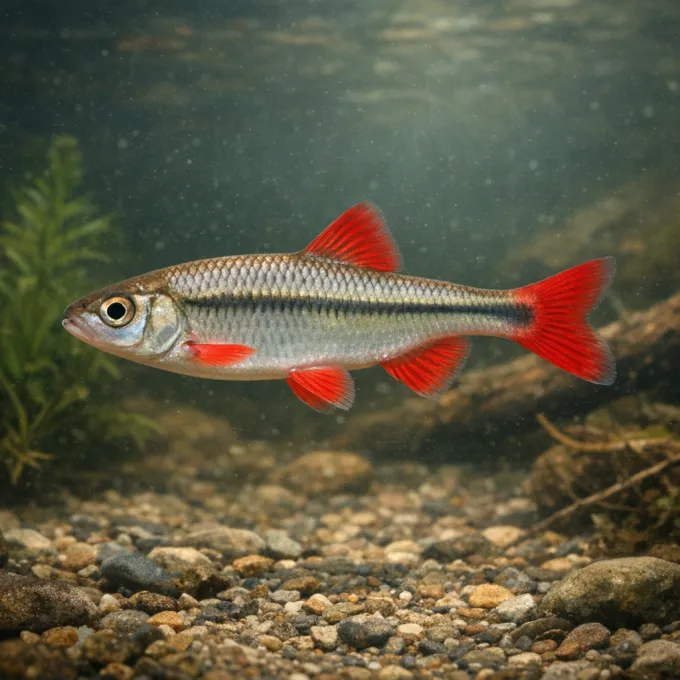
Description
How to identify
The Redfin shiner (Notropis umbratilis) is a freshwater fish belonging to the family Cyprinidae. It is a small species typically reaching 7 to 9 centimeters in length, commonly found in various water bodies.
The body is compressed laterally, with a bluish-silver coloration and olive tints on the back. During the spawning season, males develop bright red fins, which is the most prominent identifying feature of this species.
The scales are dense and shiny, with a dark longitudinal stripe along the lateral line. This dark striping becomes particularly visible against the paler belly, making the fish easy to identify during inspections.
They possess relatively large eyes, which are well-adapted for foraging in murky waters. The mouth is terminal, designed for feeding on small planktonic organisms suspended in the water column.
Redfin shiners prefer slow-moving streams, brooks, and vegetated areas. Their adaptability allows them to colonize irrigation canals and artificial water reservoirs, where they can interact with agricultural infrastructure.
What it damages
While the Redfin shiner does not cause direct damage to traditional field crops, it is considered a nuisance in aquaculture and irrigation management. Its impact is centered on the competitive displacement of valuable fish species.
In commercial ponds, they compete directly for zooplankton, which is the essential primary food source for juvenile fish of more valuable species. This competition often leads to stunted growth and lower production rates.
Within irrigation systems, large schools of Redfin shiners cause significant mechanical issues. They frequently clog fine-mesh filter screens and water intake valves, requiring frequent manual cleaning and maintenance.
The presence of this species can also increase the risk of disease transmission within a pond environment. High population densities can facilitate the spread of parasites that may negatively affect the entire fish stock.
Although they do not feed on crops directly, their negative effect on water delivery systems and aquaculture efficiency makes them a species that requires careful monitoring in controlled environments.
When it appears
The activity level of the Redfin shiner is highly temperature-dependent, with peak activity occurring during the spring and summer months when water temperatures rise above 15 degrees Celsius.
The spawning season coincides with the period of maximum growth for aquatic vegetation. During this time, the fish expand their range rapidly, often moving into new canal systems or ponds.
During the peak of summer, their metabolic rate is at its highest, leading to an increased demand for food. This is when they are most likely to infiltrate aquaculture facilities and irrigation infrastructure.
As water temperatures begin to drop in autumn, the species becomes less active. They typically migrate to deeper, more stable sections of the water body to prepare for the winter dormancy period.
Winter months are characterized by low activity. The fish form dense schools in deep areas of the water body, where their physiological processes slow down significantly until the onset of spring warmth.
Signs of infestation
One of the primary signs of their presence is the frequent surface splashing caused by schools of fish. They are gregarious and move in groups, making them noticeable in clear sections of a stream or pond.
A reduction in water clarity, often accompanied by algal blooms due to over-consumption of zooplankton, can be a biological indicator that a large population of Redfin shiners is present in a pond.
Regular accumulation of small fish against water intake screens is the most definitive sign for facility managers. If screens require cleaning daily, it indicates a high population density in the nearby water system.
The congregation of fish-eating birds around ponds or channels is often a sign of a robust prey base, frequently including the Redfin shiner, which provides food for local predators.
Using fine-mesh control nets is the best way to confirm the presence of this species. Professional assessment via sampling is necessary to determine the extent of the population and the required management intensity.
Control measures
The most effective method for controlling Redfin shiners is the installation of fine-mesh screening at all water intake points to prevent the entry of both adults and eggs into aquaculture ponds.
Regular maintenance of irrigation canals, including the removal of excess aquatic vegetation, significantly reduces suitable habitats and spawning sites, effectively curbing their population growth.
Biological control, such as stocking predatory fish like largemouth bass or perch, can help keep the Redfin shiner population in check. Predators naturally manage the numbers of smaller, invasive-like fish species.
In enclosed systems, complete drainage and sanitation of the pond bottom can be an effective, albeit radical, method to eliminate unwanted species before the new season begins.
Proper water quality management, including controlled nutrient application, ensures that the ecological balance of the water body is maintained, preventing conditions that favor the over-proliferation of these fish.
Taxonomy
- Latin name
- Notropis umbratilis
- Family
- Cyprinidae
- EPPO code
- NOTRUM
Discussion
No discussions yet — be the first.