
Emerald shiner
Notropis atherinoides
Description
How to identify
The Emerald shiner (Notropis atherinoides) is a small freshwater fish species belonging to the family Cyprinidae and the order Cypriniformes.
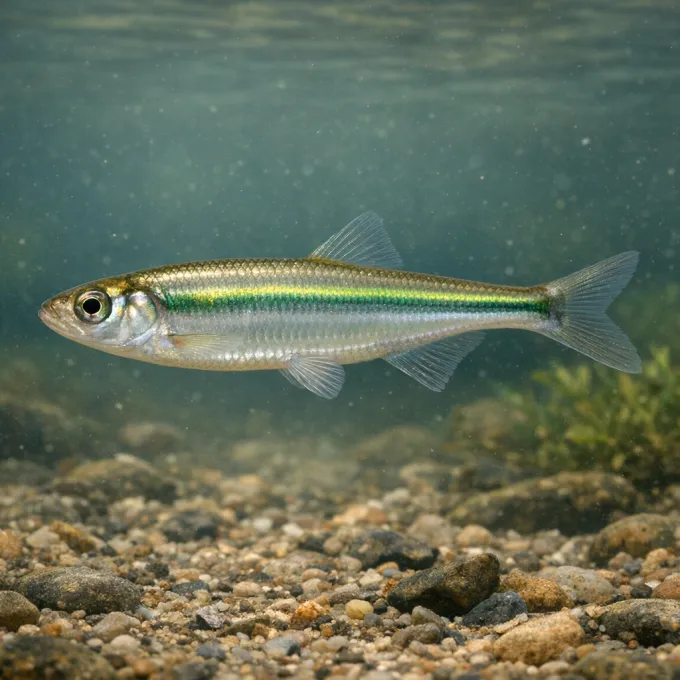
The fish is characterized by an elongated, slender body with a distinctive silvery sheen and a greenish stripe along the lateral line, resembling common shiners.
Adult specimens typically range from 6 to 9 centimeters in length, making them a common component of the forage base in North American river ecosystems.
They prefer large rivers and clear lakes with moderate currents, often schooling in the upper and middle layers of the water column.
It is crucial to clarify that the Emerald shiner is an aquatic species and does not interact with agricultural crops, making it irrelevant as a plant pest.
What it damages
The Emerald shiner causes no damage to agricultural crops, garden plants, or forestry, as it is strictly confined to aquatic environments.
Within the agricultural context, such as commercial fish farming, it is considered only as a potential competitor for food resources for the fry of valuable species.
Its diet consists primarily of zooplankton, small insects, and detritus, which has no impact on terrestrial vegetation or field crop yields.
As it does not feed on vegetation or roots, it is not classified as an agricultural pest, and there are no reports of it damaging any commercial crops.
Labels of "pest" for this species in agronomic databases are factually incorrect and represent a confusion between aquatic biology and crop protection.
When it appears
The seasonal activity of the Emerald shiner is highly dependent on water temperature and the specific biological cycle of riverine fish populations.
Spring serves as a peak activity period, coinciding with the warming of water and the onset of the spawning season for the species.
During the summer, the fish are highly mobile, actively searching for food in various parts of the river system, driven by their metabolic needs.
As autumn temperatures drop, their activity levels decline significantly, leading them to migrate toward deeper areas for winter survival.
Winter months are characterized by reduced activity and metabolic rates, during which the fish remain in deeper, slow-moving water until spring.
Signs of infestation
The presence of the Emerald shiner in a water body is typically detected by visual observation of schooling behavior during daylight hours.
Scientific identification usually involves standard netting techniques or electrofishing used by biologists to monitor the fish population composition.
There are no signs of "infestation" in the traditional agronomic sense, as the fish does not leave any biological traces on land plants.
Indicators of their population density are best observed through changes in the zooplankton community structure within the aquatic environment.
Since the fish does not damage crops, there are no diagnostic signs or monitoring protocols required for agricultural or horticultural management.
Control measures
Since the Emerald shiner is not a plant pest, no control measures or chemical treatments are required or recommended for this species in agriculture.
In aquaculture, if the species is considered a nuisance, population control is achieved through physical water filtration and pond drainage before restocking.
The use of pesticides or herbicides for fish management is strictly forbidden due to the risk of significant environmental damage to the local ecosystem.
Best practices for management focus on maintaining natural biodiversity and ensuring that pond systems remain balanced without excessive intrusion of wild fish.
No agricultural intervention is necessary or effective, as the Emerald shiner poses zero risk to plant-based production systems.
Taxonomy
- Latin name
- Notropis atherinoides
- Family
- Cyprinidae
- EPPO code
- NOTRAT
Discussion
No discussions yet — be the first.