
Red locust
Nomadacris septemfasciata
Description
How to identify
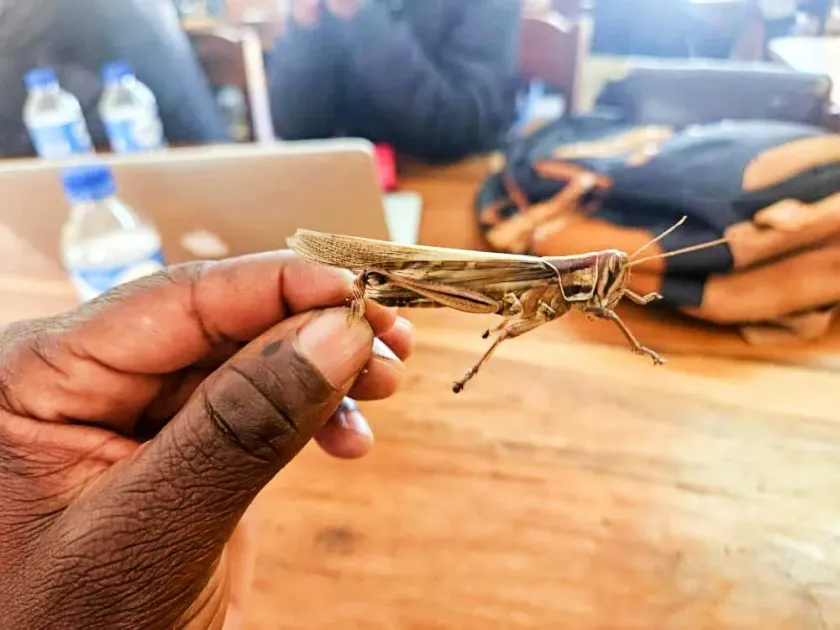
The Red locust (Nomadacris septemfasciata) is a member of the Acrididae family and is known for its ability to form destructive swarms. Adults are large insects, typically ranging from 60 to 80 mm in length.
Their coloration is generally reddish-brown or yellowish, featuring distinctive dark stripes on the pronotum and wing covers, which give them their common name.
Nymphs undergo several instars during their development. As they grow, their color patterns change, and in the gregarious phase, they become highly active and conspicuous.
This species is well-adapted to the climatic conditions of sub-Saharan Africa, where it thrives in grasslands and river floodplains.
The insect possesses strong flight muscles and large wings, enabling it to travel vast distances to find suitable food sources or breeding grounds.
What it damages
The Red locust is an extremely polyphagous pest capable of causing total destruction of crops. When in a swarm phase, it consumes virtually all green vegetation in its path.
Primary target crops include cereals such as maize, sorghum, millet, and rice. In cases of severe outbreaks, entire fields can be stripped of leaves and stems in a very short time.
Pastures and grazing lands are also severely damaged, which has significant economic consequences for livestock production in affected regions.
The damage is not limited to the consumption of leaves; the locusts also damage stems, which weakens the plant and leaves it susceptible to secondary pathogens.
Economic losses are compounded by the speed at which the swarms move, making it difficult for farmers to react in time to save their harvest.
When it appears
The life cycle of the Red locust is closely synchronized with annual rainfall patterns. Eggs are laid in moist, friable soil shortly after the start of the rainy season.
After hatching, the nymphs develop through several stages, with the speed of growth being highly dependent on temperature and food availability.
During the dry season, the locusts typically concentrate in permanent breeding areas, such as grassy plains and wetlands, where they maintain their population until conditions favor a swarm outbreak.
The transition from a solitary phase to a gregarious swarm phase is often triggered by changes in population density and climate fluctuations.
Swarms are highly migratory, often moving hundreds of kilometers in search of favorable feeding grounds, which makes tracking them essential for effective management.
Signs of infestation
The first sign of an infestation is the sighting of "hopper bands" (nymph swarms) that move across the terrain. These groups can be seen consuming crops systematically.
On the fields, the damage appears as irregular edges on leaves or completely defoliated stalks. Large areas of the field will appear barren after a swarm has passed.
The presence of adult swarms is unmistakable, often audible as a loud whirring sound of wings, and visually dense enough to block out light.
Droppings left by the locusts on the soil and plant surfaces are another clear indicator of a significant infestation level.
Early identification of swarm formation sites is critical, as preventing the emergence of the adult swarm is far more effective than trying to manage the adult population later.
Control measures
Effective management of the Red locust requires a proactive approach, primarily focusing on monitoring and suppressing breeding sites.
- Aerial application of targeted insecticides to destroy nymphs before they become winged adults.
- Utilization of biological control agents, such as specialized fungi (e.g., Metarhizium), which are safer for the environment.
- Strategic tillage or plowing of known breeding grounds to destroy eggs deposited in the soil.
- Establishing international monitoring systems to track swarm movements and alert farmers in advance.
- Using barrier spray techniques to stop the progression of hopper bands toward valuable agricultural land.
Taxonomy
- Latin name
- Nomadacris septemfasciata
- Order
- Orthoptera (locusts)
- Family
- Acrididae
- EPPO code
- NOMASE
Discussion
No discussions yet — be the first.