
Nomadacris
Nomadacris
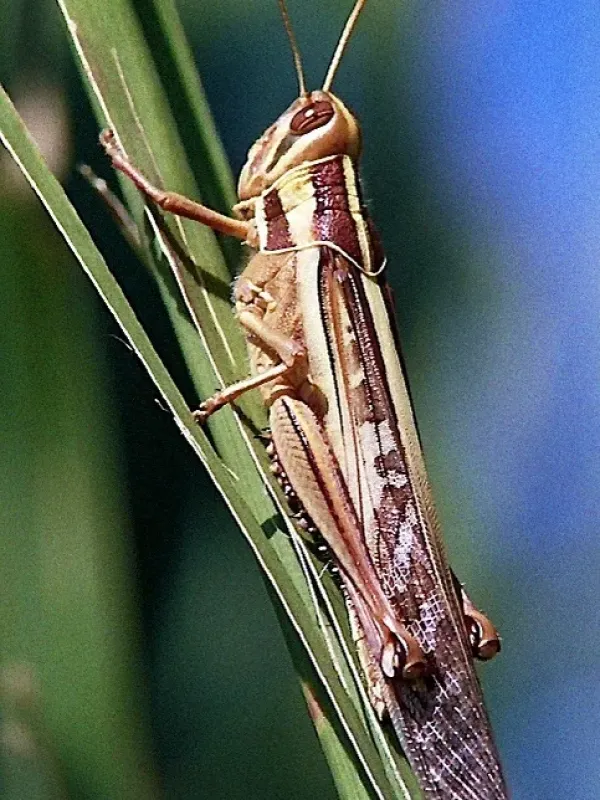
Description
How to identify
Nomadacris, represented notably by the red locust (Nomadacris septemfasciata), belongs to the Acrididae family within the order Orthoptera. These are robust, large-bodied insects equipped with powerful chewing mouthparts.
Adult specimens exhibit a variable coloration ranging from green to brown, often featuring dark longitudinal stripes on the pronotum, which provides natural camouflage within grassland habitats.
A diagnostic feature for identification is the presence of a sharp spine located on the prosternum between the front legs, distinguishing them from other similar grasshopper species.
The life cycle is hemimetabolous, meaning they undergo incomplete metamorphosis through egg, nymph, and adult stages. Nymphs closely resemble adults but lack functional wings.
These insects are highly adaptable; they can transition between solitary and gregarious phases, with the latter phase being characterized by significantly different behavioral and physiological traits.
What it damages
Nomadacris species act as severe agricultural pests, causing devastating damage to a wide range of cereals including maize, sorghum, rice, and wheat, as well as sugarcane.
During gregarious phases, swarms can strip entire fields of vegetation, consuming leaves, stalks, and grains, often leading to total yield failure for affected farms.
Both nymphs and adults are voracious feeders. While nymphs are restricted to the area of hatching, adult swarms are highly mobile and capable of migrating long distances to find food.
The economic impact of an infestation is catastrophic, as the pests can destroy thousands of hectares of crops, threatening food security and causing significant financial losses.
In addition to direct consumption, the swarms contaminate the remaining crop residues with excrement, reducing the quality and marketability of any salvaged harvest.
When it appears
The activity and lifecycle of Nomadacris are strongly dictated by seasonal rainfall patterns, which trigger the hatching of eggs and the growth of succulent host vegetation.
Nymph hatching typically occurs at the beginning of the rainy season, as moisture is essential for the successful emergence of juveniles from soil-bound egg pods.
Adults are most active during warm, dry periods when high temperatures facilitate flight and migration, allowing swarms to cover extensive areas in search of new food sources.
Seasonal environmental factors, particularly humidity levels, influence the duration of the reproductive cycle and the speed of population buildup in specific regions.
By the end of the breeding season, females deposit egg pods into the soil, where they enter a period of diapause, ensuring survival during unfavorable weather conditions.
Signs of infestation
Early signs of an infestation include the presence of skeletonized leaves and irregular chewing damage on the leaf margins of cereal crops during the vegetative stage.
Increased density of nymphs on stems and leaves is a primary visual indicator, especially during the early morning hours when insects are less mobile and feeding actively.
The accumulation of pellet-shaped frass (excrement) at the base of the plants is a tell-tale sign of high population density that necessitates immediate scouting and control.
For swarming phases, the emergence of dense, moving groups of insects is a clear warning sign, often accompanied by the characteristic buzzing sound of mass locomotion.
Field inspections identifying egg pods in the topsoil provide essential data for forecasting the size of the next generation and planning appropriate control strategies.
Control measures
Chemical control remains the most effective intervention for managing outbreaks, utilizing systemic and contact insecticides applied directly to nymph-infested areas.
Agronomic practices, such as deep plowing or harrowing in known breeding grounds, help destroy egg pods by disrupting the soil, significantly reducing the survival rate of the next generation.
Biological control alternatives, including the application of entomopathogenic fungi or specialized natural predators, are increasingly utilized to manage populations while minimizing chemical residue.
Integrated Pest Management (IPM) strategies, which combine regular monitoring, early warning systems, and localized chemical treatments, are crucial for preventing mass migrations.
Effective management requires coordination at both local and regional levels to monitor population trends and deploy interventions before the insects transition into the destructive swarming phase.
Taxonomy
- Latin name
- Nomadacris
- Order
- Orthoptera (locusts)
- Family
- Acrididae
- EPPO code
- NOMASP
Discussion
No discussions yet — be the first.