
Neoseiulus peruanus
Neoseiulus peruanas
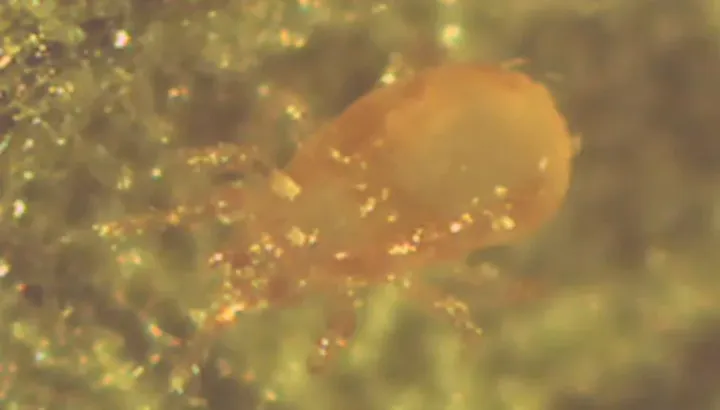
Description
How to identify
Neoseiulus peruanus belongs to the Phytoseiidae family, within the order Mesostigmata. In agronomy, this species is correctly identified as a predatory mite rather than a plant-eating pest.
The morphology of the mite is typical for the family, with a small oval body measuring approximately 0.3–0.5 mm in length. Its coloration varies based on its diet, ranging from translucent white to light brown.
The biological life cycle consists of several stages: egg, larva, protonymph, deutonymph, and adult. The developmental rate is highly temperature-dependent, allowing for rapid population growth in favorable conditions.
These mites are active hunters that patrol the underside of leaves. They are highly efficient at detecting and capturing prey without causing any mechanical damage to plant tissues.
Accurate identification requires microscopic examination of the dorsal shield chaetotaxy. Specialists differentiate N. peruanus from related species like N. cucumeris based on the length and arrangement of specific setae.
What it damages
It is critical to clarify that Neoseiulus peruanus is not a plant pest. It lacks the specialized mouthparts required for phytophagy (feeding on plant sap or tissue) and does not harm crops.
Instead, this mite is a highly beneficial organism used in commercial greenhouse agriculture as a biological control agent. It consumes various small pests that threaten plant health.
Its primary diet consists of spider mites (Tetranychidae) and other small herbivorous arthropods. By preying on eggs, larvae, and adults of these pests, they keep pest populations below economic damage thresholds.
The deployment of this predator in protected cultivation significantly reduces the need for chemical pesticides. This promotes healthier plant growth and ensures produce meets strict safety standards.
Labeling this species as a pest is scientifically incorrect. Within the context of agricultural management, it is classified strictly as an acariphage used for the protection of valuable crops.
Control measures
There are no control measures to eliminate Neoseiulus peruanus; rather, agronomists focus on preserving and augmenting its population to provide continuous biological control.
Management strategies involve avoiding the use of broad-spectrum insecticides and acaricides that can cause mass mortality among predatory mite populations. Preference should be given to selective or biological pesticides.
Integrating N. peruanus into greenhouse systems requires maintaining appropriate microclimatic conditions, specifically humidity levels, to ensure the predator remains active and mobile across the crop.
Establishing refuge areas or using banker plants can support the predator population during periods of low pest density. This provides the mites with alternative food sources such as pollen.
Monitoring the efficacy of the predator-prey balance is essential. If the pest pressure exceeds the predatory capacity, supplemental releases of the mite may be necessary to restore the ecological balance.
Taxonomy
- Latin name
- Neoseiulus peruanas
- Order
- Mites
- Family
- Phytoseiidae
- EPPO code
- AMBSPR
Discussion
No discussions yet — be the first.