
Neoseiulus fallacis
Neoseiulus fallacis
Description
How to identify
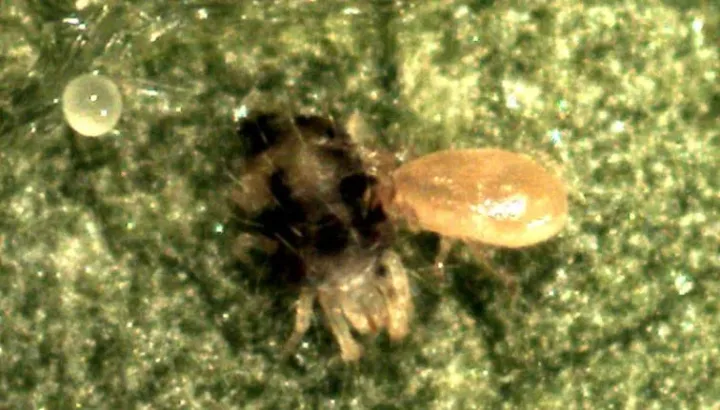
Neoseiulus fallacis (syn. Amblyseius fallacis) is a predatory mite belonging to the Phytoseiidae family. These mites are very small, typically measuring about 0.3–0.4 mm in length.
The body shape of the adult mite is pear-like, and its color varies from translucent to pale yellow or brownish, depending on the prey consumed.
Adult females are generally larger than males. Both nymphs and adults are highly active, moving rapidly across leaf surfaces to hunt their prey.
As a member of the Phytoseiidae family, it is widely recognized for its role as a key natural enemy of several plant-feeding mites.
Precise identification of this species usually requires microscopic examination to observe specific dorsal plate features.
What it damages
It is crucial to note that Neoseiulus fallacis is not a plant pest, but a highly effective beneficial predatory mite.
Its primary food source includes various spider mite species, most notably the two-spotted spider mite (Tetranychus urticae).
The predator consumes all developmental stages of its prey, including eggs, larvae, and adults, which allows it to suppress pest outbreaks rapidly.
It is used extensively in Integrated Pest Management (IPM) programs for vegetable, small fruit, and ornamental crop production.
By providing natural biological control, it helps farmers reduce dependence on chemical acaricides, promoting a more sustainable agricultural ecosystem.
When it appears
The activity and population growth of Neoseiulus fallacis are highly dependent on environmental conditions, specifically temperature and humidity.
This mite thrives in warm climates, with optimal development occurring between +20°C and +30°C and relative humidity above 60%.
Lower temperatures can slow down its metabolism, and in colder regions or winter months, they may enter diapause to survive.
The life cycle from egg to adult is short, typically lasting between 7 to 10 days, allowing the population to build up quickly when prey is abundant.
In greenhouse settings, they can remain active throughout the year, provided that prey density and environmental conditions are maintained.
Signs of infestation
A sign of successful predation is a noticeable decline in the spider mite population, characterized by the disappearance of webbing and the cessation of new leaf damage.
Using a hand lens, growers can observe the predatory mites actively moving on the underside of leaves among the spider mite colonies.
If foliage remains healthy and green without the typical stippling patterns associated with mite damage, it is a strong indicator of successful biological control.
The absence of typical spider mite outbreaks despite favorable environmental conditions for pests suggests that N. fallacis is performing its role effectively.
Regular scouting is necessary to monitor the ratio of predators to pests to determine if additional releases of predatory mites are required.
Control measures
To conserve Neoseiulus fallacis populations in an agricultural setting, the use of broad-spectrum insecticides and acaricides must be strictly avoided.
If chemical intervention for other pests is unavoidable, growers should choose selective pesticides that are known to be compatible with predatory mites.
Biological control strategies involve releasing laboratory-reared mites into infested areas, which allows for rapid establishment and management of the pest population.
Maintaining adequate humidity levels is essential for the survival and development of the mites, especially in dry greenhouse environments.
- Regular monitoring of crop health and mite population density.
- Strategic release of predatory mites during early stages of pest infestation.
- Avoidance of harmful chemical inputs that could disrupt the balance of natural enemies.
Taxonomy
- Latin name
- Neoseiulus fallacis
- Order
- Mites
- Family
- Phytoseiidae
- EPPO code
- NEOUFA
Discussion
No discussions yet — be the first.