
Neoseiulus cucumeris
Neoseiulus cucumeris
Description
How to identify
Neoseiulus cucumeris is a small predatory mite belonging to the Phytoseiidae family, widely recognized for its role in biological pest control programs.
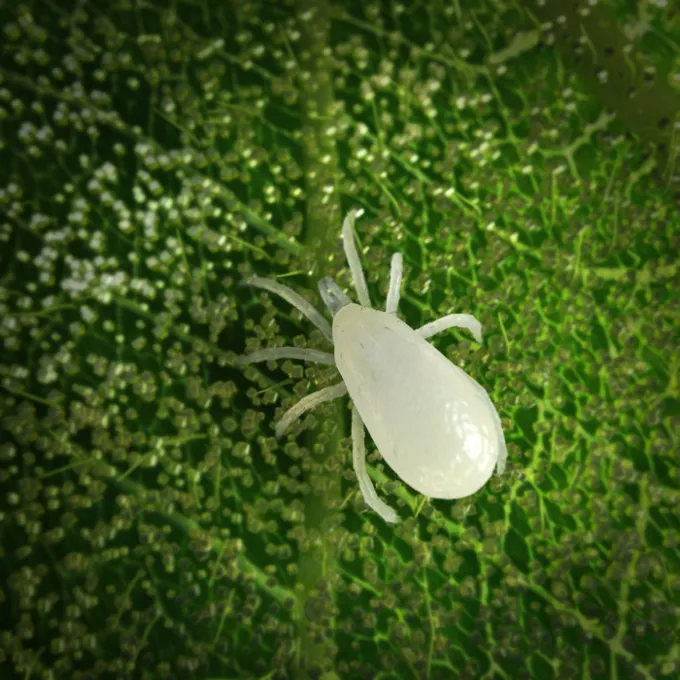
Adult mites are teardrop-shaped and typically measure between 0.4 and 0.5 mm in length, displaying a pale white to light brown color.
The life cycle consists of the egg, larva, protonymph, deutonymph, and adult stages, and it is highly dependent on ambient temperature and relative humidity.
These mites are extremely mobile and proactive hunters, constantly patrolling leaf surfaces in search of prey, which allows them to effectively cover large areas of foliage.
Under optimal conditions, including temperatures between 20°C and 25°C and relative humidity above 65%, their population can grow rapidly, providing excellent protection for crops.
What it damages
It is crucial to state that Neoseiulus cucumeris is not a plant pest. It is a highly beneficial organism used specifically to suppress pest populations.
The primary diet of this predator consists of larval stages of various thrips species, most notably the western flower thrips, which are a major threat to greenhouse crops.
Additionally, Neoseiulus cucumeris is capable of feeding on spider mite eggs and various eriophyid mites, providing a multi-functional approach to pest management.
An interesting biological trait of this mite is its ability to survive and reproduce on a diet of pollen, which acts as a secondary food source when prey is scarce.
By implementing this biological control agent, farmers can successfully reduce their reliance on chemical pesticides, leading to healthier plants and cleaner crop outputs.
When it appears
The activity period for this predator typically begins in early spring as temperatures rise, making it an ideal choice for greenhouse production starting from the very first stages of crop growth.
In temperature-controlled greenhouse environments, Neoseiulus cucumeris can be active and effective throughout the entire year if a consistent food source is available.
It is recommended to introduce the mites preventatively before the pest population reaches damaging levels to establish a stable and protective colony.
During autumn and winter, shorter daylight hours and lower temperatures can slow down the mite's reproductive rate, requiring a strategic increase in application dosage.
The predator's life cycle speed correlates directly with the density of prey, ensuring that the mite population expands precisely when the threat from thrips is highest.
Signs of infestation
The most reliable sign of effective mite activity is the absence of new necrotic patches on the leaves and the growth of healthy, undamaged terminal shoots.
A closer inspection using a magnifying glass will reveal the presence of adult mites near the veins on the underside of the leaves, where they usually wait for prey.
A reduction in the number of thrips larvae visible on sticky traps or foliage is another strong indicator that the predatory mites are successfully controlling the infestation.
If foliage begins to show the classic "silvering" appearance or distorted growth, it is a clear warning that the mite population may not be sufficient to cope with the pest pressure.
Observing a decrease in black excretory spots on the leaf surface is a positive sign that the population of thrips is being suppressed by the predatory action of the mites.
Control measures
Maintaining high relative humidity is the most important factor in managing Neoseiulus cucumeris, as dry conditions significantly decrease the survival rate of eggs.
Users must avoid using broad-spectrum chemical insecticides, as these are usually lethal to predatory mites and will disrupt the entire biological control program.
For successful integration, growers should rely on compatible pesticides only and strictly follow safety intervals to ensure the survival of the beneficial mite population.
Using slow-release sachets allows for a consistent flow of mites onto the plants, which is far more efficient for long-term protection than a single high-density release.
- Use blue or yellow sticky traps to monitor pest population trends.
- Maintain optimal irrigation and microclimate parameters within the greenhouse.
- Introduce predators preventatively to ensure early establishment.
- Avoid using pesticides that are toxic to phytoseiid mites.
- Supply pollen-based supplements if pest levels are extremely low.
Taxonomy
- Latin name
- Neoseiulus cucumeris
- Order
- Mites
- Family
- Phytoseiidae
- EPPO code
- AMBSCU
Discussion
No discussions yet — be the first.